ie8 fix
madison

Zero Day

Ryan Naraine, Emil Protalinski and Dancho Danchev

Stuxnet 2.0? Researchers find new 'cyber-surveillance' malware threat

By | October 18, 2011, 12:14pm PDT

Summary: Symantec warns of a new high-end Trojan that’s “nearly identical to Stuxnet” but notes that the malware has a completely different goal.

[ UPDATE: McAfee says DuQu's main objective is espionage and targeted attacks against sites such as Certificate Authorities (CAs). ]

Researchers at Symantec have sounded an alarm for a new piece of malware with “striking similarities” to Stuxnet, the mysterious computer worm that targeted nuclear facilities in Iran.

The new malware, identified as Duqu, is a highly specialized Trojan capable of gathering intelligence data and assets from entities, such as industrial control system manufacturers, in order to more easily conduct a future attack against another third party.follow Ryan Naraine on twitter

Inside Stuxnet: Researcher drops new clues about origin of worm ]

“The attackers are looking for information such as design documents that could help them mount a future attack on an industrial control facility,” according to Symantec’s security response team.

Symantec said it got a copy of the in-the-wild malware from an unnamed research lab with strong international connections.

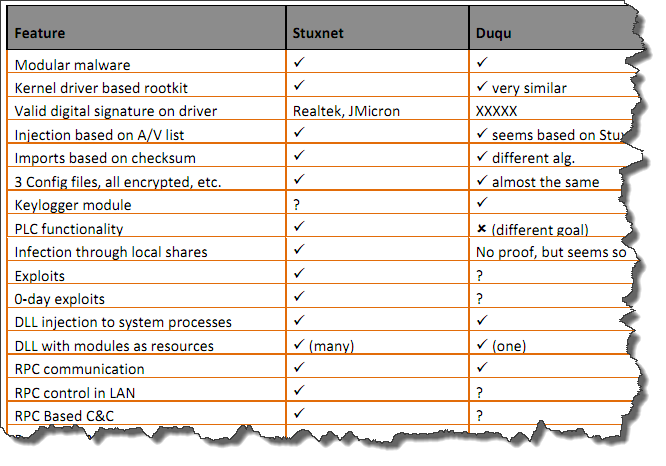
The company found that parts of Duqu are “nearly identical to Stuxnet” but noted that the malware has a completely different goal.

Duqu is essentially the precursor to a future Stuxnet-like attack. The threat was written by the same authors (or those that have access to the Stuxnet source code) and appears to have been created after the last recovered Stuxnet file. Duqu’s purpose is to gather intelligence data and assets from entities, such as industrial control system manufacturers, in order to more easily conduct a future attack against another third party. The attackers are looking for information such as design documents that could help them mount a future attack on an industrial control facility.

The company said Stuxnet and Duqu shared the same modular structure, injection mechanisms, and a driver that is digitally signed with a compromised key.

Stuxnet: A possible attack scenario ]

Unlike Stuxnet, Symanted said the new malware does not contain any code related to industrial control systems.  It was built to be a  remote access Trojan (RAT) that does not self-replicate.

“The threat was highly targeted toward a limited number of organizations for their specific assets. However, it’s possible that other attacks are being conducted against other organizations in a similar manner with currently undetected variants,” the company warned.

The attackers used Duqu to install another infostealer that could record keystrokes and gain other system information. The attackers were searching for assets that could be used in a future attack. In one case, the attackers did not appear to successfully exfiltrate any sensitive data, but details are not available in all cases. Two variants were recovered and, in reviewing our archive of submissions, the first recording of one of the binaries was on September 1, 2011. However, based on file compile times, attacks using these variants may have been conducted as early as December 2010.

One of the variant’s driver files was signed with a valid digital certificate expiring August 2, 2012. The digital certificate belongs to C-Media Electronics Incorporation, company with headquarter in Taipai, Taiwan. The certificate was revoked on October 14, 2011.

Symanted noted that Duqu uses HTTP and HTTPS to communicate to a command and control server which is currently operational.

Some more details on Duqu:

Through the command and control server the attackers were able to download additional executables, including an infostealer that can perform actions such as enumerating the network, recording keystrokes, and gathering system information. The information is logged to a lightly encrypted and compressed local file, which then must be exfiltrated out.

The threat uses a custom command and control protocol, primarily downloading or uploading what appear to be JPG files. However, in addition to transferring dummy JPG files, additional data for exfiltration is encrypted and sent, and likewise received.

Finally, the threat is configured to run for 36 days. After 36 days, the threat will automatically remove itself from the system.

Symantec’s researchers believe that the creators of Duqu had access to the source code of Stuxnet.

A technical paper describing the similarities between Stuxnet and Duqu can be found here [PDF].

Kick off your day with ZDNet's daily e-mail newsletter. It's the freshest tech news and opinion, served hot. Get it.

Topics

Ryan Naraine is a journalist and social media enthusiast specializing in Internet and computer security issues.

Disclosure

Ryan Naraine

The most important disclosure is of my employment with Kaspersky Lab as a member of the global research and analysis team. Kaspersky Lab is a global company specializing in anti-malware and secure content management technologies. I do not own stocks or other investments in any technology company.

Biography

Ryan Naraine

Ryan Naraine is a journalist and social media enthusiast specializing in Internet and computer security issues. He is currently security evangelist at Kaspersky Lab, an anti-malware company with operations around the globe. He is taking a leadership role in developing the company's online community initiative around secure content management technologies.

Prior to joining Kaspersky Lab, Ryan was Editor-at-Large/Security at eWEEK, leading the magazine's and Web site's coverage of Internet and computer security issues and managing the popular SecurityWatch blog, covering the daily threats, vulnerabilities and IT security technologies. He also covered IT security, hacker attacks and secure content management topics for Jupiter Media's internetnetnews.com.

Ryan can be reached at naraine SHIFT 2 gmail.com. For daily updates on Ryan's activities, follow him on Twitter.

37
Comments

Join the conversation!

Just In

RE: Stuxnet 2.0? Researchers find new 'cyber-surveillance' malware threat
Les Blachut 8th Nov
Just because it targets nuclear facilities in the far east doesn't mean it's US-originated. Based on the code it looks like someone is trying to steal their technology - not to destroy it! I wouldn't be surprised to learn that our own nuclear industry is the target a 9-11-style attacks set off by a remote-controlled device similar to the system described above. (read symantec report - compare to cyber security act of 2010 S 773)
So, the US government successfully used Stuxnet to set back the Iranian's nuclear development. One could reasonably assume that Duqu is another ongoing covert US intelligence operation that you have now successfully blown the cover of. Back in WWII, there was a very common poster that was hung at various manufacturing facilities and military bases. It read, "Loose Lips Sink Ships!" There is a difference between journalism and responsible journalism. Quite frankly, I think you may have crossed that line...
@wineaux
.... Symantec would not be publishing these warnings in the first place. We already know that there are government sniffers that the security software deliberately ignores and that we never know about unless accidentally discovered ala Sony's root kit fiasco!
@kd5auq - Your tin foil hat is crooked...
@wineaux
I'm sorry, but I have to laugh! Did you really come to ZDNet
for responsible journalism? Oh, if the information is already
in the public domain, does reporting on it here or elsewhere
constitute irresponsible journalism?
@wineaux
If you cross a line between journalism, and responsible journalism...now you're in the domain of responsible journalism. I think you meant something else.
@wineaux There is no way Symantec had not already talk to US government intelligence sources to make sure it's not a covert US operation. And there's no way Symantec didn't also make sure it was okay to publicize this to ZDNet.
@RonShepston ... No disrespect intended here, but if you would have read the article in full you would see that "Symantec said it got a copy of the in-the-wild malware from an unnamed research lab with strong international connections.". Perhaps a black counter op?
@wineaux

Ever think someone could be using it against us (as in the US)??

Where's the command and control center located? If it's on our home turf or in a country with friendly ties, you may have a point; but if the CCC is elsewhere we may just be the target, especially since our power grid and other vital networks are SO secure...
@wineaux
A ???responsible assumption??? is still an assumption and once you cross that line, you are no longer dealing with facts.
@wineaux: It's been an 'interesting'. day and I needed the laugh!
@wineaux
It's funny how you assumed that this is a United States malware?? My thoughts were maybe Iran is getting back at US??? In that case there would be no loose lips. Sunken ships yet to be determined!!!
@wineaux Who says it is or was the US government? Maybe it was the North Koreans, Chinese or someone else who wants to steal secrets from US weapons manufacturers. Maybe it is being used by organized crime to break into banks. Maybe it is being used by terrorists. Why can you reasonably assume Duqu has anything to do with the US? Where is the war? In WWII we knew who we were at war against. Since when did the US say they are at war with Iran? To declare a true war you have to declare who it is you have declared war against. Just to say "the war on terror" is not declaring war with anyone since they don't state which country the war is against.
@wineaux
Indeed, the first thing a Covert US Op would do would be to make itself "invisible" to any known security software.
very interesting article. Is this Trojan targeting windows? aren't most industrial plants running unix/Linux OSes behind really big firewalls? I don't really understand how Trojan can get into what should really hyper secure sites that should simply not be connected to the web. Can someone say a bit more about how security works in those nuclear plants and whether there are windows/Linux pc connected to the net in those even if in the DMZ???
@Drakkhen
Wow... did you mean to imply that Unix isn't 100% secure and invulnerable against all attacks!? wink sorry, couldn't pass that one up...

But, on the serious side, I think many of the critical industrial and/or vital infrastructure facilities are actually in a closed system which *should* eliminate outside influence. However, it's really hard to say because there is so much mobile tech running around that it's virtually impossible to lock anything down anymore.
@BET7139
Thanks. I did not know Symantec was looking at viruses on Linux/Unix. I thought their market was windows. That is all. Also in a closed environment nothing can get in or out except via usb stick which should be eliminated. So a Trojan in close environment could harvest stuff but as long as it can't send anything... that is fine I would presume
@Drakkhen
I believe the article says that it was targeted at the industrial control manufacturers and not at the controlled factories/facilities. The purpose was to gather information about the controls and would probably be used to for a future attack on the controlled systems themselves.

BTW, some of the factory control systems have gone to controllers based on Windows. However, no system is completely invulnerable.

FTH
@Drakkhen Actually, most of the control systems at my plant are running on Windows. Honeywell, Rockwell, Neles, Emerson are all on Windows 2003 servers. Our boilers, natural gas turbines, water systems and manufacturing processes are all controlled in this fashion. Our whole MES runs on GE's Proficy information system - Windows servers again. At the power plants I've visited I saw similar controls.
@Drakkhen

Too many people are using windows for sensitive data, unfortunately.

Security in nuclear plants is a very good question.

So many Nuclear vulnerabilities without Windows PCs, I hope they are not running Windows. Hopefully the age of most US plants will mean that they are too ancient for Windows.
@Drakkhen

Most worms/bots today are installed using self booting USB thumb drives - this is why most government facilities will (should?) not let you use them anymore. Though the worm would still need some kind of net access to report the data it harvested.
It would be ridiculous to even suggest that the US government does not engage in cyber surveillance (to put it politely). However, it would be completely ludicrous to think that they would do such a poor job of covering their tracks that standard, publicly available OTS software would be capable of stopping them.

It's far more likely that the two pieces of malware belong to another government or other well-connected group. And, in my not-so-humble opinion, I would be more inclined to think that Stuxnet and Duqu were MEANT to be found in order to determine our capabilities and to judge our reaction. This would better enable the mystery attackers to tweak the code of their REAL attack to evade detection altogether. Hmmm, anyone ever heard of "decoy..."
Microsoft has been deliberately leaving security holes in Windows for years, most IT professionals are well aware of this, and many believe the US government has been party to this for such such reasons as described the article. I personally would not allow Windows computers to be used in any sensetive location.
sorry jack, the us government should not be failing to fallow internatinal laws they themself put into place!!!! Go back to kindergarten and relearn how laws work just because they work for the government does not mean they are
exempted from lawing the law. After all that what the Nazi said "just following orders", failing to follow the rule of law no defence.
Loose Lips Sink Ships
more like illegal false flag attacks sink ships to just justified braking of the law, like gulf of tonkin.
http://en.wikipedia.org/wiki/Gulf_of_Tonkin_Incident
Once the product was in the wild every major government on earth most likely got a copy. Who it's being used on will give you a clue as to who reworked it but if they are smart they will plant a few inside their own systems both as a test and to through off hunters.
Well it depends on where its targeted at? Where did symantec get its binary from?
Does anyone believe someone at Microsoft just forgot to implement a GUI for outbound packet filtering in Windows Frewall when it was released with Vista? That firewall would have and could have been the best software firewall for Windows there has ever been. The reason why it wasn't is Microsoft never intended to prevent unauthorized outbound internet communication and in fact by deliberate ommission, encourages it.
0 Votes
+ -
skynet!!!
rodsmus 18th Oct
A.I., wtih the tenticles of the internet reaching all but the most remote parts of the planet, the ones that need not be reached, what better way to execute command and control! J1939, an arcatechture that allows remote control and sensing of a given "subsystem' by a controller. Not to mention the US military equivilent of same with even more paramaters, and command sets, expand that to the "system" via the internet. Not just a "subsystem". Who would do that, and why? Not who but what? Stuxnet and stuxnet 2.0, they have the same auther, no way! Is your car keeping tabs on you? Maybe! Is that production line in the factory that you work at watching you? Maybe! Is that control panel that you use to fly that drone from looking back at you? And, what the heck do they all have in common, I am not suppose to mention this but J1939 and its compatable equivilents. Don't take my word for it Fact check, find out for yourself. Why haven't you heard about this before? Why would it let you! I hear something outside, hope it isn't a .............nope not tonight. Any and all mispelllings arre intentionnal an ment to confus the, well it! I think I hear somethe-0';lkjhgfd
Linux and OS X users need not worry. Stuxnet...it exploited so many security holes in Windows and it took Microsoft ages to fix those gaping holes
Duqu? As in "Count Duqu" from Star Wars?? Who comes UP with these names???

I'm trying to remember whether we've seen any real comprehensive "root-kit purge" tools show up yet...
0 Votes
+ -
Who named it?
LadyGray 25th Oct
@flared0ne "Who comes UP with these names???"

An Hungarian CyberSecurity Lab named it. The Martians among us.
There is nothing to indicate that this new version is built by USgov, as there was little to indicate that was the origin of the last one, on the contrary(A very good guess would have been Israel, at least thats's how it was meant to look) The methodologies of STUXNET have been available to almost anyone, to think that the original 0day's haven't been patched by anyone who might have obligations to a public, is difficult to fathom. Seems some so-called security experts working in government is paying more attention to forums posts made by the kind of ppl they should hire rather than security bulletins.
With all of the information on Stuxnet that has been published, I would think that it would be possible for a determined group to reproduce something similar.

This would be especially true if someone could obtain a copy of Stuxnet.

If would be interesting to know if Duqu has similar coding signature.
This raises the possibility that the Iran worm was not a US/Israeli operation, but a trial run about which western powers would not complain.
0 Votes
+ -
36 days
kidtree 19th Oct
Going to erase itself in 36 days, huh? What effect does it have on vote-counting systems?
Just because it targets nuclear facilities in the far east doesn't mean it's US-originated. Based on the code it looks like someone is trying to steal their technology - not to destroy it! I wouldn't be surprised to learn that our own nuclear industry is the target a 9-11-style attacks set off by a remote-controlled device similar to the system described above. (read symantec report - compare to cyber security act of 2010 S 773)

Join the conversation!

Formatting +
BB Codes - Note: HTML is not supported in forums
  • [b] Bold [/b]
  • [i] Italic [/i]
  • [u] Underline [/u]
  • [s] Strikethrough [/s]
  • [q] "Quote" [/q]
  • [ol][*] 1. Ordered List [/ol]
  • [ul][*] · Unordered List [/ul]
  • [pre] Preformat [/pre]
  • [quote] "Blockquote" [/quote]
ie8 fix
Click Here
ie8 fix

The best of ZDNet, delivered

ZDNet Newsletters

Get the best of ZDNet delivered straight to your inbox

Facebook Activity

White Papers, Webcasts, & Resources
ie8 fix
ie8 fix