Who makes the best hard drives?

By | July 10, 2007, 11:31pm PDT

Summary: I’m just hoping to avoid the worst Vendors and large users won’t tell us who makes the best hard drives. So I decided to figure it for myself. Surprising findings: Over all quality is up. Western Digital is doing much better. Seagate/Maxtor has work to do. Disk drives are marvels of engineering and precision volume manufacturing for [...]

I’m just hoping to avoid the worst
Vendors and large users won’t tell us who makes the best hard drives. So I decided to figure it for myself. Surprising findings: Over all quality is up. Western Digital is doing much better. Seagate/Maxtor has work to do.

Disk drives are marvels of engineering and precision volume manufacturing for which the industry gets far too little credit. But when a drive dies without warning - as 2 of mine did last week - I get grumpy.

Beyond the 2 failed drives I also upgraded the StorageMojo mainframe from a notebook to a tower with 4 SATA bays. I’m thinking 10k Raptor for system disk.

Scientific method?
The method is simplicity itself. Total up the number of hits that “[vendor name] sucks” gets on Google. For companies who aren’t exclusively disk vendors search on “[vendor name] drives suck.”

Please note this is only a proxy for real numbers. One brand may attract the clueless and another the easily enraged. Some vendors sell more to OEMs who don’t complain online. One thing I did figure out is that we can look at all-time numbers and numbers for the just the last year.

A final point about the numbers: rather than a direct measure of drive quality, this method is more an index of customer (dis)satisfaction. Someone’s drives may be great, but if the warranty process turns people into keyboard-pounding Reavers, that’s a bug.

Why “suck”?
I needed a standard term of derision. There is no strong pejorative in the 3000 most popular American words. So I went with my default term.

For the drive companies I added both the “drives” and the “vendor name” totals. For diversified companies like Hitachi I only used the “drives” total.

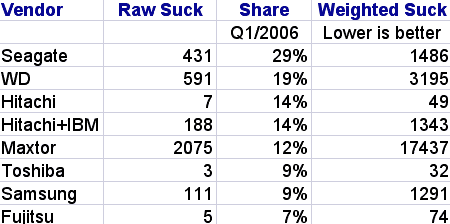
Market share weighted suck factors
Then I used the Q1, 2006 market vendor market shares - by total shipments - as calculated by iSuppli and compiled by DigiTimes online (no link due to DigiTimes subscription requirements.)

Dividing the Raw Suck by market Share gives a Weighted Suck factor. The lower the number the better.

So here’s the score: lower is better
all-time-drive-complaints3.png

Maxtor bites it!

This last 12 months
After I did all that, I realized that the method found all complaints over all time. What about lately? I’m not buying a drive 5 years ago, I’m buying one now.

So I ran the searches limiting the results to the last year. The good news is that the vendors have improved customer satisfaction.
i-year-online-drive-complaints.png

Western Digital snags the “most improved” award. They equaled Toshiba after being second worst to Maxtor over all.

The still-strong anti-Maxtor number may be people repeating old news. Maxtor is now the Seagate consumer brand selling Seagate-designed drives exclusively, so there shouldn’t be a big difference between the two. Maybe Maxtor was the drive company people loved to hate.

The Storage Bits take
What is surprising is that once you get past Maxtor, all the other drive companies are doing a pretty good job. And Maxtor is no longer making Maxtor drives: they’re now Seagate and thank goodness.

Given all the other variables in drive operation, there isn’t a single vendor I wouldn’t buy from based on these numbers. Instead, I’ll be looking at warranty - Seagate shines here - price and, for external drives, features.

Comments welcome, as always. Other ideas for a good proxy? BTW, I learned of the search idea from Vaughn Aubuchon and added a few wrinkles.

Update: After my morning coffee I reconsidered my late-last-night conclusion. The data didn’t support my comments as well as I like, so I changed ‘em (the comments, not the data!) so they did.

Update II: Savvy reader Combrink pointed out that I’d left out IBM’s Deskstar (aka “Deathstar”) and Travelstar drives. Good point! I went back and got the numbers for them and added them to the first table. There was only 1 IBM, Travelstar or “Deskstar drives suck” in the last year so I didn’t alter the second table. Sounds like people are happy with their Hitachi drives.

Kick off your day with ZDNet's daily e-mail newsletter. It's the freshest tech news and opinion, served hot. Get it.

Topics

Robin Harris has been messing with computers for over 30 years and selling and marketing data storage for over 20 in companies large and small.

Disclosure

Robin Harris

Robin Harris is a president of TechnoQWAN, a consulting and analyst firm in northern Arizona. He also writes StorageMojo.com, a blog which accepts advertising from companies in the storage industry, and has a 25 year history with IT vendors. He has many industry contacts, many of whom are friends and all of whom he has opinions about. Robin has relationships with many companies in the technology industry. Every company he writes about may have sought to influence his opinion through carefully-crafted marketing messages and self-serving white papers, gifts ranging from desk calendars, t-shirts, lunches and trips as well as analyst or consulting assignments. He also invests in some technology companies. He may accept payment for services in stock as well. Robin discloses financial investments in or client relationships with companies named in Storage Bits. To help readers sort out the gold from the dross in his writings, Robin tries to communicate his reasons as clearly as he can. If you agree, you are intelligent and discerning. If you disagree, well, you disagree. In all cases, Robin encourages readers to subject everything they read, see or hear on the internet or from politicians to some simple questions: * What assumptions are implicit in the world view and judgments of the author? * What, if any, is the factual basis for the opinions the author expresses? * Is it reasonable, logical and clear? Your critical faculties: use ‘em or lose ‘em!

Biography

Robin Harris

Harris has been messing with computers for over 30 years and selling and marketing data storage for over 20 in companies large and small. He introduced a couple of multi-billion dollar storage products (DLT, the first Fibre Channel array) to market, as well as a many smaller ones. Earlier he spent 10 years marketing servers and networks. After leaving corporate life he founded TechnoQWAN, a consulting and analyst firm. He also developed StorageMojo into one of the top storage industry blogs.

Robin writes, consults, coaches and lives among the mountains of northern Arizona.

Related Discussions on TechRepublic

Did you know you can take part in these discussions with your ZDNet membership?
107
Comments

Join the conversation!

Just In

Look at reviews on Newegg and draw your own conlusions.
brmwia Updated - 9th Mar
Based on Newegg reviews, The number of DOA's is astonishing. Combine the DOA's with failure in the first month or two and I can't see how today's drives could possibly get worse. Review after review stating even replacements from the manufacture have been DOA. Clearly, there appears to be a lack of QA from ALL manufactures or UPS is destroying on ton a drives.
0 Votes
+ -
... at zdnet has spread more bunk about an industry then you have with your vendetta against disk drive manufacturers. For the most part there are very few issues with disk drive reliability. Even your own dubious statistics bear this out. Try dividing the the number of disk drives sold by the number of complaints you found and see for your self. I would expect better from someone claiming to be a storage expert.
0 Votes
+ -
Some Flaws
combrink 11th Jul 2007
I have read several articles about Hard Drive test that claim to say one drive is better then another. Where this test is that I have problems is with Hitachi drives and the manner he came up with the rated suck factor.

I dont know about you but I have had more issues with Hitachi drives know as the Desk Star series. Most IT Professionals I know refer to them as a Death Star drive. Though they may have become better but in the last 5 years they where sued for quality problems. I can not understand how this slipped by and got such a low suck factor for 5 years ago.

I agree with how you say they should have tested these drives. I have seen Western Digitals fail expecially last year with 320 gig sata drives first hit. They should have gotten stats from the company about RMAs and the Number of Drives sold. This would have provided a percentage of drive faliure and wouldnt be biased based off a web search.

All drive manf. have good drives and bad drives that come off the line. That is okay because the average life of a hard drive still is longer then most people keep their machine nowadays. Remember it is the only constantly spinning and working device in the computer that is mechanical. It is going to fail at some point.
0 Votes
+ -
Contributr
Good point about IBM
R Harris 11th Jul 2007
So I updated the post and the table to add IBM, Travelstar and Deskstar. IBM wasn't
as good as Hitachi, and yet looking at the last year Hitachi has done a good job.

I'd love it if companies released more statistics. They don't and they don't want to
and nobody can make them do it. So I wouldn't hold my breath. Why the array
vendors or independent PC companies don't is beyond me.

Also agree that good and bad come off the line. That's why for the low-volume
buyer, drive life is a matter of luck.

Robin
0 Votes
+ -
Contributr
Sounds a little defensive, ShadeTree
R Harris 11th Jul 2007
I like disk drive vendors. I think they are the unsung heroes of the storage industry,
and I've said so numerous times over the last several years.

I think it is a shame that array vendors have been padding their margins on the
backs of disk vendors for over a decade. I've also cautioned against irrational
exuberance over flash drives, which some of the less-informed have been touting
as disk replacements.

However, independent research has shown that there is a big difference between
what the industry sells and what customers actually see. Specifically, the CMU and
Google research found significant differences between the failure rates spec'd by
vendors and seen by users of some 200,000 drives in the field.

Would you care to explain why? Seems to me there should be greater
industry transparency around drive lifetimes, operating conditions, failure rates and
quality.

If asking for that makes me a bad guy, then so be it. I think the thousands of
people who angrily commented on the web - and the many tens of thousands who
thought the same and didn't - would like to know more.

Robin
0 Votes
+ -
Load of nonsense
willhoyt 11th Jul 2007
Hard drives have become less and less reliable as new models are introduced. There are some reasonable causes for this such as high density, more platters, faster spin rates, etc., but the fact is that they are not as reliable as they used to be and consumers don't seem to know this.

I've got 10 year old SCSI drives with a 1,000,000 hour MTBF. Yeah, a million. I am actually researching a bit for this response, I see that some Samsung Spinpoint drives have a MTBF of 330,000 hours. Still sounds not bad but don't believe it.

I've found the best way to predict the reliability of the drive is by the warranty. If a drive has a 1-year warranty, consider it temporary storage and unreliable. A 5-year warranty points to the manufacturer's greater confidence that it isn't a POS.

I don't think the author's statistics necessarily bear anything out because I think relatively few people bother to post that this or that hard drive "sucks." The results, therefore, are likely to be skewed by whoever was most pissed off. The way a drive fails might get owners of certain drives more angry than others, while the drive sucks no more or less. I've had Samsung drives that simply gave lots of write errors. The damned thing appeared to be working fine, but in reality you couldn't get the data back without errors. That REALLY pissed me off, even more than the Maxtors that went clicking off to hard drive hell because at least that was obvious.

I agree with you that the problem should be approached with a more rigorous methodology, but I disagree with your apparent belief belief that the drives are reliable.
0 Votes
+ -
Several problems with what you say.
ShadeTree 11th Jul 2007
There are less platters in the new drives then the old ones. In many cases only one. There is no coorelation between the number of platters and drive failures. The higher density has been achieved by flying the heads closer to the platter and by turning the magnetic particles on end. I am not aware of any study showing a coorelation betwen these two factors and reduced reliability. There is also no coorelation between spin rates and drive failure.

You start of your post talking about a SCSI drive. It is unfair to compare and Enterprise class drive to a Consumer class drive which is what you are doing by introdsucing the SCSI drive. Warranty has nothing to do with drive life and has more to do with marketing then anything else. It is not an accurate predicter of drive reliability. Finally your conclusion that drive reliability has went down is simply wrong! Drive reliability has steadily improved.
0 Votes
+ -
Again, don't be ridiculous...
Antagonist 16th Jul 2007
Stop trying to argue with people's own experience of drive failure rates. We know how many drives we have had fail. Those of us in the industry that have had to buy the drives, install them and then replace them when they go bad know which drives suck. The author clearly stated that drives were getting better but that some drives suck worse than others. He states his conclusions clearly and I for one believe he has it right. I know from my own experience in replacing hard drives. Oh, and I also disagree that warranty has nothing to do with drive life. The difference between a 1 year and 6 year warranty is quite OBVIOUSLY an indication of predicted drive life. Don't be stupid.
0 Votes
+ -
Warrenties
desamuelson 18th Jul 2007
I will not sayone way or the other, I am not a bean counter with a HD manufactor, but I can tell you that in other industries, the higher price you pay for a product with a longer warrenty is oft times the additional costs to replace the failures, the units come off the sam eline, the ones labled X go in one box with one warrenty, he ones labled Y go into the othe rbox with the other.
The authors statistics are accurate, just not properly performed. The number of people who write is a statistic of the total number of people that have views of thatever you are looking at. that is why calling your congressman gets more action than sending an email. If you are upset enough to call you may be a reprentative of another 5000 constituants, a letter may be 3000, and an email 1000 (ficticious examples).
The polling people actually have better idea of what the proper ratios are, its what they recieve money for.
Last, as much as we might say we want all the data for MTBF, infant mortality , expected life span, unless its regulated or is falling under a gov sepc for sale, you will probably not ever see it. Why would an independent vendor open their books to competition if they can help it? The number sold is information available for stockholders, the defects are buried in operating expenses. bottom line is whats truely public in a publicly held company.
0 Votes
+ -
Who makes the best hard drives?
aussieblnd@... 19th Jul 2007
Not everyone complains or blogs about such and such HD sucks! It's rather childish to begin with. I have only had one Maxtor drive fail on me. Maxtor replaced the drive free of charge with a new, not refurbished drive that was actually larger than the one I bought. (Including shipping I paid nothing) Out of the nine computers running Maxtor hey only one failed. On the other had 22 computer have WD and 12 of them failed. Not a good percentage. But to WD's credit all of the drives were replaced and none have failed since. Drives fail get over it!
0 Votes
+ -
You call 5 failures out of 10 drives "bunk"?
TechRepublic@... 12th Jul 2007
Over the past 5 years I have purchased about 10 hard drives for my personal use and 5 of them have died before the warranty expired. The only other place I know of where a 50% failure rate is considered acceptable is weather forcasting. Incidentally, all the drives were Maxtors (I finally admitted defeat and switched to Seagate late last year) and no, I haven't complained online so my results aren't figured into the tables in the article.
0 Votes
+ -
Yeah Maxtor drives truly do suck
Antagonist 16th Jul 2007
We had 10 maxtors out of 10 fail. And seagate is now seagate/maxtor. I believe they have their act together now as we haven't had a single new seagate/maxtor drive fail. However, we haven't purchased as many seagates as we did WD. My own experience of WD is that THEY are the most reliable, though. We have yet to have a single Western Digital drive ever fail. I myself have purchased over 100 of them in the last 5 years and not a single drive has had a problem or failed. That may be luck but I don't think so.
i guess i'm lucky i have yet to have a maxtor drive fail in this box i'm writing this on has 3 maxtor sata 2 drives in it.

i've all ways had good luck with them.
0 Votes
+ -
Correction: Maxtor IDE Drives Suck!!
Bob Wya 23rd Sep 2007
Hold on a minute mate thats way to sweeping a statement to make.

I boot off 4xRAID-0 U320 15K rpm SCSI Maxtor Atlas II SCSI in my Opteron Server. I've blown many a SCSI drive up with accidental rewiring of PSUs (OK I got 5V and 12V mixed up happy and there was no hassle with the Maxtor 5 year warranty (no doubt they could put a new board on the drive anyways bless them... happy )... As I recall Seagate let me stack up my RMAs but Maxtor was one return at a time (presume that policy still holds today even with them both being under one umbrella)... But anyway thats Enterprise drives right!! All killed off by my own incompetence...

When it comes to IDE drives (PATA/SATA) I have a couple of PATA drives from a Lacie IEEE1394 external drive that run hot as hell and died horribly sometime ago... Only drives I didn't kill myself so far (touch an earth line, etc.)!!

So in summary Maxtor Enterprise drives are pretty good!!

Bob Wya
0 Votes
+ -
another 2 failed Segates
yAks 12th Jul 2007
I know another 2 Segate HDD's that failed just after warrenty period. so I think author of this artcle has a point
0 Votes
+ -
Don't be ridiculous
Antagonist 16th Jul 2007
This entry is completely valid. And your opinion of drive reliability is contrary to the numbers. I myself experienced a 100% failure rate on a batch of 10 maxtor drives that our department ordered 2 years ago. All 10 drives failed within 8 months. So get your own facts straight before slamming someone else.
0 Votes
+ -
Nothing ridiculous about it.
ShadeTree 16th Jul 2007
As an engineer for one of the top three PC OEM's I can assure you my experience with disk drives involves a lot larger sample size then yours. I stand by my comments.
0 Votes
+ -
ridiculous
aussieblnd@... 19th Jul 2007
Like anything else perhaps you just got a bad batch! Hey it happens!
0 Votes
+ -
Hitachi (IBM) TravelStar
D T Schmitz 11th Jul 2007
I have had good results with Hitachi drives.
FYI, I found an interesting study produced by Google on 'Disk Failures'.

Download and read the pdf here

Apparently SMART isn't necessarily so smart in sensing errors which lead to failure.

Thanks Robin for a good article!
0 Votes
+ -
I agree _dietrich
Scrat 11th Jul 2007
I use Travelstars in my notebooks, and Deathstars in my desktops.

IBM / Hitachi drives are superb, quiet, fast and not too expensive. I'd recommend them to anyone.
0 Votes
+ -
Finally...
D T Schmitz 11th Jul 2007
...someone agrees with me!
(kidding)
Thanks Scrat!
0 Votes
+ -
I really don't know about your methodology. It is creative, but I don't think you can possibly be producing an accurate result. Do your marketshare stats take into account OEM drives installed by manufacturers or are they only drives sold to end-users?

Maxtor shouldn't be getting many compliments, but I've used many, many drives and none are worse than Samsung. I want my view to count, so I'll say it, "Samsung drives suck."

BTW, I thought Maxtor bought WD some years ago?
The experience of our large organization concurs with the survey results: Maxtor drives fail a lot. Our large organization upgraded to new name-brand PCs 2 years ago and these PCs all had EIDE Maxtors. We experienced consistently higher failure rate with Maxtor drives than earlier WD drives. I personally prefer the old IBM Deskstar drives, now owned by Hitachi.
0 Votes
+ -
Seagate Warranty Rules!
t_mohajir 11th Jul 2007
Seagate's standard 5 year warranty is reason enough to buy their drives in my opinion. Although, I don't understand why they bought Maxtor. My own experience with the old Maxtor drives has been horrendous. I bought a 200GB 7200rpm IDE drive from them to replace a 40GB 7200rpm Western Digital drive that ran reliably for me for 6 years. I only replaced the WD drive because I ran out of space, not because of any issues. The Maxtor failed within 6 months. They sent me another one under warranty, and the replacement failed within 1 month. They sent me another one and that failed within 2 months. I took the last one they gave me and just stuck it in a USB enclosure for temporary storage because that's all their drives are good for.

I'm now running dual 500GB Seagate 7200.10 in a RAID 1 on a Mac Pro. So far so good.
0 Votes
+ -
Seagate Warranty Does Not Rule
jsz1940 11th Jul 2007
I purchased a new Seagate drive which failed within one (1) year and Seagate replaced it with a refurb:-( And of course Seagate didn't toll the warrany.
0 Votes
+ -
I was under the impression that all hard drive manufacturers do warranty replacement with refurbs. I've dealt with Maxtor (before they merged) and WD, and I got refurbs from them. But Seagate gives you a 5 year warranty while the best I've seen from WD is 3 years.
0 Votes
+ -
Seagate Warranty
pj_mouse 13th Jul 2007
I have to second that. It's hard for a small-time tech to get any real numbers beyond limited anecdote so when I look at warranties and see Seagate going well beyond everyone else, I have to think I'm more willing to give them a sale if they're that confident of their drives. Over the 15+ years I've been doing PC building and repair, I've had very little problem with them and the warranty is just icing on the cake. In the past couple of years, it's been almost exclusively Seagate for me and I've not had problems from a single one.
0 Votes
+ -
Thanks Robin
howdougd@... 11th Jul 2007
A good research. I think this topic is about why the general populace makes a purchase of certain brands and not necessarily about large volume purchases.

I and the "low income" folks I help don't need hard drives over 80GB and we typically buy one drive at the time. Here are my own non-scientific findings from the past few years and why Western Digital is now my drive of choice:

The Samsung Spinpoint runs too hot. The first one was defective and returned. It's replacement is now a standby in my wife's computer.

The Seagates just don't sound right. Perhaps it's from remembering the large "dinner plate" drives that held only a few MB's from years ago.

Maxtor had been my choice until I began experimenting with Linux/Win dual boot. I did a lot or repartitioning/reformatting and I needed a free utility that would do a low level format to clean/diagnose any brand. Maxtor's Utility worked on Maxtor only. On other drives I got the "This is not a Maxtor Drive" message.

Western Digital covered all aspects: good price, good looks, good sound, not too hot, good website, good warranty, and excellent utilities that are not "brand specific". About two years ago I Emailed Western Digital thanking them for a dependable, affordable product, and now my drive of choice. At this moment I have 4 WD Caviar's in daily use in my personal computers.

This is not a scientific research but it is why a one-at-the-time buyer now buys Western Digital Hard Drives.
0 Votes
+ -
Thanks
aussieblnd@... 19th Jul 2007
intresting but if you buy volume for large a company upgrades common sense would should tell you no matter who makes the drive figure at least one in ten will fail
0 Votes
+ -
Bet you dig deep enough
Linux User 147560 11th Jul 2007
you will find that the cause for high failures is due to start up and shut down of drives. I said it before and I will say it again, other than a couple WD drives that died quickly, most of my drives last over 3 years easily.

I don't shut them down, I don't sleep them I keep then spinning 24/7. It's a trade off really, some of the data I have is pretty valuable, so it justifies the cost. BUT the fact is every person I know that keeps their boxes powered up, has had fewer hardware problems all around. Those that are constantly shutting down and starting up have had a higher hardware failure rate, including drives. devil
0 Votes
+ -
Who makes the best hard drives?
mike1mb 11th Jul 2007
I have several machines I run this way 24/7 and my partner prefers to do daily shutdown and morning boot. We have had previous bad experience with WD and have avoided them for the most part over the last few tears favoring Maxtor and Seagate. Big difference between us also is I'm using Raid Mirroring on most of my drives, while the partner is not. I've had no Maxtor/Seagate failures and one WD (was system OEM choice) over the last 4 years. In the previous 4 years we combined had 3-4 WD failures, admittedly this was before Iwent RAID, and was a decisive factor.

On a side note I have an ARCHOS Jukebox20 that I've been running 24/7 in random play mode, because the startup gets flaky and I just want to put the headphones on and listen. Don't know what kind of drive it is, but for that kind of use (MP# player) that is high use.
0 Votes
+ -
Contributr
You have a point
R Harris 11th Jul 2007
The two large-scale studies of drive life were done in constant-use environments.

Yet notebook drives are designed for frequent shutdowns and the seem to do just
fine.

I'd like to know more.

Robin
0 Votes
+ -
Portable drives are smaller all around.
Linux User 147560 12th Jul 2007
Less area for stress on the spindle bearings. Also I noticed when I took a few apart the spindle / bearing assembly is larger in comparison to the larger drives. Now I am not 100% sure on this, still looking for an answer that is adequate for me, but I believe the smaller laptop drives also are spun up slower initially.

The larger drives are literally taken from static friction to full speed instantly. This puts HUGE stressed on spindles and bearings, eventually the bearing case will start to warp and deform, all it takes is a micrometer and that head smacks a platter and your drive is toast.

Again another design difference, the smaller drives are designed with movement in mind, which accounts for the larger bearing and spindle sizes. Also the portable drives as a rule, spin much slower than the non-portable. Average for most laptops is 4200RPM but there are 5400 and even a few 7200RPM drives out there. I have a Toshiba 80GB 7200RPM drive in my laptop.

So from a mechanical point, it looks like the smaller drives are designed more durable than the larger drives, hence the higher price for the portable drive: 2 years ago that 80GB 7200RPM laptop drive cost me $230.00 before shipping and tax, where an 80GB 7200RPM desktop drive was around $95-100.00.

One thing people fail to realize is the thermal loading their PC goes through as well. Some of the components are pretty "flimsy" when you get right down too it. Thin gold coatings on connection points that heat up and cool off frequently will eventually start to flake and fail... hence memory chips going bad, the chip probably isn't bad, but the connection to the board are worn and ineffective. Hence why they tell you to remove and re-insert a memory module before you replace it. You might be able to get the connections again.

I could go on, but I have to get the kids ready for daycamp and off to work myself... I'll try to continue later today. devil
0 Votes
+ -
The deskstar aka deathstar
Protector 11th Jul 2007
The IBM deskstar is the worst drive I have ever seen, I have several of all sizes fail. They have been since bought by Hitachi and I'm not sure if they got better, but I would never use one. I still have never had a Western Digital fail and I have used literally hundreds of drives.
0 Votes
+ -
My experience the opposite
j.m.galvin 11th Jul 2007
I've maintained a small fleet of Macs for many years.

I've never esperienced a drive failure on any Apple machines and every one came with an IBM drive. All have ben run in a full time production enviroment. We brought in some Motorola mac clones when they were around and experienced drive failures. They had Maxtors.

I guess different people'e experience varies.
0 Votes
+ -
More of a Hungarian issue...
Uber Dweeb 11th Jul 2007
The drives coming out of the new IBM plant in Hungary had horrendous failure rates and all of IBM storage was tarnished by the event. My Deskstars were made somewhere in the Orient at the same time of the Deathstar fiasco and are still running after 7+ years.
0 Votes
+ -
my 2 cents and 100 drives
MIS Master 11th Jul 2007
The computers and servers I administer have maxtor, seagate, hitachi and western digital.
Most reliable in server: Hitachi
Most reliable in workstation: western digital. Least reliable: Maxtor
0 Votes
+ -
There are HUGE flaws with this method of comparison. The largest being that there is in no way a 1:1 relationship between complaints and failures. One would assume that the complaints would at least correlate (roughly) to failures equally for each drive manufacturer, but that is simply not the case.

An example: Maxtor went through a period of about a year and a half where their drive failure rate was observed to be about twice that of the industry average. Since then, Maxtor's reputation has continued to suffer. When Seagate purchased Maxtor, their "Google reputation" suffered in kind. Have a look at the detail behind many of those "Seagate sucks" comments and you'll find comments along the lines of "Seagate purchased Maxtor, and Maxtor sucks. Therefore, Seagate sucks."

If you want to know the failure rate of drive by manufacturer, you need to look at a large data sample of drives and look at the actual failure rates. Consumer satisfaction numbers are about as reliable as eye-witness testimony. That is to say, not very reliable.
0 Votes
+ -
agree 100%
Been_Done_Before 11th Jul 2007
Customer satisfaction surveys are not scientific.. people who are going to complain are more likely to respond to a survey then people who have never had an issue.

I personally own 15+ seagate drives.. some that 4g ata and they still run.

The only thing i agreed with in the entire article was that maxtor sucked. I have sent back atleast 4 drives and i have not bought a single one since the last one i sent back. If i replace a maxtor that is out of warranty, i usually toss in a seagate.

As the other guy said.. seagate has a 5 year warranty. Hard to beat.

The other question here.. why is it that most companies like dell, hp-compaq and ibm have used seagate drives for years?
0 Votes
+ -
UH - guys - read the article!
Freebird54 11th Jul 2007
At no point does the author even suggest that this methodolgy has any direct. scientific validity. In fact, in a 'throwaway' at the end, it sure looks to me as if he is poking fun ay anyone who considered taking it seriously!

Update: After my morning coffee I reconsidered my late-last-night conclusion. The data didn?t support my comments as well as I like, so I changed ?em so they did.

It can be fairly said that it VERY difficult to find any actual, real data on HD quality. Compounding that is the fact that quality varies wildly within a brand name depending on model. It even varies wildly within model depending on the actual manufacturing site, and whether it had a good day/week/month/year.

All anyone can do is post about their own experiences, which also vary wildly depending on useage patterns. So for what it's worth, here's my list:

Maxtor - current running 2 - no problems. BEst ever drive was a Maxtor (full height 5 1/4) that I ran straight up, and RLL'd and dubl'd. Still functions, 27 years old.

Seagate - minor failures early in their life, mostly 'stiction' and easily fixed (or got around by running 24/7). Good warranty - always come back from bad ones.
Cheetah's (10K SCSI) were amazing at the time of intro!

WD - always seemed slower/cheaper - had more failures (actual) than others. Good utilities, quality now seems average

Conner - never any problems - but someone bought them out.

Personally, I feel offended if I have ANY troubles with a drives short of 10 years. ON the other hand (despite evidence that hear doesn't matter) I have ALWAYS ensured good airflow around the drives -even to the point of adding 'tray fans' if necessary. YMMV

Author got a lot of response for an 'idle moment' experiment didn't he? happy
0 Votes
+ -
Contributr
Actually I was serious
R Harris 11th Jul 2007
I originally put in some musings that reflected my personal criteria for the several
drives I'll be buying in the near future. Then I realized this morning that those
thoughts went beyond the data.

So I went back to the data - warts and all - and drew what conclusions I fairly
could.

Thanks for sharing your experiences. A 27 year old drive? Amazing.

Robin
0 Votes
+ -
You got me!
Freebird54 11th Jul 2007
I was sure you weren't expecting too much from that metric - but I can get fooled too.. happy

As for that drive - it was a 60 Mb when used MFM, almost 90 as an RLL, and an amazing (!) 119 when run on a special controller. The most fun part of it was the song (literally!) that it played when it finished spinning up. I don't think they kept that sort of quality going on though - it was designed for what were known as 'mini-computers' of the time - but it did a great job on my multi-line BBS for a long time.

As for your own stuff - go Seagate. Prices OK, record OK, odds OK. Enjoy!
0 Votes
+ -
I find them all the same
voska 12th Jul 2007
For me I've used almost all the different types of drives over the years. I've never found one to be better or worse than the other. I've found drives will fail eventually and some do it sooner than others but it doesn't seem to be dependent on the manufacturer. It doesn't matter what manufacturer you choose, sometimes you just get a bad drive or really good drive.
0 Votes
+ -
You forgot Quantum
georgef@... 13th Dec 2007
Come on now. Aren't they best you've ever seen? I agree with most of the rest of what you say and have had similar experiences. I would take a Maxtor over a Seagate.
All computer problems are caused by virus put there by terrorist countries.
0 Votes
+ -
U can do better than THAT BALTY! n/t
btljooz 11th Jul 2007
n/t
I bought an IBM "Deathstar" 60GXP when everybody was still praising them. They were good on paper. Six months later the problems started creeping up, and I still don't trust the Hitachi drives today.

Seagate is getting my business now. That 5 year warranty is unbeatable (though I haven't had to use it yet, knock on a lot of wood.)
0 Votes
+ -
My 60 & 75GXPs are still running great
Documatador 12th Jul 2007
About 7 years old, running 24x7, they have been great, and out lived a number of WD and Maxtors. Maybe I got lucky...
0 Votes
+ -
Simply my experience:
btljooz 11th Jul 2007
Between MY computer (I use it DAILY) and the four that I currently have stored that belonged to my late spouse who built them; ALL are over FOUR years old, one of the drives in MY puter is Vintage Win 95...came out of an old Compaq, and all computers have MAXTORS in them. All are desk tops. There's not, nor has there ever been, a laptop or notebook owned by me, my late spouse or my new roomie.

The ONLY hard drive I, personally, ever had that borked was a WESTERN DIGITAL. It was only just over a year old. This was THREE years ago. I replaced it with a new (at that time) MAXTOR. Every single one of these computers, WHILE IN USE, has always been shut down at the end of the time using it and re-booted (obviously) to be able to use it again. ...Mine on a daily basis for over TEN years now. Mine is on for at least eight to 10 hours a day. The late spouse's main two where treated the same for about eight years, or so, until their death when I put those computers in 'mothballs'.

Now, my room mate has a computer with two Western Digitals in it. It's a Gateway Desktop that's _about_ six years old? The hard drive in it fried while it was owned by the roomie's brother. The brother fought Gateway over it for SEVERAL months up to, maybe, a year? He finally got sick of the fight and gave the puter to my roomie...this was four years ago. At that time, my (NOW) roomie bought two 40 gig Western Digitals and my late spouse installed them in that computer. NOW, that puter is running like a SNAIL!!!!!

I, personally, think that the thing could be getting ready to bork its hard drive because it's giving me the EXACT same 'signs' that MY Western Digital gave before it fried. (BTW: when the roomie bought their two drives, I bought my Western Digital along with them and it was installed in my computer). I'm going to wipe the drive (roomie's computer) and start with a clean OS install to see what happens...... only time will tell....

My conclusions based on these experiences are:

1. Evidently the older Maxtors have/had it WELL over Western Digitals in general...at least in these limited instances.

2. Shutting a computer off isn't NECESSARILY a 'bad' thing??? It actually helps save electricity, cutting energy co$t$ resulting in the reduction of fossil fuel emissions by electric generating plants...which are in the MAJORITY at this time.

3. The numbers given in the article make me wonder WHEN the described "posts" were made complaining about certain Brand Names and WHAT brand names are ROUTINELY installed into off the shelf boxes making them more numerous. Ergo, Windoze being the predominiate OS simply due to OEM installation of that particular OS dominating the market. This would in deed have a bearing on the accuracy of those numbers just as the dominance of Windoze results in more mal-ware written for it as compared to other OSes.
0 Votes
+ -
Simply my experience:
aussieblnd@... 19th Jul 2007
Wow that was LONG! zzzzzz!
0 Votes
+ -
Personal Experience
rruss5328@... 11th Jul 2007
I know that experience is a risky thing to base an article or buying decision on, however I have had no trouble with the Maxtor in spite of all the drives I've installed - must be twenty or so. Seagate I've always had problems with, and Hitachi in my experience has failed in so many cases, it doesn't bear thinking about. OTOH I have also had great experiences with the Samsung drives - all sizes, and all speeds. I can't say that I've ever been partial to Western Sizzler drives - others who are have indicated that they are no better nor worse than others.
Based on Newegg reviews, The number of DOA's is astonishing. Combine the DOA's with failure in the first month or two and I can't see how today's drives could possibly get worse. Review after review stating even replacements from the manufacture have been DOA. Clearly, there appears to be a lack of QA from ALL manufactures or UPS is destroying on ton a drives.

Join the conversation!

Formatting +
BB Codes - Note: HTML is not supported in forums
  • [b] Bold [/b]
  • [i] Italic [/i]
  • [u] Underline [/u]
  • [s] Strikethrough [/s]
  • [q] "Quote" [/q]
  • [ol][*] 1. Ordered List [/ol]
  • [ul][*] · Unordered List [/ul]
  • [pre] Preformat [/pre]
  • [quote] "Blockquote" [/quote]
ie8 fix

The best of ZDNet, delivered

ZDNet Newsletters

Get the best of ZDNet delivered straight to your inbox

Facebook Activity

White Papers, Webcasts, & Resources
ie8 fix