comScore: Apple's smartphone market share grows to 1 in 3 subscribers

Summary: Samsung maintains its lead in the mobile OEM market despite a small slip, while Apple makes some small but noteworthy gains.
On the heels of the news that the Samsung Galaxy S3 usurped the iPhone 4S as the top-selling smartphone in the United States, comScore has released figures showing that Apple's slice of the market share was still growing -- at least through July.
Covering the 3-month period between April and July 2012, there were more than 114 million smartphone owners in the U.S. -- a 7 percent increase from April.
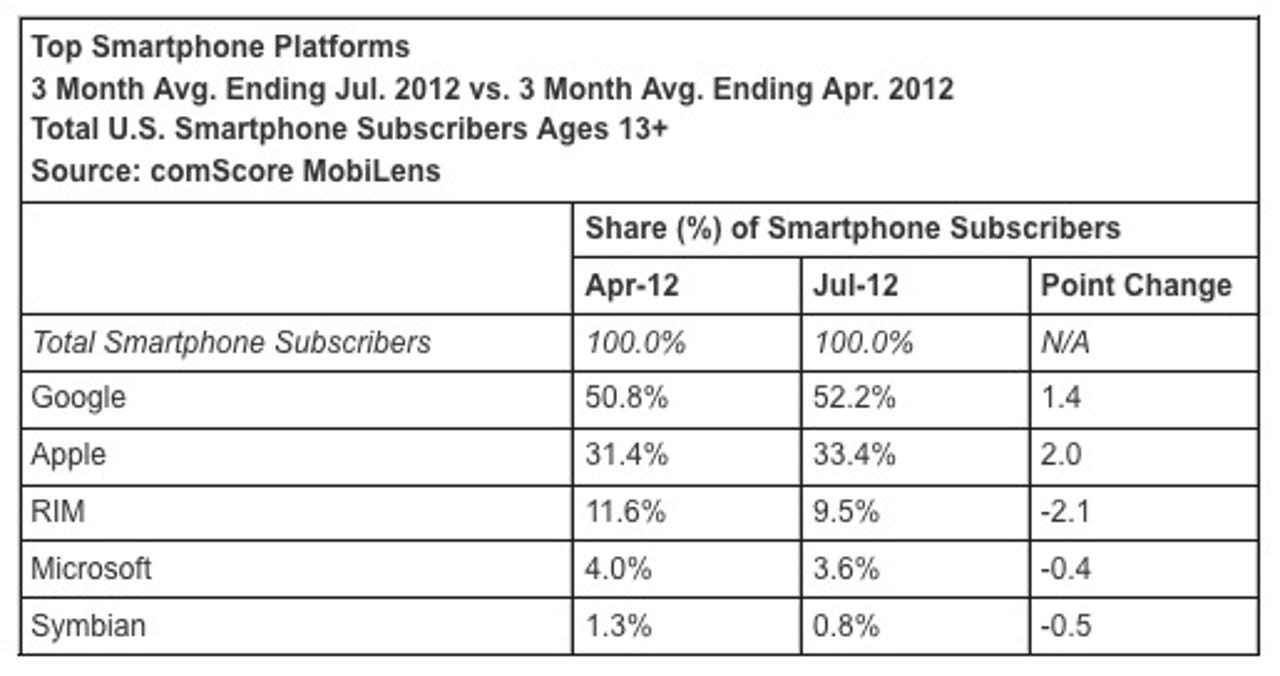
More specifically, Google's Android platform continues to lead with more than half of the platform market share at 52.2 percent, but Apple's 2 percentage point increase tipped the scales so that it now accounts for approximately one in three subscribers domestically.
Those two giants were trailed by RIM, Microsoft and Symbian -- all three of which saw their smartphone market share percentages decrease.
On the mobile OEM front, Samsung continued to lead despite a negative 0.3 point change. Nevertheless, the Korean electronics giant continued to retain 25.6 percent of the market share from the June 2012 report.
Interestingly, the only two mobile OEM makers to see gains in July were Apple in third place and HTC in fifth place. However, the August report could be very different based on earlier news on Tuesday regarding the Galaxy S3.

For reference, comScore surveyed more than 30,000 U.S. mobile subscribers for this report. Approximately 234 million Americans age 13 and older were accounted to have used mobile devices by the end of July.
Charts via comScore
Kick off your day with ZDNet's daily email newsletter. It's the freshest tech news and opinion, served hot. Get it.
Talkback
It's always interesting when you see the army
Pagan jim
All-in-all
LOL
Apple sucks.
Um Apple never had it all.. In terms of cell phone market share at least.
Pagan jim
Not really
Flashy new things inevitably attract a few customers, but what brings in the bulk of them and retains them is the ecosystem. Can you get the apps you want, primarily. Are the devices available in the form-factor you're after. These things ultimately get reflected back as market share, and that back as increased sales -- people like to back winner.
So it's a virtuous circle for your plaform after you pass a certain threshold... and a vicious circle when you don't. The stink of failure alone can taint a brand. Microsoft, RIM, and Nokia have each fallen from a commanding lead to a fractional share of the market. Both Microsoft/Nokia and RIM are planning to come roaring back in the next 12 months... pretty much all at the same time, since Windows 7 Phone was a failure (eg, not enough sales to keep Nokia from losing money, even with Microsoft's $250 billion cash per quarter added in -- that's a very clear definition of failure vs. success in Nokia's case). And looking at those charts, there's just not that much share left to take before you have to get Android and iOS users to switch to your platform. Neither of these guys has even addressed that yet.
When Apple first released the iPhone
It's Microsoft that seeks to eliminate choice
You didnt see second chart do you?
On the subject
Bet you didnt know this about penny stock
http://greatestviews.com/penny-stock-egg-head-is-it-a-scam/
Subscribers and dollars