Could Samsung cripple Apple by withholding the next big innovation in mobile?

Summary: Samsung leads the way in the technology that will drive the next big transformation in mobile devices. Could it withhold the innovation from Apple?

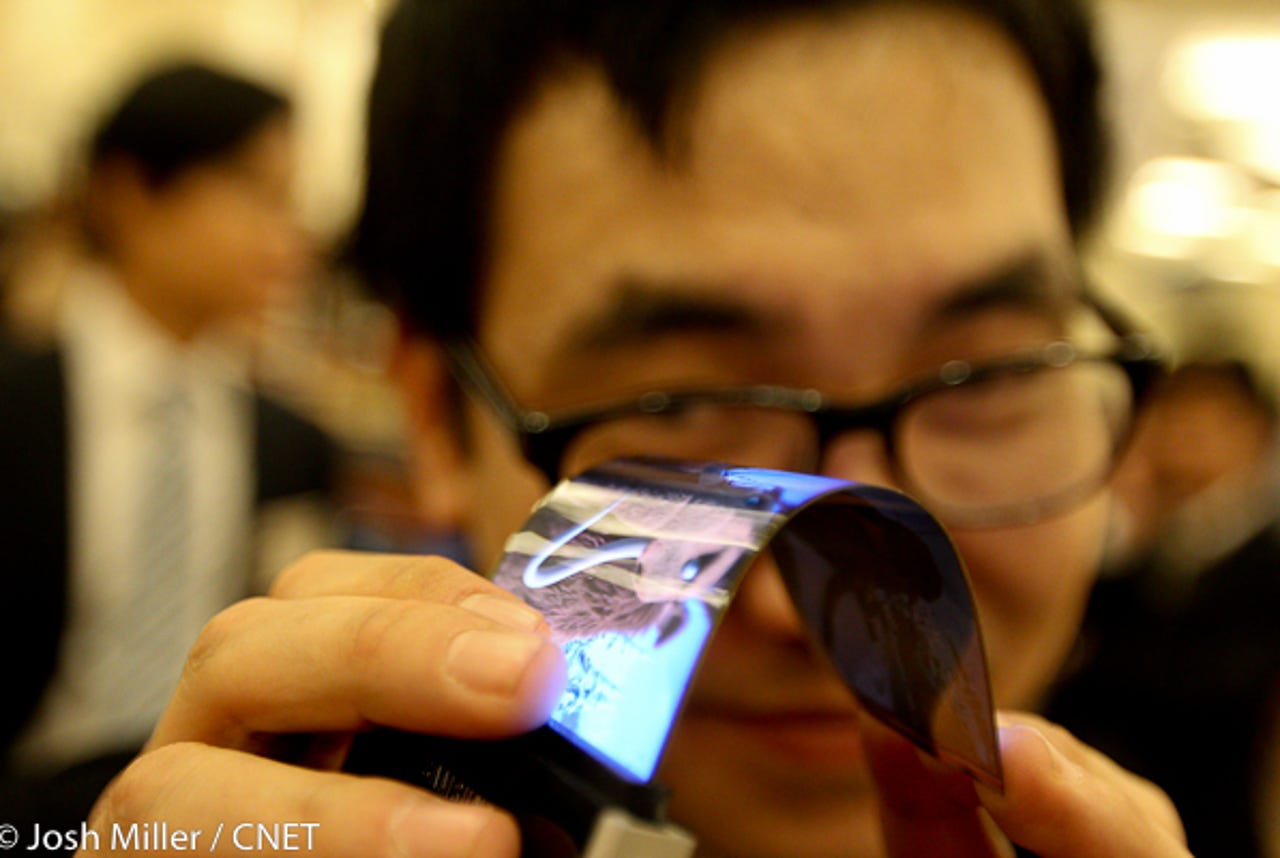
Samsung is drawing closer and closer to the technology that will transform the future of smartphones and tablets. It will show off its progress in a couple weeks at CES 2013 when it demos a 5.5-inch flexible display with a 1280x720 resolution and a 267 pixel density (an upgrade to the one pictured above from CES 2011).
While these displays are still at least a couple years away from being used in mainstream products, they represent the next big innovation in mobile devices. They will enable much thinner, more power-efficient smartphones and tablets, and a lot more flexibility (pun intended) in product designs and form factors.
The big question is whether or not Samsung would share this innovation with Apple.
As you know, Apple and Samsung are still embroiled in an epic legal battle over whether Samsung has illegally mimicked Apple devices and infringed upon Apple patents with its Galaxy family of smartphones and tablets.
Since Samsung is also the maker of lots of mobile hardware components, Apple had been one of its best customers. And from Apple’s point of view, Samsung was one of its most important partners for the iPhone, iPad, and iPod lines.
However, the legal cold war between the two companies has inevitably altered the relationship. Apple has been methodically moving business away from Samsung. While some of this has been guised in the wisdom of diversifying its supply chain, it’s impossible not to suspect this as retribution for its perceived improprieties on Samsung’s part.
Apple has significantly reduced its reliance on Samsung for memory chips. It is reportedly doing everything in its power to stop using Samsung to build the processors for its mobile devices. And it has moved much of its display business from Samsung to rival LG -- although it had to reportedly go back to Samsung and use it to make the Retina display for the iPad 3 because neither LG nor Sharp could meet Apple’s next-generation display requirements.
Overall, the lost Apple business clearly hasn’t hurt Samsung too badly. It has likely used the extra capacity to supply its own Samsung Mobile business, which saw the Galaxy S3 smartphone overtake the iPhone in 2012 as the most widely sold mobile device on the planet. The Galaxy Note has been a bigger seller as well.
Meanwhile, both Apple and Samsung continued to gobble up most of the profits in the mobile device market in 2012. As they go their separate ways, both companies are doing fine. The two will almost certainly continue to dominate the mobile market in 2013, as they introduce incremental improvements to their market-leading devices.
However, it’s when we get to the next big leap forward that the divergence between Apple and Samsung could really matter.
The kind of flexible OLED displays that Samsung is showing off at CES in January are going to change the game. Because they are bendable, less breakable, lighter, thinner, and more energy-efficient, they will unleash a wave a new designs in mobile devices -- lots of the things that haven’t even been imagined yet as well as designs that weren’t possible until the right technologies and materials were available.
Samsung is far and away the leader in this category. According to its own executives, Samsung produces over 90% of the OLEDs currently sold. And, it’s the only company publicly showing off these types of bendable OLEDs on a large scale -- and it’s been doing it for over two years.
Other companies like Philips, Sony, and Nokia have talked up this concept, but none of them are as close to bringing it to the real world as Samsung is.
So, the natural question is where this would leave Apple if Samsung does end up as the clear winner in the OLED race? Would it withhold the technology from its bitter rival and reserve the technology only for its own Samsung-branded devices?
The division that makes Samsung displays and the one that makes Samsung smartphones and tablets are two separate businesses within Samsung and each has their own P&L statements to optimize. So, it’s doubtful that Samsung will keep the display technology to itself -- at least not indefinitely.
But, since Samsung and Apple have such a fierce rivalry in the mobile market and now have such bad blood between them because of their legal squabbles, it’s not hard to imagine Samsung giving its own devices the exclusive first implementation of flexible OLED displays.
It will eventually sell them to Apple and other device makers to make their own designs. But, since this technology represents such game-changing, corner-turning opportunity, the rest of Samsung’s competitors will be a step behind and could inevitably be viewed as copycats.
What a turning of the tables that could be.
Apple certainly won’t let this pass without a fight. Don’t be surprised if Apple makes some quiet acquisitions to bring more display technology and expertise in-house. But, it may already be too late. Samsung could have its earliest flexible OLEDs to market before the end of 2013.
Kick off your day with ZDNet's daily email newsletter. It's the freshest tech news and opinion, served hot. Get it.
Talkback
Good grief. The salivating at the possibility of
There is nothing that Samsung has or plans that could withhold Apple
2) hi-density flash memory is planned by both Korean (besides Samsung) and Japanese industries. And since early this year Apple owns flash memory-controller design firm, which provides controller logic to all of flash memory manufacturers, including Samsung.
Instead, it is Samsung is CRIPPLED by Apple who withholding innovations for all those recent years:
1) Apple patented mathematics apparatus for multi-touch sensor recognition. While other solutions appeared, Apple's still the most optimal and provides the best accuracy;
2) back in 2007, Apple developed drilling-from-a-whole-piece-of-alluminum technologic process, and kept it exclusive until 2011, when others finally were able to invent independent manufacturing process;
3) Apple invented and patented mobile Retina-class IPS screens, and deployed the manufacturing simultaneously on three production companies under condition that they are not able to either sell screens to third-party, or use for their own products. This is how competing to Retina resolutions only appeared this year -- almost two years after original Retina;
4) Apple invented and patented "in-cell" technology, thanks to which there is no need for separate glass/sensor layer. As with matrices themselves, Apple deployed production simultaneously on three manufacturing parters under condition that they could not sell anything or use for their own good.
DDERSSS
Now that's some serious Fanboy ramble!!! Interesting stuff.
Regardless, this is headed in a great, competitive direction.
Let's get some Korean fanboys here to counter and start a good battle, shall we?
yeah
What exists outside of Apple offices?
Let me fix that for you...
(2)Samsung has not been materially harmed by this action.
(3)Apple invented the marketing term "Retina display", that's it. They do spend a TON of money on marketing to get people like you to believe in their products even if things aren't really what they initially seem to be. Steve Jobs was famous for his reality distortion field selling technique.
(4)See #2.
Samsung smartphones have been selling very well, despite Apple's attempts to club them with patent violations, having most of their success in the USA. Apple (as an extension of Steve Jobs' personality) is trying very hard to stop a natural process from occurring-evolution of technology. Getting Samsung to spend money on counter-litigation is the only area Apple has crippled Samsung and the current 1 billion dollar judgment has a LONG ways to go before any actual money exchanges take place.
Expect Apple to continue *copying* some of the best ideas Android has and incorporate them into their own handsets such as the 4-inch (and even bigger later) form factor now seen in the iPhone 5. "Good artists copy, great artists steal"-Steve Jobs, 1996.
Yep
No, he did not, especially in #3
Thank you DonRupertBitByte!
Whew, I was really worried for sometime that Apple was going to drag me into court because I have two retinas that I am constantly using without paying Apple anything.
I can now blink in confidence again...
You are a brave man...
Reality Distortion Field???
Yep
You don't think that CP/M devices were out at the same time? IBM used a very well established Clone Market for their first computer, do you think that popped up over night?
Back when the first Apple came out they were using Basic but, Digital was using a real OS.
As for printing, I believe you mean WYSIWYG which in reality is what Apple made. The printers were Canon built.
Indeed
Apple added
They did do a nice job on the design, tho.
Not quite
You're kidding, right?
Apple did not invent any of these. They simply took items that were already in existence and brought them together. If another company did the same thing to Apple now that Apple did to the inventors of the technologies, Apple would have them in court.
Personal Computer: where to start? Not with Apple, not even the Apple I was the first, much less the Macintosh. The Programma 101, released in 1965, was the first commercial "desktop computer". (Actually slightly more than a programmable calculator now.
Laser Printer: Again, Apple didn't invent it. The laser printer was invented at Xerox in 1969 by researcher Gary Starkweather.
MP3 Player: Apple was a late appearance to that market. The world's first mass-produced hardware MP3 player was created in 1997 by Saehan Information Systems.
Tablet Computer: Again, Apple was not the first. Acorn Computers developed and delivered an ARM based touch screen tablet computer for this program, branded the NewsPad in 1997.
I'm not saying that Apple doesn't "borrow" from others and improve (slightly in some cases). I'm saying they were definitely NOT the first.
A bit off
please do tell
Is Samsung becoming some form of religion, or Android?
Nope
Um no. Android is a choice for consumers granted and in all
Pagan jim