Feature driving tablet adoption: Battery life

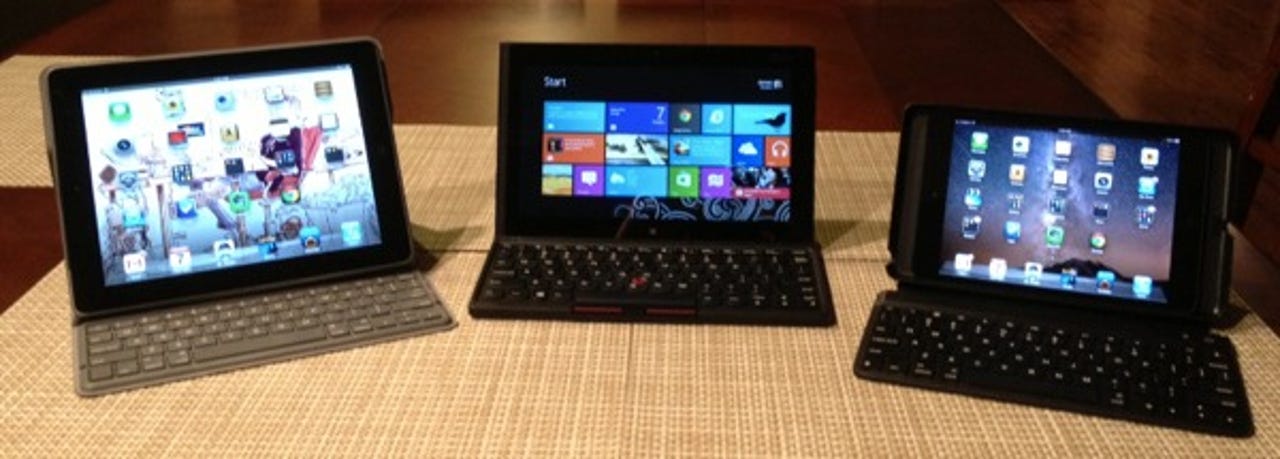
The tablet space has never been so diverse as it is today. The iPad drove the evolution of tablets, followed closely by Android slates, and now with Windows 8 tablets joining the fun. Tablets are being adopted by mobile professionals in increasing numbers who are choosing to leave the laptop behind and take the slate to work.
A number of arguments can be given for this rapid adoption. The enhanced mobility of the form is certainly helping drive the switch. The quality of apps for tablets is another good reason behind adoption. But of all the features that put tablets in gear bags, none is more important than battery life.
Given the technology of the time the only way I could get safely through the day was to take a spare battery with me in the gear bag.
In my previous career as a geophysicist I was the very definition of a mobile professional. My work day was spent going from one office to another all over town, attending as many as 5 or 6 meetings a day. When I headed out the door in the morning I could count on hours before finishing work for the day. My work days were not unique, many field reps and sales professionals have the same routine.
I used tablets for that work because the pen was a crucial tool for my work. I took handwritten notes at all the meetings, usually dozens of pages of notes daily. The convertible notebook used as a tablet was the driving force behind that work. I couldn't have done the job without a tablet in one hand and a digital pen in the other.
As important as the pen was to doing my job it was extended battery life that made it work. I could not plan on having a power outlet available at any point during the day. Given the technology of the time the only way I could get safely through the day was to take a spare battery with me in the gear bag. The magic number for battery life was 10 - 12 hours. Any less and it wouldn't work for me.
I was one of those buyers who always ordered a second battery when I bought a laptop or convertible notebook. Having the spare was the only way to get through a long day of mobile computing but that was OK. Laptops of that time had removable batteries and spares were readily available. It was a bit of a dance getting both batteries charged each night but I persevered as that's what it took to get the job done each day.
The option of a spare battery for laptops/convertible notebooks mostly disappeared as OEMs moved to a sealed battery construction. This helped make laptops thinner and lighter but it eliminated the owner's ability to pop another battery in when the meter ran dry. External battery packs would work but were unwieldy for practical usage, especially on a daily basis.
Next page: Tablets fill the void; Battery life and Windows 8 tablets
The move to fixed batteries made the run time of batteries more important than ever to the true mobile professional. With no way to swap batteries, the ability to get through heavy workdays away from an outlet became a real concern. Even though battery life improved most laptops could not get through a long day. The exposure to a dead battery was even more pronounced on business trips. It was no longer guaranteed that mobile workers could get through a full day no matter what happened.
The powerful processor of Windows 8 tablets has an appeal for power users but the mobile professional has to take a step back from the 5-hour battery life.
That's why mobile professionals were open to using tablets such as iPads to replace the laptop. All other advantages aside, having a battery life of 10+ hours was a lifeline for those needing to get through a full work day. No matter how the day unfolds for the mobile worker, these new tablets can handle it without power outlets entering into the picture.
The importance of this change cannot be overstated. Laptops for the most part lost the ability to use spare batteries, thus eliminating the ability of the user to guarantee getting through a whole day, and tablets stepped in with easy all-day battery life.
Once exposed to the liberation from the power outlet, mobile professionals are adopting the tablet in increasing numbers. Go to any meeting or public work space and you see tablets in numbers greater than ever before. It is now common to see more tablets, both with and without keyboards attached, than laptops in such venues.
Replacing a laptop with a tablet is not for everyone, some workers couldn't do it even if they wanted. But as the capabilities of tablets have increased they work just fine for more folks than ever before. That battery life is a big advantage over laptops and once exposed to that many users realize how big an advantage that is.
Long battery life was a feature driving purchases of first the iPad and then Android tablets. The ability to last 10+ hours on a single charge quickly made its value known to buyers. The same can be said for the first Windows tablets to hit the market, the Surface RT in particular.
Windows 8 tablets are aimed squarely at the mobile professional, and the 10-hour battery life of Windows RT tablets is appealing to that market segment. The same can be said for Intel Atom-based Windows 8 Pro tablets. Long battery life coupled with full Windows is a powerful draw for many mobile workers.
The same cannot be said for Windows 8 tablets with Core processors such as the Surface Pro from Microsoft. The powerful processor has an appeal for power users but the mobile professional has to take a step back from the 5-hour battery life. That won't last through even an average work day away from an outlet, much less a long one. Mary Jo Foley points out that Microsoft is aware of this shortcoming and hinted at an external battery solution for the Surface Pro. That's good but not an attractive solution for the true mobile worker.
The sealed battery technology being used in laptops and now tablets makes this feature on any mobile device more important than ever for the mobile worker. Those devices with less than 10 hours are going to have a hard time meeting the needs of the very market segment that such gadgets are trying to attract. It is a shortcoming that Windows 8 tablet makers must address, and quickly.
See related: