Forrester finds mixed prospects for Windows 8 in the enterprise

Summary: Forrester Research adds some more data to the list of early indicators as to how Windows 8 may do. And so far, it's a mixed bag, based on its survey data.
There's mixed news for Windows 8's prospects in the enterprise, according to new information from Forrester Research.
From the IT hardware buyer's perspective, the news isn't positive. "The first is that Windows 8 is seeing roughly half of the interest from IT hardware decision-makers that Windows 7 saw at the same point in its release cycle," according to a November 15 blog post from Forrester analyst David Johnson.
Johnson compares the reactions of 653 North American and European IT hardware purchasers that Forrester surveyed in 2009 to reactions of 1,282 similar professionals surveyed in the third quarter of this year. He noted that substantially fewer of those surveyed said they expect to migrate to Windows 8 at some point. And only five percent of those surveyed have specific plans to migrate to Windows 8 in the next 12 months, compared to 10 percent who said the same about Windows 7.
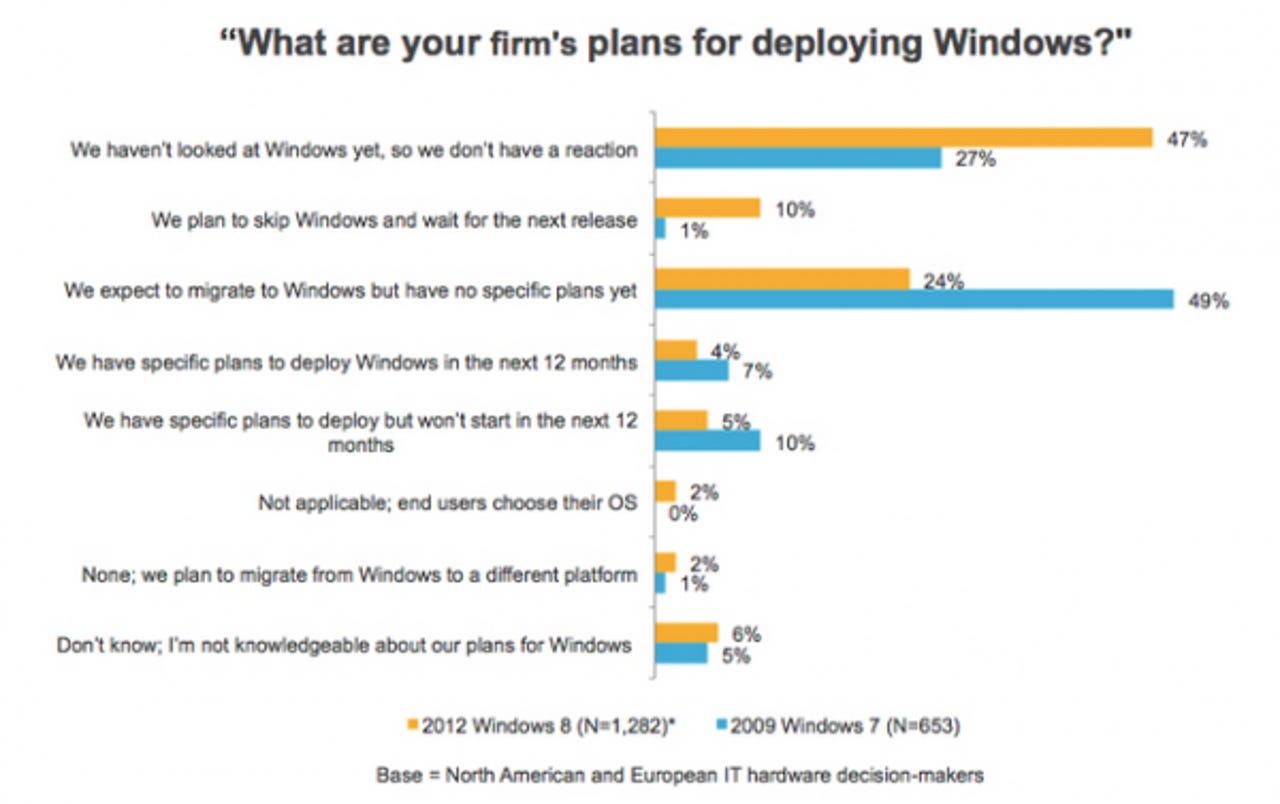
Here's what Forrester's summary fails to make explicit: Windows 7 (Windows 8's predecessor) is seen as a solid operating system release, and one to which many IT shops are only now moving. Vista (Windows 7's predecessor) was not widely adopted or seen as a release to which organizations would benefit from moving. In other words, Windows 7 might be too good for its own good (like another version of Windows before it), at least in the business world.
The other caveat: IT organizations seldom move to a new operating system shortly after it is released. Even if they stop waiting around for the first service pack before moving, larger shops have lots of planning and testing to do before making such a move. Windows 8 only became available to volume licensees a couple of months ago.
Not all of Forrester's projections spell doom and gloom for Windows 8's enterprise prospects.
Windows 8 will accelerate BYOD (bring your own device) demand, Forrester predicts, with 20 percent of the 9,800 information workers they surveyed claiming they would like Windows 8 to be the operating system on their next tablets -- more than wanted iOS, Android or Windows 7 on new touch tablets. Information workers still said they preferred Apple's iOS (26 percent of those surveyed) over all other options.
Microsoft has focused on consumers rather than IT customers first and foremost with Windows 8 and Windows RT, as the type of applications currently available in the Windows Store makes plain. This is the way Microsoft also decided to go with Windows Phone: The first Windows Phone OS 7.x releases targeted at consumers, with Windows Phone 8 OS finally starting to add more features to appeal to business users.
It's early days, in terms of predicting how well or poorly Windows 8 will sell. Early Windows 8 sales indicators, as detailed by my ZDNet colleague Larry Dignan, paint a nuanced picture.
Kick off your day with ZDNet's daily email newsletter. It's the freshest tech news and opinion, served hot. Get it.
Talkback
Not surprising
This survey makes sense for the following reason
Windows 8 does not have that advantage.
This survey is skewed because of this fact.
J
WinXP Pro
No point
Windows has been feature complete for 12 years
But what are they to do now? If they don't move the buttons they can't sell you a new OS. PC vendors can't sell you a new PC every three years. You would use that old scanner and printer, webcam and such forever, instead of replacing it because the vendor won't give you drivers for the new OS. They would have to call it a career and send everybody home - not just at Microsoft but across the entire worldwide PC client technology industry.
the year of Linux will be 2013
Re:Year of Linux
Same can be said for Windows.
If you expect a typical user to install Windows and be happy with it, you are sadly mistaken.
Though I can also say that users are beginning to rebel against the monopoly price.
ok
Android/Linux moves more client devices than Windows NOW
"Really, I'm not out to destroy Microsoft. That will just be a completely unintentional side effect." - Linus Torvalds, 2003
stop posting comments like that.
We need to make clear in these forums we are talking about the "failure" of DESKTOP linux. To those who use it, and know WHY we use it, desktop linux is just where it should be and an amazing success. No not a windows-like financial success. "Linux" does not try to be anything except what is useful for the developers to do what they need.
Some companies may take linux and roll it into a for profit desktop OS, but that has nothing to do with those who developed linux in the first place.
Its popular enough to warrant ongoing development, but not so much that it is a target of malware. Most people are not aware at just how successful 'linux' as a whole is. Those of us who don't just sit in front of a PC using commerical shrink wrapped apps, are very aware of this. People who do "real computing", like working in embedded development, servers, or scientific computing, etc..
"linux" has already had its years in phones, via android, and is now considered to be the new windows in the mobile realm. This has proven that windows is not popular because its UI so great, but it is essentially a entrenched, fat runtime for legacy apps that you can't get totally away from. If MS software prowess was so proportionally brilliant to their windows desktop popularity, they would have dominated smartphones by now.
Andoid is Linux, but not GNU/Linux
Linux as a kernel is fine. But GNU is not consumer friendly and developers don't have consumers in mind when develop its features.
Ontopic: Microsoft wants with Windows 8 to actually get ahead of Linux (Android) and UNIX (iOS), because it is playing a distant third in tablet and smartphone shipments.
This Ferrester survey misses the point: it is not DESKTOP that Windows 8 success will be judged on, but tablet and phone market. Windows 8 (not RT) tablets are the only ones that have enterprise friendly features (such as active domain etc) and run all the legacy business mission critical applications. The good news for Microsoft is that Apple is actively disinterested in serving the corporate market.
Windows 8 (for tablets) and WP8 are on the path to become the new BlackBerry - loved by the enterprise and having a moderate success with ordinary consumers.
Windows 8 for tablets loved by enterprise?
Which tablet for the enterprise?
- Apple tablets?
- Android tablets?
- Windows 8 tablets?
For the success of Windows 8 the desktop marketshare is irrelevant. How is Microsoft going to be worse off if it sells Microsoft Software Assurance (and clients install Win7) instead of Microsoft Software Assurance (and clients install Win8)?
Apple doesn't want the corporate market, Android is IMHO a mess, while Windows 8 tablets run all the proprietary and expensive software that companies run on. Dock a tablet and get a full fledged PC on Active Domain.
doesn't fly
So that only leaves the Intel based tablets that haven't been released - so you have no idea of whether they will work any better than Surface.
Windows 8 Pro has AD support
If the tablet has an HDMI output and a USB 2.0/3.0 port, you can dock it quite easily. Yes, a specialized dock connector would have saved you 20 seconds, but I don't think that plugging three cables (power, HDMI and USB hub) is a deal-breaker...
So 47% folks have not even seen it yet
Windows 8 has nothing to worry, it has everything it needs for a success but just have to pass the bad journalism test
except that it isn't fully compatable...
Except that you're wrong...
Not compatible with what?
All my applications that ran on Windows 7 Ultimate are working fine on Windows 8 Pro. And this is same tune of whoever is running Windows 8 Pro.
Hardware:
Majority of the hardware is compatible with Windows 8 Pro, which is compatible with Windows 7. If anything is missing, the drivers will be released by MS partners as long as they are HAL supported.
RT:
Windows RT is ARM based and it needs different apps, and drivers. And Microsoft clearly mentions that your existing Desktop or x86/x64 based applications wouldn't run on it.
Now tell us what is not compatible?
And I think you are clueless.