Good-Bye 386: Linux to drop support for i386 chips with next major release

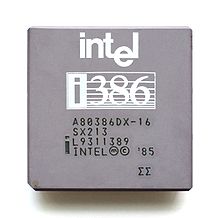
To every thing there is a season, and a time for every purpose under the heaven: A time to be born, and a time to die and a time for Linux to discontinue support for Intel's 27-years old, 32-bit 386 CPU in its next major release of the Linux kernel: 3.8.
Ingo Molnár, a Red Hat engineer and Linux kernel developer, asked Linus Torvalds, Linux's founder on December 11th to "consider pulling the latest x86-nuke386-for-linus git tree. For those of us who haven't been Linux kernel enthusiasts since day one, Molnár explained, "This tree removes ancient-386-CPUs support and thus zaps quite a bit of complexity." He continued, "Unfortunately there's a nostalgic cost: your old original 386 DX33 system from early 1991 won't be able to boot modern Linux kernels anymore. Sniff."
Indeed, back in 1991, Torvalds sent out a Usenet posting saying, "I'm doing a (free) operating system. (just a hobby, won't be big and professional like gnu [Gnu] was, and is, the free software collection of programs originated by Richard M. Stallman) for 386(486) AT clones." From that modest beginning Linux began.
Gallery: The 20 most significant events in Linux's 20-year history
Torvalds responded the next day, December 12th. I'm not sentimental. Good riddance." And, so long as the kernel team was thinking about cleaning out the code garage, Torvalds added "I think we should probably at least consider taking this one step further, and remove the dear old FPU [Floating Point Unit] emulation support too." Torvalds wondered though "Or do people still use the 486SX?"
The 486SX, an Intel chip without a FPU, dates back to 1991. While the 16MHz version is long gone except perhaps in some very dusty PCs in someone's basement, H. Peter Anvin, a Linux kernel programmer and Intel software engineer, thinks the 486SX may still be used in production systems. "There were a *bunch* of embedded 486 clones made, some still in production as far as I know, and I wouldn't be surprised if some of them lacked FPU."
As it turns out, 486SX will run Linux without any special handling. So, Torvalds has decided "Ok. It sounds like the code actually works despite lack of testing,and it clearly hasn't been the same kind of maintenance pain and problem that the lack of cmpxchg [compare and exchange, an old and troublesome 386 instruction] and friends, so let's leave it alone."
So while the 486DX and SX will live on in Linux 3.8, the 386 has come to the end of the road in mainstream Linux.
Worry not, though, if you still have a 386 chugging along in your office. It will still be supported in older versions of the Linux kernel for years still to come. Just don't expect the latest and greatest Linux kernel, which will arrive sometime in early 2013, to run on it.
Related Stories: