HP launching first version of Open webOS in beta

Summary: HP delivers the open source version of webOS in beta with the hopes of putting previous criticisms to rest.
Months after Hewlett-Packard originally announced the open source version of webOS, the beta version of the platform is on its way out the door.
Friday's release includes two environments for developers. The first is the desktop build, which is boasted to provide "the ideal development environment" for designing the webOS user experience with more features and integrating other open source technologies on the Ubuntu desktop.
Some of those new features include support for core apps such as Calendar and Contacts as well as third-party Enyo apps.
The second is the OpenEmbedded build for porting webOS to new devices. Equipped with an ARM emulator for running db8 and node.js services, HP cited that it included OpenEmbedded because of its "widespread community adoption" and cross-compiling support for embedded platforms.
Overall, the beta version of Open webOS is comprised of 54 webOS components available as open source, touted to bring more than 450,000 lines of code released under the Apache 2.0 license.
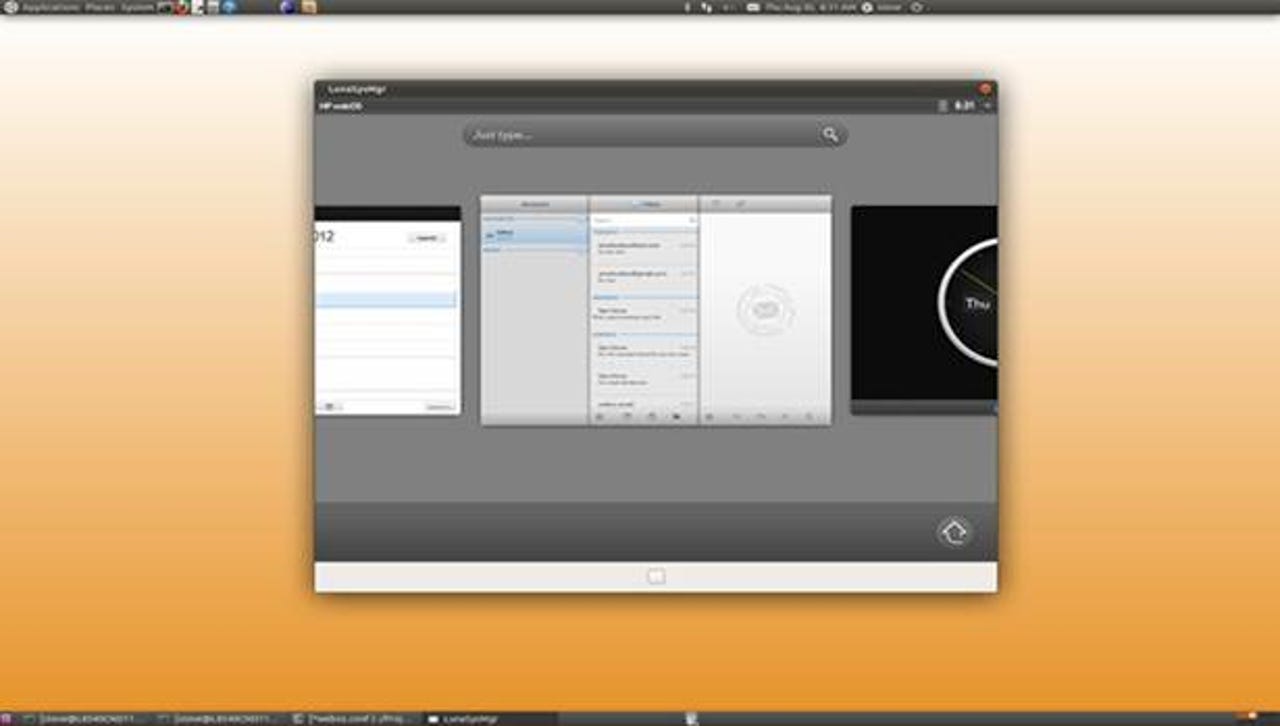
When open source webOS was first announced last year, it met a bit of negative reaction immediately as there were criticisms that HP didn't have a clear plan for the platform along with uncertainty about how it would affect the mobile spectrum in general.
HP provided a few more details in January, including that the first version of the new platform would be available by September 2012.
HP slightly acknowledged in a blog post about the lengthy time it took to push out Open webOS to developers, citing that it took "a lot of hard work, long hours and weekend sacrifices by our engineering team to deliver on our promise and we have accomplished this goal."
However, HP did not provide a specific date yet for when the September release of Open webOS will roll out.
Screenshot via Hewlett-Packard
Kick off your day with ZDNet's daily email newsletter. It's the freshest tech news and opinion, served hot. Get it.
Talkback
Well
Open webOS now available in beta
http://huntall.com/open-webos-now-available-in-beta
And here I thought I had messed up
I hope this works out, WebOS is really nice.
Commin, HP
I'd myself prefer MeeGO (Mer), TIzen. Hopefully, Debian and Ubuntu will catch up. Say, Allwinner proc + mali400 video card are pretty cheap these days yet powerful enough for a full fledged GNU/Linux distro. The problem is that specs are still not as open as one would wish...
I don't think
this won't fix the reason WebOS failed in the first place
it would be
you really want to
Thank you
Edit: It probably wasn't clear
Why not, buddy?
have you actually
I meant a tablet originally
Any 2core phone system might be able to run an Ubuntu concurrently with Android on the same kernel, being connected to a monitor through an hdmi cord.
so you want to
on a tablet it's more realistic, and I'm all for a dual boot (at least until android apps can run natively in linux, hopefully soon). but to totally rely on the terminal completely on a tablet totally defeats the purpose of having a tablet in the first place. you might as well just stick to laptops.
why again?
When working with a modern Unix-based shell, like bash (using the standard completion stuff) I barely have to type anything. The autocomlete is pretty intelligent. I do quite some select and Shift-Insert things, history arrow up/down too, It's very handy indeed. Standard android terminal although is good cannot match this power (iOS is not better). I am using it with busybox right now.
Add to all this what emacs could offer running the shell-command (on/in the region)? Again the virtual keyboard doesn't even have the proper Emacs keys... This would pretty awesome.
Yeah
And when you get a phone call, you have your headset (bluetooth, wires or even room voice system) unless you take the phone in your hand.
It would be perfect solution. All your most important data in your own private and secured NAS system, accessible by you anywhere as long you have internet connection, most important files encrypted to your phone (for offline use) and you don't need to think where you are, you just attach your device to dock at home and office.
Android could make our smartphones to be a really Personal Computers like what IBM wanted to do when they invented PC at 1981.
Today PC's and Macs are not personal for most people, as they are shared between family and friends. But no one gives their phones, even to their wife, girlfriend or especially to their family members than for very periodic time to watch some videos, specific pictures etc.
Phones are too personal, where PC's and Macs are "just computers".
Nope
Do not mistake Linux to any of those what I mentioned, than the operating system what you can download from kernel.org. Like here is one release of the Linux OS in full source http://www.kernel.org/pub/linux/kernel/v3.0/testing/linux-3.6-rc4.tar.bz2
None of GNU (or other projects) software belongs to Linux OS, so you don't need to troll saying it would be hard to use Linux on smartphone.
Why terminal?
tablet too?