India's Aakash-2: iPad Guts In A Miraculous US$21 Android Tablet
Inexpensive homegrown tablets - think between US$60 and $200 - abound in India, where the per-capita income, despite the fast-rising economy, remains US$3,700 per year. But the uncrowned king of inexpensive, Indian-made tablets is the Aakash tablet.
I say uncrowned because the student-designed, government-subsidized Aakash has yet to hit the market. And for awhile this year, the $35 tablet looked like it never would.
Besides poor reviews of version one of the Aakash tablet, there have been fingerpointing and legal suits flying between the Indian Institute of Technology (IIT), whose students and professors designed the tablet, the Indian manufacturer, and the Canadian firm DataWind overseeing the manufacturer.
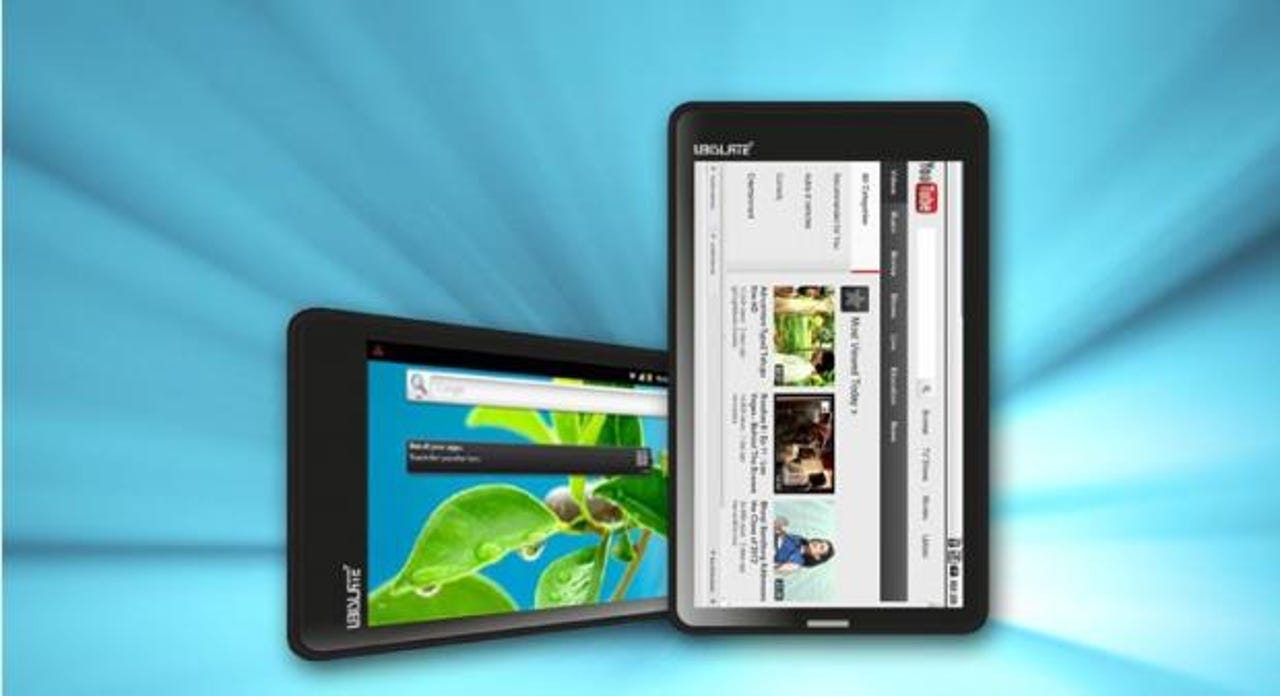
The Aakash-2 sports the same ARM chipset as the iPhone 4 and the first iPad. Not bad - just watch out for the 3-hour battery life.
But in an article last week, New York Times correspondent Pamposh Raina reports that the Aakash not only appears to be back on track, but is now targeted to be even less expensive and with better hardware than before.
How cheap? For Indian college students, the price of the Aakash-2 has fallen 40% to about $21 (1,132 rupees). A commercial version called the "UbiSlate" will cost between 3,499 and 4,299 rupees, or between $65 and $80.
And what will students get for $21? A 7-inch Android tablet/phone which, despite the latest upgrades, is honestly about 12-18 months behind what you'll see on the shelves of Best Buy. That's a relatively long time in the mobile game. But hey, at this price, who can complain?
Internally, the Aakash uses a single-core ARM Cortex-A8 running at 800 MHz, an video co-processor to provide HD video, and 256 MB of RAM. Though out of date in the dual/quad-core era, let's not forget that the Cortex-A8 with 256 MB RAM is what powers the original iPad (though at a slightly-faster 1 GHz).
Other popular devices using the Cortex-A8 include the iPhone 4, Barnes & Noble's Nook Color, Lenovo's IdeaPad A1, the Archos 5, and the Palm Pre (the latter four all via TI's OMAP chipset).
The original Aakash only came with a 7-inch resistive touchscreen. Though cheaper, these require pressure from users' fingers or styluses, and are rarely used in modern tablets.
The Aakash-2 now also comes in a glossy capacitive touchscreen version with a 800x480 resolution. According to Raina, navigation on the capacitive screen "was simple and fast, needing only a light touch," while video was "decent quality" with "very little pixelization."
One of the more impressive things about the Aakash-2 are its communication options. They include Wi-Fi a/b/g, a GPRS modem for which subscriptions will only cost 98 rupees per month, or less than US$2, and the ability to add a SIM card for voice phone access.
The Inevitable Tradeoffs
You'll need the data options to get on the Web or cloud, because the Aakash-2's internal storage (2 or 4 GB) is meager, though users can add up to 32 GB via an unspecified memory card slot.
The casing is a generic rubberized black plastic. And the operating system is out of date - Android 2.3 Gingerbread. Though it should be noted that Gingerbread still runs on 60% of Android tablets in use today. And the makers are upfront that the Aakash's battery life is only 3 hours.
One Tablet Per Backpack.
Credit: Shutterstock
Unlike the One Laptop Per Child Project, the Aakash does not feature any sunlight-readable displays, or any other cutting-edge, MIT-developed technology. It is simply a bare-bones Android tablet delivered at a miraculous price. I plan to bug my Indian colleagues to buy one for me the next time they go back home.
Like the OLPC, which has fallen short of its initial goals and only delivered 2.4 million laptops to school children worldwide in the last 7 years, the Aakash project has had its share of problems. Hopefully, it's moved past them - permanently.
Over the next six months, about 100,000 tablets are scheduled to be delivered to IIT, which plans to install a number of engineering and other educational Android apps.
In a country where more than 600 million people are under the age of 25, the Aakash tablet's makers have the opportunity to bridge the digital divide for hundreds of millions of students. And perhaps even jumpstart an Indian mobile hardware industry.