Intel Prescott: the benchmarks

Although Intel’s new processor has larger L1 and L2 caches and an enhanced set of multimedia instructions (SSE3), the company has resisted the temptation to call the Prescott chip the ‘Pentium 5’. You can identify a Prescott Pentium 4 by the ‘E’ that follows the clock speed -- as in, ‘Pentium 4 Processor with HT Technology 3.40E GHz’. There are four new Pentium 4 processors with the Prescott core (see table below). However, the 3.4GHz version will not be available in large quantities at launch, which is why Intel did not send this variant to testers. A 3.4GHz Pentium 4 with the older Northwood core will also available -- although, again, it’s not currently available for test.
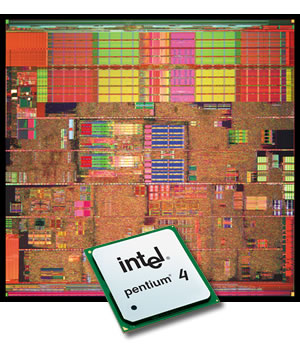
| Intel's new processors | |||
| CPU | FSB | HT support | Price |
| Pentium 4 2.8E GHz (Prescott) | 800MHz | yes | $178 |
| Pentium 4 3.0E GHz (Prescott) | 800MHz | yes | $218 |
| Pentium 4 3.2E GHz (Prescott) | 800MHz | yes | $278 |
| Pentium 4 3.4E GHz (Prescott) | 800MHz | yes | $417 |
| Pentium 4 3.4 GHz (Northwood) | 800MHz | yes | $417 |
| Pentium 4 EE 3.4 GHz (Northwood) | 800MHz | yes | $999 |
Caches, pipelines and power dissipation
The new Prescott CPU has more cache memory than its Northwood predecessor: both the L1 and the L2 caches are now twice as large as before, at 16KB and 1MB respectively. The Prescott chip also supports SSE3, which includes 13 extra PNI (Prescott New Instructions) commands. However, no applications yet support the new Prescott instructions, so they are currently irrelevant in practice.
Larger L1 and L2 caches should boost Prescott’s speed. The fact that this is mostly not the case -- Prescott is sometimes slower than previous Pentium 4 variants -- is because the chip’s command pipeline has been extended. Think of the pipeline as an assembly-line with several stages: the more stages assembly line has, the faster can it run, in theory. But if the parts (instructions and data) on the assembly-line are not in the correct order, the line must be stopped, corrected, and restarted.
Intel tries to balance this disadvantage with larger caches, which offer faster access to instructions and data than conventional main memory. But larger caches also mean that the power dissipation of the chip rises. The following tables give the results from a variety of PC systems.
| Power dissipation (Watts, with Radeon 7000 GPU) | ||||
| Motherboard | CPU | Idle (no load) | Maximum (full load) | Cool 'n' Quiet |
| Asus P4C800 | P4 3.2E GHz (Prescott) | 114 | 192 | n/a |
| Asus P4C800 | P4 3.2 GHz (Northwood) | 76.5 | 144 | n/a |
| Intel D875PBZ | P4 3.2E GHz (Prescott) | 96.9 | 188 | n/a |
| Intel D875PBZ | P4 3.2 GHz (Northwood) | 62.7 | 127 | n/a |
| Asus K8V Deluxe | Athlon 64 3400+ | 113 | 119 | 71.7 |
| Asus K8V Deluxe | Athlon 64 3200+ | 106 | 115 | 70.6 |
| Fujitsu Siemens D1607 | Athlon 64 3400+ | 107 | 114 | 65 |
| Fujitsu Siemens D1607 | Athlon 64 3200+ | 101 | 105 | 62 |
A PC with standard components and the new Intel Prescott chip dissipates nearly 50 Watts more under full load than the same system with the previous-generation Northwood chip. In Idle(no load) mode, the Prescott system still uses nearly 35 Watts more.
| Power dissipation (Watts, with Radeon 9800 Pro GPU) | ||||
| Motherboard | CPU | Idle (no load) | Maximum (full load) | Cool 'n' Quiet |
| Asus P4C800 | P4 3.2E GHz (Prescott) | 165 | 248 | n/a |
| Asus P4C800 | P4 3.2 GHz (Northwood) | 125 | 179 | n/a |
| Intel D875PBZ | P4 3.2E GHz (Prescott) | 145 | 242 | n/a |
| Intel D875PBZ | P4 3.2 GHz (Northwood) | 113 | 182 | n/a |
| Asus K8V Deluxe | Athlon 64 3400+ | 167 | 174 | 120 |
| Asus K8V Deluxe | Athlon 64 3200+ | 158 | 168 | 120 |
| Fujitsu Siemens D1607 | Athlon 64 3400+ | 157 | 166 | 114 |
| Fujitsu Siemens D1607 | Athlon 64 3200+ | 148 | 156 | 110 |
Application performance
Business and Content Creation Winstone are application-based benchmarks that carry out typical tasks like a converting video files or creating a PowerPoint presentation. The following applications are used (version numbers in the new Winstone 2004 releases are in brackets):
Content Creation Winstone 2003 (2004)
- Adobe Photoshop 7.0 (7.0.1)
- Adobe Premiere 6.0 (6.50)
- Macromedia Director 8.5.1 (MX 9.0)
- Macromedia Dreamweaver 4 (MX 6.1)
- Microsoft Windows Media Encoder 7.01.00.3055 (9.0)
- Netscape 6.2.3 (Internet Explorer)
- NewTek's LightWave 7.5 (7.5b)
- Sonic Foundry Sound Forge 6.0 (Steinberg WaveLab 4.0f)
- 5 Microsoft Office 2000 (Office XP) components (Access, Excel, FrontPage, PowerPoint, Word)
- Microsoft Project 2000 (Project 2002)
- Lotus Notes (MS Outlook)
- WinZip 8.0 (8.1)
- Norton AntiVirus (version 2003)
- Netscape Communicator (Internet Explorer)
AMD’s Athlon 64 processors are faster than their Intel counterparts under both of the new 2004 Winstone benchmarks. Despite its extended pipeline, Intel’s Prescott is slightly faster than its Northwood predecessor.
Internet performance
As far as Internet performance is concerned, AMD’s processors are ahead of Intel’s Pentium 4. The Athlon 64 3200+ is particularly impressive compared to the 3.2GHz Pentium 4 in the JavaScript and JavaScript/XML W3C tests, delivering 50 per cent better performance. The Northwood Pentium 4 scores well with the Java VM and Acrobat Reader tests, while the new Prescott chip is somewhat slower than its predecessor in all Internet benchmarks except the XML test.
3D performance: Unreal Tournament
3D games do not expose performance differences between the CPUs -- especially if image-quality-enhancing features such as anti-aliasing and anisotropic filtering are activated. Under these circumstances, the performance of the graphics card is the limiting factor.
The results show that the AMD processors are slightly faster than the Pentium 4 chips if no anti-aliasing or anisotropic filtering is activated. With higher resolution and better image quality, the performance differences are less apparent. The Intel CPUs deliver better results than the Athlon chips, which possibly points to a more effective AGP interface at higher resolutions with this test. Intel’s new Prescott Pentium 4 core is somewhat slower than its predecessor in this test.
3D performance: Comanche 4 / Splintercell
When tested with the 3D games Splintercell and Comanche 4, the new Prescott Pentium 4 lags behind its Northwood predecessor. With Comanche 4 the performance difference between the old and the new Pentium 4 is as much as 15 per cent. AMD’s Athlon 64 3400+ delivers the best performance with Comanche 4. If the image quality enhancements are activated with Splintercell, hardly any differences between the processors are evident. Here the graphics card is the limiting factor. With lower image quality settings the Athlon 64 beats its Intel competition.
3D performance: F1 Challenge 99-02
In the F1 Challenge 99-02 test, the processors from Ferrari sponsor AMD and Toyota sponsor Intel are as close as the respective cars are on the track. At 1,024 by 768 resolution, AMD noses in front. At higher resolutions and with anti-aliasing and anisotropic filtering activated, the processors are equally fast.
Load times: Racing Simulation 3
Processor performance is important for more than just gaming performance. Application startup times, loading of saved games and replays can also be affected by processor speed.
Ubisoft’s Formula 1 simulation, Racing Simulation 3, exposes particularly large differences in this respect. With this test, the time for the game to load completely is determined (1st start). The procedure is then repeated to determine the influence of the buffers (caches). Afterwards, the first replay is loaded (replay load). Finally, this procedure is repeated (2nd replay load). The results show that the AMD platform is clearly faster than its Intel competition.
Load times: F1 Challenge 99-02
The second load test, with F1 Challenge 99-02, also shows up performance differences, although not as dramatically as Racing Simulation 3. AMD’s processors are clearly faster when loading replays, while Intel’s new Prescott Pentium 4 outperforms its Northwood predecessor. Obviously here the advantages of Prescott’s larger caches outweigh the disadvantages of its longer pipeline.
Conclusions
The 3.2GHz Prescott Pentium 4 is slightly faster in some tests than its 3.2GHz Northwood predecessor, but mostly it is slightly slower. This should come as no surprise, since all new Intel desktop processors tend to be slower than their predecessors at the same clock speed. This was particularly true of the first Pentium 4, which only overtook the 1GHz Pentium III when its clock speed reached 1.5GHz.
‘What is Intel up to?’, one might well ask. The answer is simple: as far as Intel’s marketing department is concerned, 'megahertz sells'. By contrast to the mobile market (where the Pentium M that drives Centrino notebooks is approximately as fast at 1.8GHz as the Pentium 4 at 2.4GHz), traditional thinking applies in the desktop space. With its extended 31-stage pipeline, the Prescott Pentium 4 is generally slightly slower than its predecessor, despite having double the cache. But the longer pipeline means that Intel can continue to drive up Prescott’s clock speed.
Remember, though, that at 3.2GHz no other desktop processor requires as much power as the Prescott Pentium 4, which should reach 4GHz by the end of 2004. ‘Megahertz sells’? We shall see.
| Test environment | |||
| Component | AMD Athlon 64 | Intel Pentium 4 | |
| Motherboard | Asus K8V Deluxe | Asus P4C800 Deluxe | |
| Chipset | VIA K8T800 | Intel 875P | |
| Memory | 512MB Infineon DDR400 (CL25) | 2 x 256MB Memory Solution DDR400 (CL25) | |
| Hard drive | 2 IBM DTLA 307030 (Raid 0 on Promise Fasttrack 100) | 2 IBM DTLA 307030 (Raid 0 on Promise Fasttrack 100) | |
| Graphics card | ATI Radeon 9800 Pro 256 MB, Catalyst 3.10 | ATI Radeon 9800 Pro 256 MB, Catalyst 3.10 | |
| Operating system | Windows XP Professional SP1 | Windows XP Professional SP1 | |