Is Android too hard for the average user to figure out?

Summary: If Android is crushing the competition and dominating the mobile market, then why did iOS devices wipe the floor with Android when it came to Thanksgiving and Black Friday online shopping?
Yesterday, Asymco analyst Horace Dediu posted some charts based on data gathered by IBM’s Digital Analytics Benchmark for U.S. Thanksgiving and Black Friday sales.
However, there's one chart that stands out above the rest, and it's this one that shows the data broken down into individual platforms.
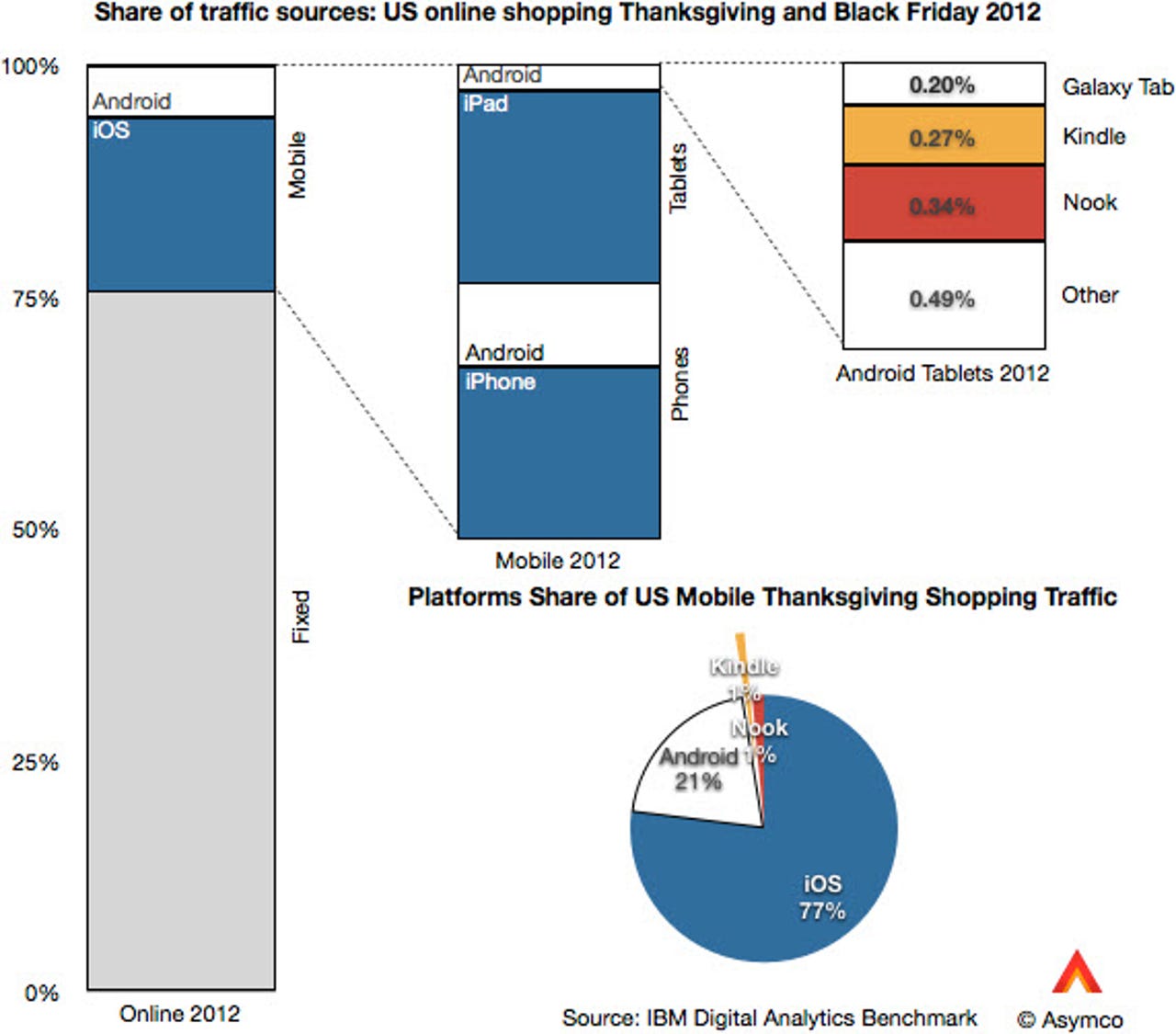
The part I am interested in specifically is the breakdown between Android and iOS devices, and it raises an interesting question.
It's clear that Android devices outsell iOS by a significant factor. According to IDC's Worldwide Mobile Phone Tracker, Google's mobile operating system accounts for 75 percent of the international smartphone market share.
In just three years, Android has crushed the smartphone competition.
If Android is dominant with respect to market share, why did Apple's iOS-powered devices wipe the floor with Android when it came to Thanksgiving and Black Friday online shopping?
It might be easy to try to pin this discrepancy down on the users themselves, perhaps by suggesting that iOS users are more flush and have more cash to spare, or that they are more conditioned to spend money on their smartphone or tablet because there are fewer free apps in the Apple App Store than in the Google Play store.
To be honest, I don't believe that the difference is down to the customer, and even Dediu dismisses this suggestion.
"I'm not satisfied with the explanation that Android users are demographically different," writes Dediu, "because the Android user pool is now so vast and because the most popular devices are not exactly cheap."
So if it's not the users, what is it? Dediu's not sure, but that doesn't stop him pointing fingers at where he thinks the problem lies.
"There is something else at play. It might be explained by design considerations or by user experience flaws or integration but something is different."
I think Dediu onto something here, but I think he's over-thinking the problem. I think it comes down to one rather simple but key difference between the two platforms.
iOS is easier to use than Android. Or, flipping that around, Android is too hard for the average user to figure out.
Let's face it, from the outside there's little to separate one black rectangle from another other than screen size. What separates them from each other is not how they look, but how they work, and if more people are buying Android devices than iOS devices, but more iOS users are using them to do real stuff like shopping, that's down to the software -- both the operating system itself, and maybe the apps.
But this data gives us an even deeper insight into the differences between Android and iOS usage. Online shopping is a task primarily carried out through the browser, and once you get as far as firing up the relevant browser on an Android or iOS device, the experience is, on the whole, not that dissimilar.
This would tend to suggest that the core difference between iOS and Android is that owners are more inclined to look at an iOS device -- whether it be an iPhone or an iPad -- as a tool to get things done. Android users aren't getting as far as clicking on the browser, because if they did, the experience from that point onwards is not that different to the iOS experience.
This would suggest that Google is facing a problem. People are buying Android-powered smartphones and tablets, but there are barriers or obstacles that gets in the way of engagement that aren't present in Apple's iOS platform.
Part of this is undoubtedly down to user education. Apple has spent a lot of time and money creating commercials that show its products being used to solve real-world problems. As short and as simple as these ads may be, they give owners -- and potential owners -- an idea of what the iPhone or iPad can do. That might seem extremely basic, but it gets people to explore the potential of their iDevice.
Compare this to ads I've seen for Android hardware, which seem to focus on the device itself rather that what it can do for the owner.
Monkey see, monkey do.
Image source: Asymco.
Kick off your day with ZDNet's daily email newsletter. It's the freshest tech news and opinion, served hot. Get it.
Talkback
Wrong!
Even looking at the Chart and breakdown of Droid Devices sales, Seeing the Nook and Kindle devices which are multimedia platforms more than a true tablet, shows that my thoughts are in the right direction.
The App Store/iTunes couldn't influence these numbers
the iphone is a consumption device
Apple/Iphone/Ipad - Conspicous Consumption for the 1% (1% to 10%)
People w/ a propensity to consume the latest 'tech' buy iPhones/iPads. People w/ a propensity to be productive/efficient go with Android. Those with lots of money (ie the wealthy) brought lots of expensive online TVs (via Amazon, AppleStore, etc.), tech gadgets to have the latest/greatest.
Apples/Iphones are -- broadly speaking - about class signifiers/"kewlness", ego & status. Ultra-American consumers at the top of the pyramid cocoon (if you will permit the metaphor). The other is about the marketplace. You know, labor theory of value (rather than consumer ethos self-actualization).
"People w/ a propensity to be productive/efficient go with Android"
People on average that can't afford to pay $200-$300 for a smartphone are also unlikely to understand most of the capabilities that Android offers, but there's a much bigger issue at stake here that again goes back to the argument of "sold" vs "shipped". If we even begin to believe that every Android device supposedly "activated" every day, which some pundits claims is over 2 million per day, then why is it that we don't hear about more than 1.4 billion Android phones in use right now and those web numbers showing up far higher than they do?
Why? Because the vast majority of those Android activations are either re-activations of existing phones or replacement phones which have died for whatever reason--even combining the 'shipped' numbers by all the Android OEMs doesn't add up to the total number of "activations" over a given time period.
Pundits love to look microscopically at sales, ignoring real-world usage if it doesn't agree with their viewpoints. If you want real usage stats, you have to look at the market macroscopically--the entire market, not just one tiny piece.
Cheap?
I'm glad your reading retention is good
Just because you paid more for yours doesn't mean everybody does. For most Android buyers, price is far more important than quality--at least when they buy their first one.
Wrong again
I know, I know, you iPeople like to feel special... even more affluent. But the fact is... iPhones are the same price as equivalent Android devices.
Luxury
Apple's shares are what they are because the company in not only valued on the products it makes but the MARGINS on those products. Apple has all the incentive in the world to price its wares higher. This should be NO secret to anyone. Looking at sticker rather than value, Apple devices START at higher price points than the competion.
This is not a criticism but it is a stigma the company has (and one it probably embraces).
Where is the follow up cross section of the "average" iOS device owner?
P.S. When did you buy your Android phone...
HTC Inspire
I will be using her Feb'13 upgrade to get either an SGS III ($49-$199 on contract depending on sales and where you buy) or a Note II ($299 on contract). I may again use a July'13 upgrade for a 3rd line I have to get the SGS IV if it is available at that time.
hardware requirements
Most people are too stupid to operate a phone. That's why they buy Apple...
Love all the fud.
:-)
"Activations" don't necessarily equate to "sales".
Wow
Lets see your references for these bald assertions. (And I don't mean Lovey).
Correction
Corrected that for ya.
"Is it any wonder why a product designed for brain dead people is so popular?"
You referring to Android's outselling iOS, right?
Correcting Corrected
Android not Android's...
Corrected Correcting Corrected
This is one of the most common (and, to me, most annoying) grammatical errors.
And another one "bug's" me a lot, though it isn't quite as common. Can you guess what it is?