Microsoft 'Big Boobs' gaffe points to wider industry problems for women in tech

Summary: The Microsoft 'Big Boobs' code gaffe exposes an industry culture which results in dismally low minority and gender representation. Can the industry afford it? Transparency is the first step.
The BBC is reporting today that Microsoft has swiftly removed a bunch of code labelled 0xB16B00B5 which can be read, I guess, as 'Big Boobs'. It's the second embarrassment of its kind in as many months for Microsoft. Last months Azure Norwegian developer conference culminated in an interesting dance routine which led to a sheepish apology from Redmond:
This week’s Norwegian Developer’s Conference included a skit that involved inappropriate and offensive elements and vulgar language. We apologize to our customers and our partners and are actively looking into the matter.
Microsoft runs a comprehensive diversity programme and it has never been afraid to take its leadership to the barricades on such issues of social justice, so I'm not sure this is altogether a fair comment on Microsoft in particular. I suspect it's rather a sign of a more endemic problem throughout the industry. Matthew Garrett of Redhat writing in his blog said:
At the most basic level it's just straightforward childish humour, and the use of vaguely-English strings in magic hex constants is hardly uncommon. But it's also specifically male childish humour. Puerile sniggering at breasts contributes to the continuing impression that software development is a boys club where girls aren't welcome. It's especially irritating in this case because Azure may depend on this constant, so changing it will break things.
But what about the business case for diversity? Can we really afford to alienate 50% of the workforce? In a thoughtful piece ZDNet's Tom Foremski wrote:
Silicon Valley is running hard to maintain its position as the global innovation engine, against competition with dozens of fast growing innovation centers around the world.
Which is why it's puzzling that Silicon Valley has such a large gender gap in key sectors such as angels, VCs, entrepreneurs, engineers, and in senior executive roles.
Why isn't Silicon Valley using all of its people?
A cursory look at the numbers overall makes grim reading. From a paper published by the Anita Borg Institute, Minorities and High Tech Employment:
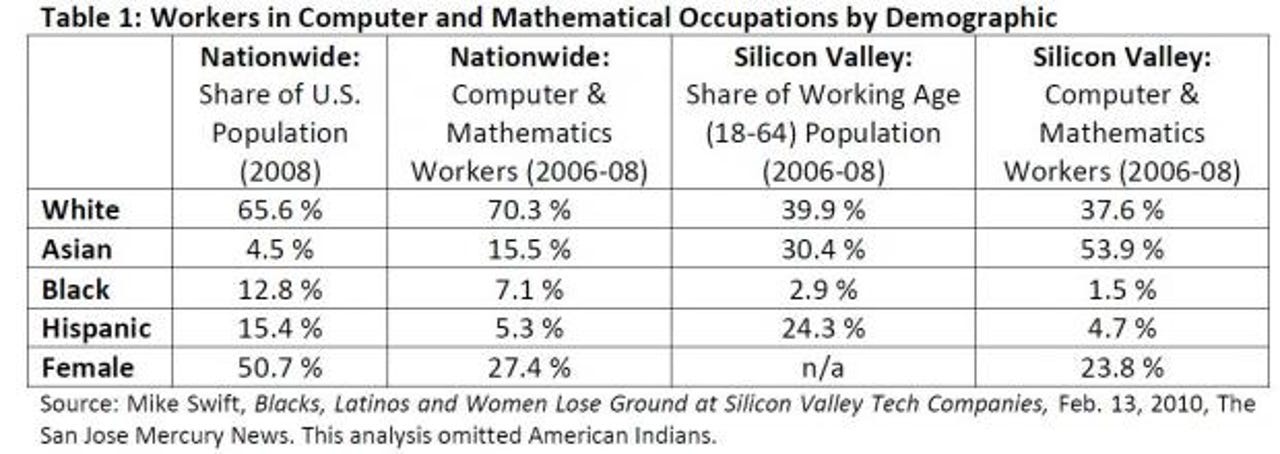
Focusing on gender alone here are the stats from the major tech leaders, many of whom are corporate partners of the Anita Borg Institute - an organisation dedicated to the advancement of women in tech, who at least are prepared to be transparent:

Most concerning of all is the long list of tech leaders who are not yet prepared to publish any performance data at all. Without evidence and transparency are women and minorities just supposed to trust that they will be welcomed and supported upon recruitment?
Among those not yet disclosing: Apple, Adobe, Amazon, Applied Materials, Broadcom, Brocade, CA*, Facebook, Google, Intuit, JDSU, Juniper, Marvell, NetApp, Neustar, Salesforce, Thought Works, Yahoo!, LinkedIn.
*CA does disclose women at executive level which is currently 8% and perhaps the most comical explanation for non disclosure comes from Google in 2010 when it then claimed the race and gender composition of its workforce is a trade secret.
In a week when Marissa Mayer joins the growing ranks of women in top tech jobs, the numbers (and lack thereof) beg the question of whether the success of Mayer, Whitman & Rometti represent the exception rather than the rule for women in tech.
Updated with VC data:
At the start up end of the industry things don't look much better. CB Insights research of 160 funded start ups from January to June 2010 show the same depressing trend. However, one proof point perhaps for the business case for diversity is that mixed gender start up teams are attracting more funding.

And lest we think that the problem is completely universal and therefore immutable consider the statistics from Massachusetts which together with California and New York make up the big three states for VC funding. Of the 16 start ups funded in the period January to June 2010, 31% were all women founders. Compare this ratio to just 3% each in New York and California over the same period.

Referring to the recent Kleiner, Perkins, Caulfied and Byers sexual harassment lawsuit Tom Foremski came up with an ingenious mitigation idea that could just be the start of a tide turning:
I have a great suggestion for a new VC fund from Kleiner Perkins: the $100 million Triple 'F' Fund- "The Female Founders Fund - Investing in all our people." It can't hurt KP's reputation beyond what's already done, and the fund would probably do very well.
How about it?
Kick off your day with ZDNet's daily email newsletter. It's the freshest tech news and opinion, served hot. Get it.
Talkback
Well...
lol...
FoREX indicator
Welcome Our Magic World Web place. This is a special website all the finical user and Entertainments users. We partake of agreed amaze Many Important Question Answer, templates, Web designs, Software, MT4 Protrader Review - Fx Multimeter - Best Forex Indicator For Metatrader 4. Forex developers are for all time updating the software which payback the user in their trading processes.
FoREX indicator
So what?
Yeah very sexist to think bigboobs refers to women more than men
to think bigboobs refers to women more than men
lol...
Instinct versus logic.
Oh, and "lol".
Well it made me feel good, FuzzyWuzzy
;)
well
gender, yes. Minority, no way.
BTW, it is not the problem of industry, it is the problem for those who has no interest joining the IT force.
Minorities
Exactly
Too true. I'm a female programmer, and although I get the occasional person who doesn't want to hear what I say, the majority are great to work with and respect my input. In social life, I can get into conversations with guy friends regarding technology and my work, while the girls are polite enough to listen but they honestly don't give a rat's a** about it all. It's a complete difference in gender, and you're obviously going to see that coming into the stats in the work force.
Please elaborate.
Not necessarily even gender
Imported labour is especially important in creating differences in demographics between the overall population and the relevant labour pool. If you import a lot of skilled workers from Asia or Europe on job-related visas, then the proportion of qualified labour within the Asian or European populations will tend to be much higher than the average for the domestic population. In contrast, if you import a lot of unskilled workers from Latin America, the proportion of qualified labour within the Hispanic population will tend to be much lower.
The gender distribution of imported labour will also be affected by the norms of the source country. Labour imported from Northern or Eastern Europe, for example, is likely to be more balanced in terms of gender than labour imported from more patriarchal societies in Asia – although China might be something of an exception to the Asian norm, owing to its Communist past (which was mostly a disaster, but did dramatically improve equality between the sexes).
35 million dead
WilErz
However, I do think we need to look further up the pipeline to understand why more women and minorities are not entering the tech labour market.
Thanks
The evidence from the Pisa mathematics test tends to support the idea that social structures are a factor in driving the gender gap in mathematics, which in turn is probably linked to career choices. The most gender-equal societies are the Scandinavian countries, and the gender gaps on the Pisa mathematics test to be smaller than average in Scandinavia (at least amongst non-immigrants). In fact, in Iceland, which is the most gender-equal country (but otherwise quite different from the rest of Scandinavia, e.g. with a relatively small government), girls actually score higher on the Pisa mathematics test than boys. I think it's the only country where this is the case. Having said that, I work in a scientific field that is heavily male-dominated, and every Icelandic colleague I've had has been male, so there's obviously more to it than that.
Immature
What makes you think that tech isnt hiring every qualified woman/minority
Men are from Mars, women are from Venus?
Women on the other hand are all about relationships. Virtually everything they do is towards this end. To the extent that work can be harmonious with their relationships, women will pursue work. However once women start seeing certain types of work (such as tech) undermining their relationships, they stay away from it like the plague. Women in general don't like the geek image. Many consider geeks social handicaps, and would rather not be counted among them. Also women just don't receive the same type of emotional gratification from scientific or tech achievement, as they would from being say an actress or supermodel, where all men would like to have them, and all women would like to be like them.
While I'm all for equal opportunity. I however just don't think anyone should hold his or her breath, for women to come stampeding into tech any time soon.
SPOT ON
we can live all we want in politically correct lalaland; forget the stupid feminist indoctrination. My son at 8 played with lego, his room was a cemetery of computers, now is an accomplished python programmer. My daughter, at the same age, is all about Monster High dolls, her friend Chloé, her friend Béatrice, her friend Anna. Men & women we are different, thanks God. Last thing we need is politicians pushing more gender targeted hiring. The world we live is already bad, no need to make it worse.
and Idiots are from WHERE ???