Microsoft to deliver new Windows 8 and Windows RT Lync app in late October

Summary: The product formerly known as Lync MX, a touch-centric, Windows Store app, will be available for Windows 8 and Windows RT PCs and tablets in late October.
Testers have been putting the new version of the Lync 2013 desktop client and Lync Server 2013 through their paces for a few months.
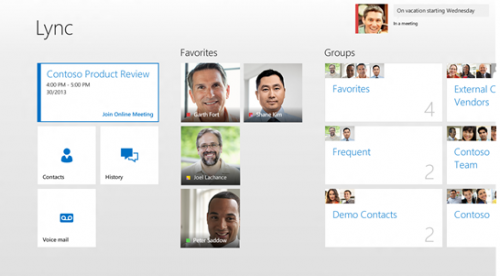
But there's another Lync product in the family -- an Lync app built specifically for Windows 8 and Windows RT. This is the product to which Microsoft officials previously referred as Lync 2013 MX. This touch-centric, Metrofied ("Windows Storized"?) version of Lync was not released as part of the Office 2013 Customer Preview in July.
But there's now word that this new Lync application will be available in the Windows Store for both Windows 8 and Windows RT as of late October. That's according to a September 20 post on the Lync Team Blog.
Lync is Microsoft's unified communications family of products. Lync offers enterprise instant messaging, VOIP and conferencing. In addition to the desktop client, the server and the new Windows 8/Windows RT Lync app, there also are versions of the Lync client for a variety of smartphone platforms and a browser-based Lync web app.
"The new Lync App ... will be compatible with both Lync Server 2010 and Lync Server 2013," explained the team in the latest blog post. It "is Lync re-imagined for the new Windows Experience."
The coming versions of Lync, as Microsoft officials have indicated, will include Skype federation. Lync 2013 users will be able to see presence, instant message or call anyone on Skype.
Microsoft officials have attempted to distinguish Lync and Skype by describing Lync as Microsoft's inside-the-firewall unified-communications solution, and Skype it's outside the firewall one.
The fact that this new Lync for Windows 8/Windows RT application will be available in the Windows Store in late October 2012 does not mean that Microsoft will release all of the Office 2013 products to manufacturing in October. Microsoft officials are continuing to decline to say when Office 2013 will be released to manufacturing or generally available. (The rumor is November for RTM and February 2013 for general availability/launch.)
Microsoft officials said recently that the final version of Office 2013 Home & Student for Windows RT would be available starting in early November.
Kick off your day with ZDNet's daily email newsletter. It's the freshest tech news and opinion, served hot. Get it.
Talkback
Microsoft Fragmentation Strikes Again
Profit Opportunity
Re: Profit Opportunity
As for Skype, that's not something you put in the same sentence as "profit"...
Lync integration
Green32.com
Microsoft Lync Mobile Solution w/ Damaka's Xavy
1.) To keep Google from getting the user base.
2.) To integrate with Lync and provide a mobile solution.
Item one is politics and behind the scenes, this is why the price was high for the acquisition.
Item two was the public message during the acquisition, and what I believe Steve Ballmer really believed (or was told) could be done.
But as ldo17, these are two completely different architectures.
One of Microsoft's most recently announced partners should tell you where they are headed with Lync.
Press Release with Demo Video on iPad:
http://www.prweb.com/releases/2012/8/prweb9806063.htm
I don't think you know anything except slamming Microsoft at every
HTH
Re: I don't think you know anything except slamming Microsoft at every...
Skype Federation
If you are referring to interoperability of Lync and Skype, it will be fixed with Lync 2013/Lync Server 2013 and the next release of Office 365/Lync Online, since all will support Skype Federation.
http://lync.microsoft.com/en-us/Pages/Lync-2013-Preview.aspx
“it will be fixed with Lync 2013/Lync Server 2013 and the next release”
Lync Preview
pointless
That will take some time
I imagine the three will merge though. For now it's Lync for business and Skype/Messenger for consumers. With some Skype cross-over in business. I imagine Messenger will be phased out for sure.
There's also a Skype Metro app coming too.
Microsoft bashing by people who don't understand software development
Facts:
- Microsoft's acquisition of Skype is recent (Skype became a division of Microsoft a bit less than a year ago)
- Skype was (and still to a large extent is) a P2P technology primarly aimed at the consumer market
- Lync has always been a client-server technology primarily aimed at the enterprise market
- Skype, for better or worse, has always been using proprietary/non standard approaches for virtually everything (authentication, signaling, media...)
- Lync has been using standard based approaches for virtually everything and has also published its client-server protocol extensions
- For people to ask if there are any commonality between the two infrastructures is akin to asking whether there is commonality between a nice private house and the Empire State Building... in short there are massive differences resulting from the different functions and histories - only people with no understanding of software whatsoever could miss this, like ldo17 does
- Without having a crystal ball, it's fairly obvious that Microsoft has lots of reasons to get the 2 solutions to converge technically, so they can communicate (which is indeed one of the capabilities announced in the upcoming Lync 2013 release - one year or so to introduce that federation after the acquisition seems very reasonable timeline-wise for people who understand enterprise grade software)
- But they have no interest whatsoever in breaking either Skype or Lync, so this is not about bastardizing either dumbling and hastily; if there is technology convergence (and I believe there will be soon) it is a) a lot of difficult work and b) something that cannot impact end users negatively at all
- I predict that Skype will progressively evolve to adopt more (standards based) Lync technology, as well as becoming more client-server; meanwhile, Lync might onboard some of the codecs of Skype and benefit from Skype's larger economies of scale to be present on even more platforms. Convergence of core stacks will eventually enable development of a single core engine for platforms such as iOS and Android, where today Microsoft at large has to develop 2 complete stacks.
To me, this all makes sense - technical and business sense and most importantly sense for the customer. Being able to use Lync in the Enterprise and Skype for virtually every consumer unlocks very rich B2C scenarios, much preferable to using the outdated, insecure and costly PSTN. It's hard to understand the gratuitous bashing in this case.
Skype
Gee that's funny. That's exactly what Skype offers. I don't get it; there is a Skype-Enterprise offering, which could easily be extended, and have a Metro interface built for it. I don't get why Lync is needed; Skype is encrypted, why would any business need something else?
(That's not a rhetorical question by the way; quite likely that Lync does offer something to big enterprises that Skype doesn't, I just don't yet understand what it is after reading the article.)
Lync vs SharePoint
http://technet.microsoft.com/en-us/library/gg398806.aspx
http://blogs.technet.com/b/drrez/archive/2011/04/27/lync-2010-exchange-2010-sharepoint-2010-and-office-2010-integration-part-2.aspx
Lync vs Skype
I hate it when that happens, too
What about the 99% of us without touch monitors???
Then you use your mouse.