Microsoft's 'Bing it on' challenge beats Google's results 2:1

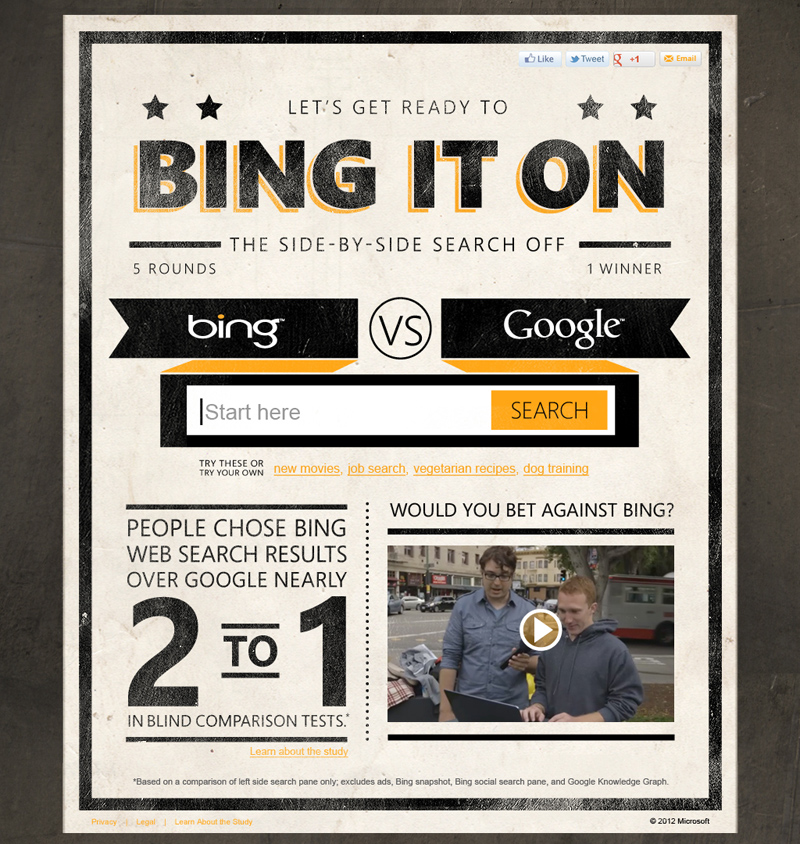
Last week the Bing blog announced the launch of the ‘Bing it on’ campaign. The campaign focuses on a competition where search results are displayed side by side for users to choose which results are the most relevant to them. Independent research showed that Bing was beating Google in search relevancy.
“Relevancy of search results is the No. 1 driver of search engine preference, and independent research shows that people chose Bing’s Web search results over Google’s nearly 2-to-1,” according to Mike Nichols, corporate vice president and chief marketing officer of Bing.
Mary Jo Foley’s Bing it on post on CNET notes that Bing has 15 per cent of the U.S. search share which rises to 28 per cent considering that Bing powers Yahoo search.
And share size matters. Not only to advertisers but to Microsoft itself.
A larger share not only increases advertising revenue, but also returns a larger data set which aids machine learning and product feature development.
So a side by side comparison of Bing to Google gives Microsoft extra insight into what results searchers prefer when offered two sets of results.
Side by side
According to the Bing blog:
An independent research company, Answers Research based in San Diego, CA, conducted a study using a representative online sample of nearly 1000 people, ages 18 and older from across the US.
The participants were chosen from a random survey panel and were required to have used a major search engine in the past month. Participants were not aware that Microsoft was involved’.
‘The research shows that people chose Bing web search results over Google nearly 2:1 in blind comparison tests’.
The ‘Bing it on’ campaign challenges searchers in the US to:
‘Conduct five search queries of your choice and compare unbranded Web search results from Bing and Google side by side. For each search result, you choose a winner or declare it a “draw.’ you then get to see which search engine ‘came out on top’.
The campaign is aimed at US users so the results may show significant differences when the campaign is eventually rolled out across other regions throughout the world.
Emotions run high over Bing v’s Google. Most of the comments on Mary Jo’s post favour Google over Bing, some comments rail against Microsoft, malware, privacy, operating systems and monopolies. So why do we have such strong feelings about a search engine?
Old habits?
Google's dominance might be down to our ingrained PC habits. Many PC’s still run the operating system that was sold with it. Consumer users do not tend to upgrade their home systems when a new version appears. We often use the first software tool we have discovered and do not see the need to change.
The same habit might also be applied to Google v’s Bing. Google, which has search share dominance, has been around the longest as a single brand name. ‘To Google’ is now in our lexicon. The name has stayed the same since it was launched in 1998.
Bing, in its current iteration is a relative newcomer. Although MSN Search also launched in 1998, it has been through a number of name changes. MSN Search evolved into Windows Live search, then Live Search before the Bing brand was launched in 2009.
Perhaps confusion over different branding has stopped people from staying loyal to Bing throughout its evolution. Perhaps searchers prefer the stability and ease of accessing the Google name. But 2:1 blind comparison tests can not be lightly dismissed.
Other search platforms, embedded in tools also deliver the results we want.
Facebook search, powered by Bing, gives it a competitive edge that could challenge Google with its focus on personal relevance. Amazon search, brings results based on user recommendations and preferences. Both could be significant future competitors as our search behaviour evolves.
If Microsoft can continue to grow the Bing brand and avoid renaming every time that the online team has a re-org then I think that its market share will continue to grow at the expense of Google.
Google, on the other hand will continue to innovate and improve its product set as the threat to its market dominance and competition increases.
Whatever the result, the consumer will ultimately benefit from whichever company manages to successfully ‘bring it on’.