NBN 3-year plan covers 3.5m premises

Summary: Prime Minister Julia Gillard today announced the three-year roll-out plan for the National Broadband Network (NBN), which expects to cover 3.5 million premises and most Labor, Liberal and cross-bench seats by 2015.
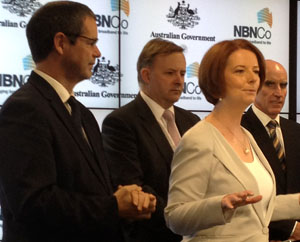
Prime Minister Julia Gillard today announced the three-year roll-out plan for the National Broadband Network (NBN), which expects to cover 3.5 million premises and most Labor, Liberal and cross-bench seats by 2015.
Stephen Conroy, Anthony Albanese, Julia Gillard and Mike Quigley
(Credit: Josh Taylor/ZDNet Australia)
The roll-out plan for the next three years will cover a total of 1500 communities, Gillard announced in Sydney today, saying the NBN was "about to go into high gear".
New South Wales is the big winner, with 1.01 million premises expected to be connected to the NBN by 2015, followed by Victoria at 691,600, Queensland with 678,600, Western Australia with 429,200, South Australia with 327,300, ACT with 135,300, the Northern Territory with 65,200 and Tasmania with 209,100. The combined numbers cover approximately one-third of the entire roll-out.
NBN Co has set up a roll-out map where people can look up to see whether their suburb will be connected in the next three years.
The three-year indicative plan has been released following the finalisation of the $11 billion deal with Telstra that will see its copper network retired and customers moved onto the NBN. NBN Co could only release the three-year plan once it had assessed the dark fibre, ducts and exchanges it will lease from the telco giant for the NBN.
In expectation of criticism from suburbs that missed out on being included in the initial three-year plan, NBN Co CEO Mike Quigley explained how exactly NBN Co determined the suburbs picked.
"First we needed to complete the sites we had already announced. We had to take into account the instructions our shareholder, the government, gave to us, which was to get a balance between regional and metro areas. And also to achieve a balance across the states of Australia and also to complete Tasmania by 2015," Quigley said.
"We had to build our plan on the basis of the infrastructure that was available from Telstra," he added.
NBN Co also had to prioritise "growth corridors", where there would be the majority of greenfields sites so NBN Co could get those done as efficiently as possible. The company also had to prioritise links that were essential for the operation of the fixed-wireless network and the satellite earth stations in preparation for these networks to be in place by 2015.
Quigley said the company then had to "load balance" for construction contractors and adjust the build to prevent congestion in local communities. Meanwhile, it had to ensure that James Cook, New England, Wollongong and Melbourne universities had access to fibre as they are researching high-speed broadband applications.
Communications Minister Stephen Conroy said that 67 of the 72 Labor seats, 61 of the 71 Coalition seats and six of the seven independent seats will be covered by the roll-out.
Gillard said that it was time to retire the ageing Telstra copper network.
"Whilst our 100-year-old copper telephone network has served us well, it cannot deliver the broadband we need for the future. If we don't move as a nation to the National Broadband Network, then we will see choked off the economic possibilities of the future and we will see choked off the service delivery possibilities of the future," Gillard said.
"Wherever you are scheduled in the roll-out of the NBN, your access to broadband is not safe if the government changes. Tony Abbott has been very clear that he wants to demolish the National Broadband Network. The only way to ensure that broadband is there ... is for our government to continue that mission."
The NBN three-year plan goes past the next election, which, on the basis of polling today, the Gillard Government is likely to lose to the Coalition. The Coalition has proposed to scale back the NBN roll-out significantly. Conroy said that the NBN roll-out wouldn't stop in the election period and said Opposition Leader Tony Abbott's plan to buy Telstra's copper for a fibre-to-the-node network was "rooted in the last century" and ignores the bandwidth demand across Australia.
"The copper is strangling our economy," Conroy said.
Although the government is talking up the fact that the copper network will be retired as part of the NBN roll-out, Quigley could not say when or where the first parts of the copper network will be deactivated. Once an area is declared "ready for service" on the National Broadband Network Telstra will switch off the copper network in 18 months. However, Quigley indicated that Telstra CEO David Thodey wanted to switch it off faster.
Conroy also said that the government's decision on whether it will provide battery back-ups for all premises on the NBN is expected to be made in May.
Kick off your day with ZDNet's daily email newsletter. It's the freshest tech news and opinion, served hot. Get it.
Talkback
Your comment is invalid.
The rest of the hospitals aren't. Some are new and aren't in need of further capital funds. Some have excess capacity and need no expansion and yet others are in dire need of funds and not receiving it. Plenty of examples around if you only opened your eyes.
And even the new Hospitals (such as the Austin Hospital in Melbourne) are in need of further money but do not receive it. The money they need may not be for major capital works, but instead for the fact that since reopening in 2005, they have not had a fully operating ICU (Intensive Care Unit) centre. The Austin is constructed with 3 such wards but has only ever had the funding for 2 of them. The 3rd is used as no more than storage closet... So yes, the Hospitals do need more funding.
Health expenditure is $57B p.a and it is budgeted for.
The NBN is $3.6B (for 10 years only) and is funded via bond, securities sales etc.
As for your actuals, please read ravstas comment below
http://www.zdnet.com.au/nbn-key-for-royal-childrens-hospital-339334344.htm
@ Chatterbox62, Yep they missed out in the first 3 year rollout. I imagine however that after a year the engineers building the network will divise faster ways to roll out the network and you may find that by next year they may not only be back on schedual but could even incude more premises than they first thought.
I'd also like to add that most victorians voted against a NBN but now it seems it's a good idea some victorians are winging that they aren't getting it fast enough. A bit hipocritical if you ask me.
What's the basis for this statement? In the last Federal election when the NBN was up as an election platform issue, Victoria returned 22 ALP members to 14 Coalition members - probably the ALP's best performance of any state in that election.
Or are you taking the results of the Victorian state election as a proxy for any and all Federal ALP policies (a very dubious proposition)?
Cheers
We've added them in. Sorry about that.
The roll-out is 14 months behind schedule and customers are simply not connecting. The highest take-up rate in the nation is 29%. Based on page 77 of the NBNCo Corporate Plan, they were expecting take-up to be 43% rising to 70%.
About the only thing not to go wrong yet is the budget.
They're all old debaters tactics - stall, argue about definitions, cavil at minor points while ignoring the main issue at hand.
The rollout is around eight months behind schedule - and that is very largely to the delay (read: foot-dragging and hardball negotiation) on Telstra's part in coming to an agreement, as well as meeting the Conditions Precedent, including the ACCC approval of the structural separation.
"The customers are simply not connecting"? Incorrect on the simple facts reported. The connection rates are at or above those forecast. The figures on page 77 are misleading because they do not measure brownfields connections only, but include a large chunk of the original "BOT" - Build Operate Transfer arrangements that are no longer part of the corporate plan and should not be included in the figures.
The useful figures for brownfields and greenfields connections are actually to be found on page 15 of the 2010 plan. They show June 2012 targets for active service connections: 5,000 greenfields, 5,000 brownfields and 13,000 for the satellite first release.
Obviously we haven't reached that date yet, but on projections the brownfields figures (the only ones that people generally refer to) are close to target. I haven't seen any greenfields connection figures yet (this is a rather different metric, since these are premises which have only a fibre fixed line, not copper), but the satellite connection figures are apparently 5,000 now and heading upward rapidly at around 500 per week. At this rate, there will be around 11-12,000 satellite connections by June 2012 - fairly close to the target figure.
And of course, the one thing that all NBN critics consistently ignore is that with the progressive shutdown of copper, all RSPs will be actively migrating their customers to fibre, as there will be no copper-based service left. With this, the eventual 70% takeup figure seems quite achievable (and beatable).
The Labor Government WILL be defeated at the next election and Gillard and Conroy will be sitting on the Opposition Benches. What is the point of proceeding with discussing their future plans for the NBN? Better we investigate what is going to happen when Abbott and Turnbull assume command.