Netbook platforms: VIA Nano v. Intel Atom

Introduction
Despite the rapidly cooling economic climate, netbooks sold like hot cakes last year. The boom in small, affordable, notebooks looks likely to continue this year. Most netbook manufacturers use Intel's Atom processor along with the somewhat dated G945 graphics chipset.
The main criticisms levelled at netbooks centre on poor performance. AMD chief Dirk Meyer predicts the netbook's demise, while Nvidia president Jen Hsun Huang has criticised the weak performance of the Atom platform and announced a graphics chipset that's designed to address the Atom's deficiencies. This Nvidia chipset, called Ion, could give a significant boost to Atom-based netbooks. Ion has a clear edge over any graphics option than Intel can currently muster. On top of that, Ion can use Nvidia's CUDA parallel computing interface to perform calculations for certain non-graphics applications. The arithmetic performance of the graphics chip far exceeds that of the main processor.
Some manufacturers view the VIA Nano processor as a viable alternative for netbooks. Samsung has just released the NC20, which is equipped with a particularly energy-efficient variant of the Nano chip. The benchmark tests presented here examine the VIA and Intel chips. Nvidia's Ion is not yet available, but is due to appear in April.
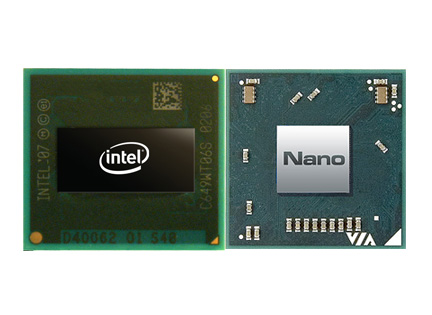
Test models and platforms
We looked at the two main netbook processors, the 1.8GHz VIA Nano L2100 and the 1.6GHz Intel Atom 230. We used standard motherboards from the two manufacturers — VIA's Epia SN and Intel's 'Little Falls' D945GCFL, which are both equipped with 2GB of RAM as standard. Intel manufactures the Atom using a 45-nanometre (nm) feature size, while VIA still uses 65nm technology. For this reason, the VIA Nano uses more power than Intel's Atom. But there are some particularly energy-efficient models in the Nano range, which can match the Atom for power consumption. Samsung's new NC20, for example, uses a 1.3GHz VIA Nano that consumes a nominal 8W.
The internal architecture of the two processors differs significantly. To save power at the expense of speed, the Atom dispenses with out-of-order instruction processing, unlike the Nano which in theory can thus offer faster instruction processing. But the Atom partly makes up for this disadvantage by using hyperthreading. Our benchmarks show which of the two architectures performs best in practice. For reference, we compared the netbook results with a conventional desktop machine based on a 2.5GHz dual-core Pentium E5200.
Everest: memory and arithmetic performance
Intel's Atom outperforms the VIA Nano in the SinJulia floating-point unit (FPU) test, which measures the speed of single-precision 32-bit FPU calculations. However, the Nano carries off the win on the double-precision 64-bit Mandel test, scoring 547 against the Atom's 143.
The differences are even more pronounced in the integer benchmarks. In the AES test, the Nano even outperforms the dual-core Pentium, and substantially so. In fact, with a score of 58,285, the Nano is faster than a Nehalem processor. VIA's Nano delivers outstanding floating-point performance thanks to an add algorithm and multiplier that both have exceptionally low latency. These features are aimed largely at accelerating high-definition video playback and 3D rendering.
The Nano comes out in front of the Atom in every other integer benchmark except for the Queen test. As far as memory performance is concerned, the Nano is clearly superior in every test.
Windows Vista 32-bit: longer bars are better
Windows Vista 32-bit: longer bars are better
Windows Vista 32-bit: longer bars are better
3D performance: 3D Mark, OpenGL
The 3D Mark 2003 and 2005 benchmarks, and the OpenGL test from the Cinebench suite, underline the fact that netbooks are not intended for 3D operations. The dual-core Pentium E5200 desktop with the 965 chipset and integrated graphics is several times faster than the netbooks. Of the two netbook chips, the Nano comes out on top.
Windows Vista 32-bit: longer bars are better
Windows Vista 32-bit: longer bars are better
Application performance: compression, encryption
In the 7-Zip compression/decompression test, the Atom is slightly faster than the VIA Nano, which does better in the TrueCrypt 6.1 encryption test — even though this does not capitalise on the Nano's Advanced Encryption Standard (AES) hardware support. The value of this support is shown in the dual-core Pentium E5200's performance, which performs five times faster than the netbook processors.
Windows Vista 32-bit: longer bars are better
Windows Vista 32-bit: MB/s (longer bars are better)
Internet performance
Email and web surfing are two of the most common tasks for netbooks, making performance in this area is of primary importance to netbook users.
The VIA Nano emerges as the better processor for internet tasks. While the Atom needs 132.8 seconds to display simple HTML pages, the Nano does it in 70.1 seconds. But compared with the desktop processor, which finishes the same task in 33.3 seconds, even the Nano looks sluggish.
The same picture emerges in the Java and JavaScript tests, where the Nano clearly performs better than the Intel Atom. These tests are not academic exercises, because more and more web pages contain JavaScript. The SunSpider test is a good indicator of performance in this area, and browser manufacturers use it to measure the JavaScript performance of their engines. Intel's Atom takes nearly twice as much time to complete this test as the VIA Nano.
Windows Vista 32-bit: seconds (shorter bars are better)
Windows Vista 32-bit: seconds (shorter bars are better)
Windows Vista 32-bit: seconds (shorter bars are better)
Multimedia performance: MP3, video, image handling
The results from iTunes, Adobe Media Encoder, Cinema 4D 10, Jalbum, Autopano Pro and Paint.NET show that netbooks are not great at handling video, sound and images. Although the VIA Nano delivers better overall performance than Intel's Atom, that's nothing to crow about as both are vastly slower than the dual-core Pentium E5200 desktop chip.
Windows Vista 32-bit: seconds (shorter bars are better)
Windows Vista 32-bit: longer bars are better
Windows Vista 32-bit: seconds (shorter bars are better)
Power consumption
Next to performance, the issue that most preoccupies netbook manufacturers is power consumption. For power economy, Intel's Atom has a clear advantage. The 1.8GHz VIA Nano needs a hefty 20W more under full load than the Atom. Here, the Atom's 45nm feature size pays off. But VIA can compete in this area with its power-efficient 1.3GHz variant, which is used in Samsung's new NC20 netbook. Despite this chip's lower clock speed, it should still be able to beat the higher-clocked Atom in important benchmarks, such as the internet tests.
Windows Vista 32-bit: Watts (shorter bars are better)
Conclusion
Two clear facts emerge from our benchmarks of the Intel Atom and VIA Nano netbook processors. First, the Nano not only matches the Atom in many performance areas, it's significantly ahead in key tests. The Nano loads HTML, XML and JavaScript pages faster than the Atom. Second, when it comes to graphics, netbook users have to accept performance compromises. At about €60, the attractively priced dual-core Pentium E5200 is far faster than the netbook processors. In popular application areas — such as image handling — netbooks suffer from weak performance. Indeed, at times, the netbook chips performed so sluggishly that our testers felt as though they had slipped back to the IT Stone Age.
Translation by Toby Wolpe