PC sales fell in Q1 as tablets trumped netbooks

Summary: Both the major PC research companies, IDC and Gartner, have reported a decline in PC sales during this year's first quarter, which was otherwise marked by the Japanese earthquake and tsunami and by the launch of Apple's iPad 2, which may have sold about 2.5 million units.

Both the major PC research companies, IDC and Gartner, have reported a decline in PC sales during this year's first quarter, which was otherwise marked by the Japanese earthquake and tsunami and by the launch of Apple's iPad 2, which may have sold about 2.5 million units. IDC estimates that global PC sales fell by 3.2 percent to 80.6 million units, while Gartner registered a 1.1 percent fall to 84.3 million units.

While the two companies are generally in broad agreement, this time they differ in their view of Acer, which is the world's second largest PC supplier by units, and the biggest supplier of netbooks. It certainly looks as though netbooks took a hit, especially in the US market, where Gartner has Acer Group's shipments falling by 24.9 percent to 1.8 million units, while IDC's numbers are -42.1 percent and 1.3 million units.

It seems that Acer entered the year with 12 weeks of inventory rather than the usual six, according to the Financial Times, which could have limited new shipments. Either way, it is presumably not a coincidence that the Taiwanese company's Italian boss, Gianfranco Lanci, had a disagreement with the board and left at the end of last month.

In its quarterly statement, IDC said:

"Although the forecast for the quarter was already conservative – IDC expected a mere 1.5% growth in shipments – a steady but still cautious business mentality and waning consumer enthusiasm persisted. A spike in fuel and commodity prices and the disruptions in Japan added to the mix, further dampening a market struggling to maintain momentum."

Gartner's principal analyst Mikako Kitagawa said:

"Weak demand for consumer PCs was the biggest inhibitor of growth. Low prices for consumer PCs, which had long stimulated growth, no longer attracted buyers. Instead, consumers turned their attention to media tablets and other consumer electronics. With the launch of the iPad 2 in February, more consumers either switched to buying an alternative device, or simply held back from buying PCs. We're investigating whether this trend is likely to have a long-term effect on the PC market."

It's certainly true that there was little excitement in the PC market except for the Intel Core iX Sandy Bridge chips, which deliver outstanding performance but were hit by a widely-publicised bug. There was even less excitement in the netbook market, where prices have risen but performance generally hasn't. The replacement of Microsoft Windows XP with Windows 7 Starter apparently failed to boost netbook sales, and might even have harmed them.
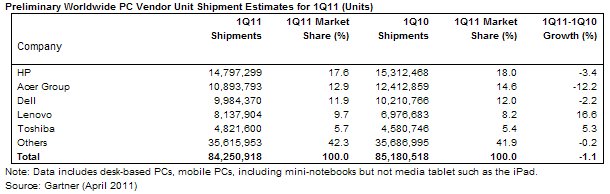
Table of Gartner's Top 5 PC suppliers

Hewlett-Packard (including Compaq) held on to its global top spot in both Top 5 tables of the largest PC manufacturers by unit shipments. According to Garter, HP shipped 14.8 million PCs -- down by 3.4 percent compared to the same quarter last year -- for a market share of 17.6 percent. It was followed by Acer (10.9m, 12.9 percent), Dell (10.0m, 11.9 percent), Lenovo (8.1m, 9.7 percent) and Toshiba (4.8m, 5.7 percent). IDC's more pessimistic view of Acer dropped it a place, so its Top 5 comprised HP, Dell, Acer, Lenovo and Toshiba.

Lenovo and Toshiba were the only Top 5 PC suppliers to increase shipments compared with the same quarter last year. IDC said: "Lenovo significantly outperformed the market with shipments posting 16.3% growth."

Apple also increased its Mac sales, as it has for the past several years, but it's still not selling enough units to overtake Toshiba globally. However, it's now not far behind Toshiba in the US market, which had a very bad first quarter. According to IDC, US shipments fell by 10.7% to 16.1 million units, while Gartner saw them falling by 6.2 percent to 16.1 million units. Fortunately the US market isn't anything like as important as it used to be….

In the (mainly) Western European market known as EMEA, Gartner reckons PC shipments fell by 2.8 percent to 26.1 million units, with only Lenovo showing an increase. The Top 5 in Europe were HP, Acer, Dell, Asus and Lenovo.

Gartner research director Ranjit Atwal said: "The PC market in EMEA had not exhibited decline since the third quarter of 2009 when the market declined 8.9 percent."

In Asia/Pacific, PC shipments grew by 4.1 percent to 28.2 million units in the first quarter of 2011. Gartner said: "PCs were not high on consumers' shopping lists during the Chinese New Year holiday. In India, consumers were distracted by the Cricket World Cup. They also preferred to upgrade or purchase new TVs or other home electronics."

The PC market in Latin America grew by 5.4 percent to 8.1 million units, and Brazil accounted for over 40 percent, according to Gartner.

In Japan, PC shipments fell by 13.1 percent to 4 million units, with the earthquake and tsunami on March 11 reducing shipments. Gartner said: "The impact of the disaster was most evident in the professional PC market, where the second half of March is the year's busiest procurement period."

Most of the large PC manufacturers are developing tablets, usually running Google's Android operating system, and many are moving into smartphones. Whether those will prove to be financially rewarding remains to be seen, but they are following the market, rather than leading it.

@jackschofield

Topic: Tech Industry

Jack Schofield

About Jack Schofield

Jack Schofield spent the 1970s editing photography magazines before becoming editor of an early UK computer magazine, Practical Computing. In 1983, he started writing a weekly computer column for the Guardian, and joined the staff to launch the newspaper's weekly computer supplement in 1985. This section launched the Guardian’s first website and, in 2001, its first real blog. When the printed section was dropped after 25 years and a couple of reincarnations, he felt it was a time for a change....

Kick off your day with ZDNet's daily email newsletter. It's the freshest tech news and opinion, served hot. Get it.

Talkback

7 comments
Log in or register to join the discussion
  • What I can't understand, Jack, is the obsession with small screens. As PC sales are down, it suggests that some people are using tablets at home, instead of PCs. Bizarre, if true. Almost any computer-related activity is diminished on a small screen (try using Photoshop) I love my Acer netbook, but it's purely for backup, or taking to the pub to write my blog, or simply stay in touch (unlike mobes there's no irritating ringtone for email) - not for serious work.

    Nor do I understand the preference for tablets over netbooks (especially given the price premium for iPads). A portable computer cries out for screen protection and a proper keyboard - you get neither with a tablet. I doubt that this fad will stand the test of time the way PCs have.
    ronwgraves
  • @ronwgraves

    It will certainy be interesting to see how it goes. The iPad works very well on the sofa in front of the TV, or in the back of a cab, or as a restaurant menu-replacement (yes, I have been to such a restaurant), especially for people who can't type. Also, while it doesn't have the functionality or features of a netbook or notebook, it has fantastic toy value, and the screen is a lot bigger than you get on a phone or a PSP/DS handheld. Does it make more sense if you think of it as a giant iPhone (more accurately, iPod Touch) instead of as a small PC?
    Jack Schofield
  • @ronwgraves, The kink in your thinking is that not everything we use a computer for these days, even MOST of the things we use a computer for these days, actually needs a full PC style computer. You don't need a full version of Photoshop when you are out and about or just casually sitting flipping through pictures or web surfing. That's why even Adobe has a barebones image/picture editor available for portable devices. If all I am doing is going across town to visit someone or go shopping, why in the world would I drive a 24' or even a 10' box truck?

    And why waste real estate on a keyboard when it isn't necessary? What is wrong with coming up with a variety of interfaces for input beyond just a keyboard? Isn't that what even the imagination of science fiction beckons us to? I personally can't wait until we think of a keyboard as a niche input device, suitable only for labs or the copy editor's desk.

    Tablets, as they exist NOW (the previous 10+ years were a joke BECAUSE they were trying to create a complete portable PC and PC experience), are no more a fad than the horseless carriage once was. We can now think BEYOND the PC.

    I remember an artist once talking about pre-modern, modern, and post modern artists. Pre-modern artists asked "How do you paint a flower?". Modern artists asked "What is a flower?" Post-modern artists asked "Is there a flower?"

    With computers I think it might go like this: First we asked "What can we do with a PC?" (think-Word Perfect, Lotus 1-2-3, etc.). Then we asked "What is a PC?" (Mac, Windows, Atari, Commodore, TI99, Sega, Nintendo, etc.). We can now ask "Is there a PC?" Really, I would rather the notion of a PC disappear entirely.

    Joe
    jfutral
  • What I find highly amusing about all of this is that in spite of various pundits' attempts to convince the unwashed masses that they must have one device that does everything, it has become quite obvious that people in general want lots of *different* devices all doing slightly different (but probably overlapping) jobs.

    This so reminds me of the music centre wars in the 1970s
    Tezzer-5cae2
  • @Tezzer
    > people in general want lots of *different* devices all doing slightly different
    > (but probably overlapping) jobs.

    Exacvtly right. As I pointed out in a Guardian articvle in about 1990, computing is going through the same kind of speciation as other devices. We no longer have one reel-to-reel tape machine or one clock or one radiogtram or one PC per household, as used to be the case when these products came onto the marketplace. I did a recent count and found we have about a dozen different ways of listening to the radio, including Freeview, cable, and PCs. They all have different trade-offs, of course, but in my view, people are entitled to buy whatever they can afford if it makes them happy.

    Either way, tablets are exactly the same as games consoles, word processors, handheld PCs and other products that do the many of the same things as mainstream desktop PCs but are customised for a subset of the market.
    Jack Schofield
  • What is ironic is i remember Ballmer once chastising Mac OS and Jobs for not being "task" oriented. Yet, that is exactly what Apple is doing with their hardware/software solutions. Overlapping, yes. But not redundant.

    Joe
    jfutral
  • No one mentions the reason to give grade school kids netbooks instead of tablets. Do a Google search on FREE EDUCATIONAL SOFTWARE. Most of it is for WINDOWS! So it won't run on Android/Arm machines.

    So why spend a few hundred dollars on a device that won't run that software when the usefulness of the software could be worth much more than the device?
    psikeyhackr