Gallery: Scientists react to Hadron success

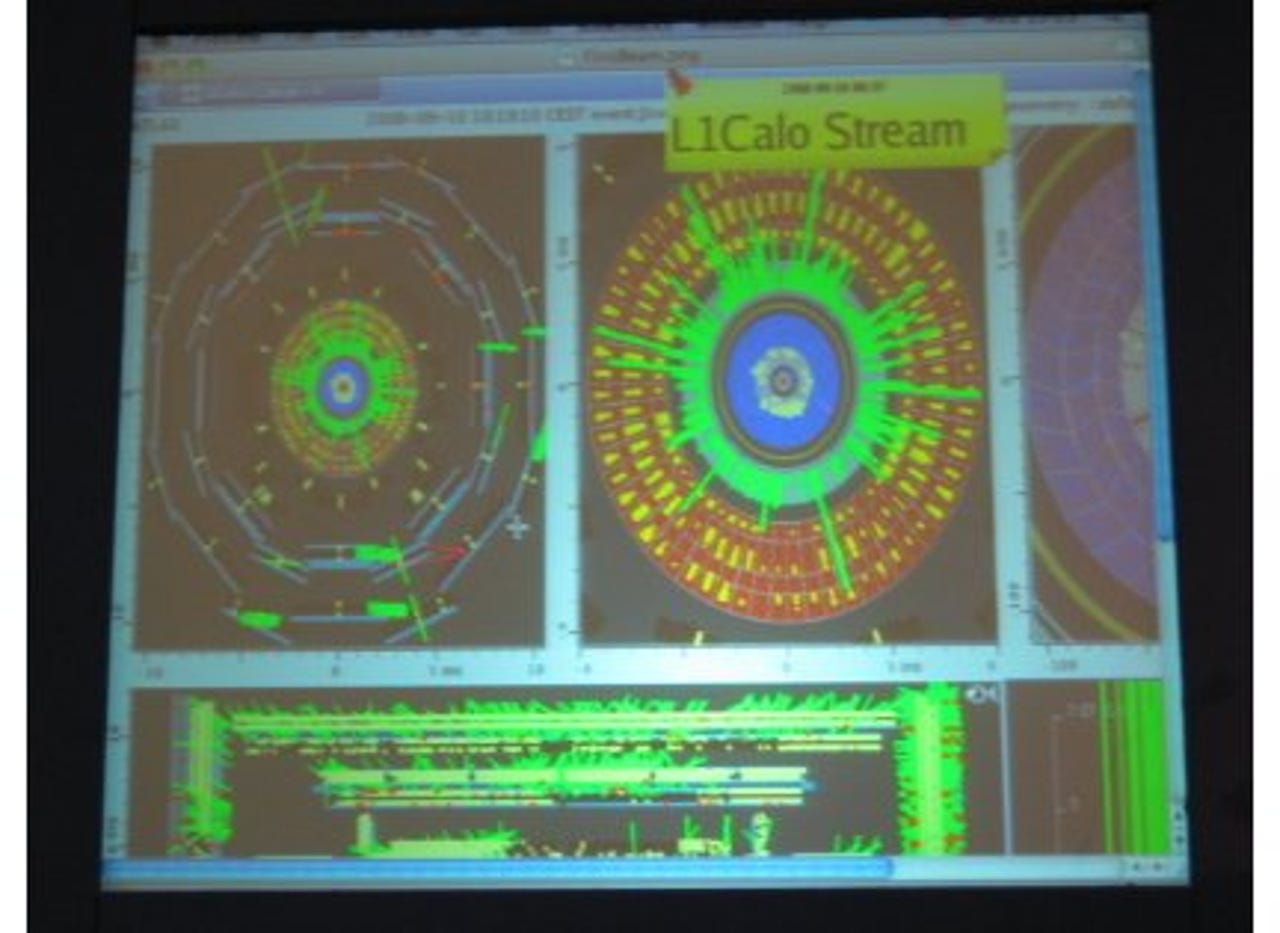
The new science resulting from this grand experiment will turn up in the coming weeks and months, but what Wednesday's event did prove was that the world's largest machine works. Part of that machine is the cathedral-sized Atlas detector, one of two general-purpose detectors (the other is the Compact Muon Solenoid, or CMS) in the LHC.
Atlas's development and construction benefited from a great amount of UK involvement, particularly that of the Science & Technology Facilities Council. Pictured above is the very first image from Atlas showing the particle beam passing through.
ZDNet.co.uk was at a Science & Technology Facilities Council event in Westminster to see, via video-link, the LHC being initiated. On the following pages are some initial reactions from those involved in Atlas and the wider LHC project.
Photos and text from ZDNet UK
"This is the first time [the LHC] has functioned as a single machine," Butterworth noted. He added that, although no new science as such came from Wednesday's events, the machine "shows a lot of cutting-edge technology, so in that sense it is a breakthrough".
"We'll probably be getting science out of this thing for 20 years," Butterworth said.
"We were all a bit apprehensive, but they got the first beam round in just under an hour," Barratt said. "We're now looking forward to the energy ramping up." He also added that it was "mind blowing" for particle physics to be getting the international exposure granted by coverage of the LHC.
The STFC will continue to fund the LHC through the UK's subscription to Cern and the funding of research scientists, Barratt said. "Once we start receiving the data [from the LHC], those guys need to sit down and start analyzing it," he said. "Maybe they will overturn the physics textbooks as they are at the moment — who knows?"
Sankey pointed out how the 20 years of development and preparation that had gone into the LHC continued right up until recently. "This has been a long time coming," he said. "Even last week, people were working in [the CMS detector]. They were working flat out up to this deadline, and it worked."
Imense is one company that has benefited from the UK's part of the greater grid, GridPP. A spin-off from Cambridge University, Imense has used the technology to develop its content-based image search systems, which they hope will catch on as a way to find images based on keywords, even from unannotated photographs. The company was helped in this by the STFC, which granted them use of one percent of GridPP.
Two representatives from the company were at Wednesday's event. Dr Chris Town (left) described the LHC initiation as "exciting", noting that all sorts of non-physics applications are possible on the grid. Dr David Sinclair (right) added that projects such as the LHC "generate people with the skill set we [in companies such as Imense] need."