Red Hat plans to do for OpenStack what it did for Linux

In 2002, Linux was on its way to becoming a major business operating system, but it wasn't there yet. Then, Red Hat dedicated itself to make Linux an enterprise operating system. Ten years later Red Hat was the first billion dollar pure play open-source company. Today, Red Hat announced a similar plan for the OpenStack cloud.
Just as with Linux, Red Hat knows there's no way it can make OpenStack the de facto cloud software of choice for the enterprise by itself. In a blog posting, Red Hat's OpenStack team wrote, “A huge community is contributing to OpenStack. More than 180 participating companies and 400 contributing developers have produced six software releases in just a little over two years. Some organizations will choose to leverage all that innovation directly by implementing, testing, patching and supporting community releases on their own.”
Others, such as Boris Renski of Mirantis, a major OpenStack system integrator, worry that new OpenStack member VMware will undermine OpenStack. Red Hat certainly has no love for VMware. In 2011, Red Hat declared VMware its biggest enemy. But, Red Hat isn't worried. It has faith both in OpenStack and its plan on how to turn it into a profitable business as well as great software.
In its OpenStack positioning statement, Red Hat doesn't address VMware or its other OpenStack frenemies by name. Instead, the Raleigh NC-based firm is taking the same tact as it did with Linux: It's emphasizing its open-source expertise.
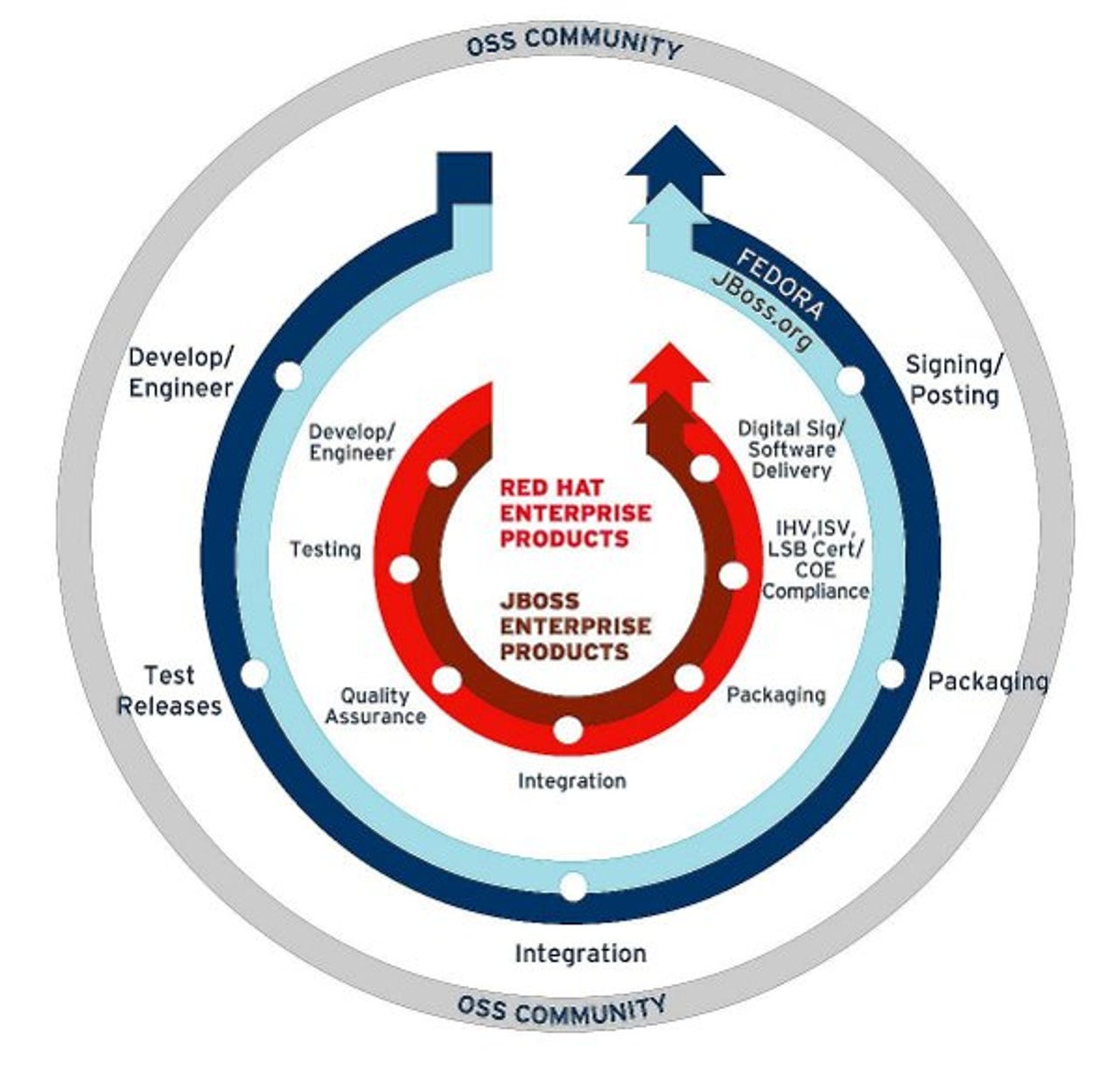
The team said: “Collaborating through upstream projects is at the heart of the economic and business model that makes open source such an effective way to develop software. Red Hat leverages the work done by vibrant open source communities such as OpenStack, thereby allowing our customers to take advantage of the work done by hundreds of companies and individual developers, not just Red Hat. However, working through communities isn't about just taking open source code and doing the downstream testing and hardening necessary to make it into a commercial product.”
They continued, “It's about participating in upstream communities as contributors and having a policy that drives code enhancements and fixes into the upstream. In many cases, Red Hat employees are among the key maintainers of and contributors to those upstream projects. This helps ensure that we take the greatest advantage of the strengths associated with open source development and that we maintain the technology expertise to provide fast and knowledgeable support to our customers.”
Specifically, ”Much of this work involves working closely with partners such as chip and system vendors. At a low level, take ACPI-based power management, for example. It's a hardware specification and interface for controlling the power consumption of a processor by offering mechanisms to dynamically change processor speed or to put processors in low power sleep states. Implementing such capabilities requires working with processor vendors such as Intel and AMD; system vendors such as IBM, HP and Dell who must decide how their systems designs and BIOSs support ACPI; and upstream Linux kernel maintainers to extend system schedulers and other subsystems as needed. While proprietary vendors work with partners as well, the level and scope of participation is often greatly enhanced with open source.”
For Red Hat, working with the hardware vendors and upstream software developers is just part of the story.
“Red Hat has a long history of working closely with technically sophisticated and demanding customers to improve Linux across a wide range of metrics such as scalability, real-time performance and security. … Increasingly, customers are not only involved with the process of developing the software on which they base their business. They’re driving the agenda.”
Sometimes this work isn't that exciting. There's not going to be “Oh shiny!” iPhone 5 moments. The statement continues: “Done properly, the outcome is somewhat boring -- systems that just work. Predictable behavior. A lack of exciting failures. Even a good night's sleep for system admins. That's good boring.”
Does that sound familiar to you? It sure does to me. It's exactly the same approach Red Hat took to making Red Hat Enterprise Linux (RHEL) the most popular business Linux in the world.
There are almost 200 companies trying to turn OpenStack into a commercial service and product. Even with VMware in the field, I wouldn't bet against Red Hat being the big OpenStack winner in the long run. Afterall, we know their approach worked perfectly when it came to Linux.
Related Stories:
- Red Hat finally commits to OpenStack for the cloud
- Concerns linger about corporate involvement in OpenStack Foundation
- Red Hat launches Hybrid IaaS, Cloud Bundles with one price per VM guest
- Microsoft, VMware and Amazon jockey for pole position in race to manage the cloud
- OpenStack's prospects: Red Hat, VMware agree to disagree