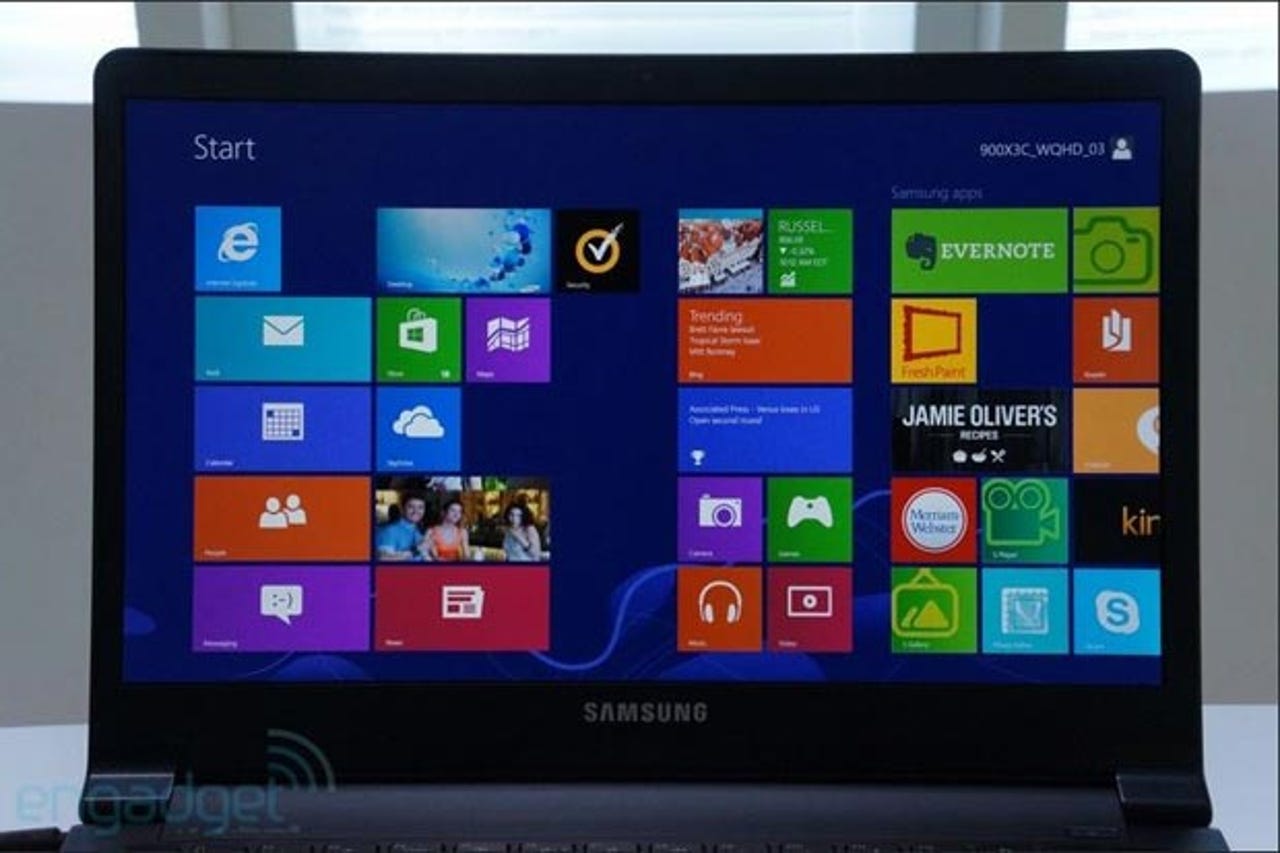
Samsung shows off Series 9 WQHD laptop with Retina Display-like resolution at IFA 2012

Summary: The prototype squeezes 2,560x1,440 resolution into a 13-inch display.

Even if you don't love Apple products, you might appreciate how its pixel-dense Retina Display technology has shaken up the market for mobile screens (and, eventually, desktop ones). You may not want an iPhone or the MacBook Pro with Retina Display, but Apple's promotion of the feature is spurring other companies to add similar technology to their product offerings.
A case in point is a new laptop prototype Samsung exhibited at the IFA 2012 trade show in Berlin this week. (More IFA 2012 news for Samsung can be found here.) Engadget spotted the Series 9 WQHD ultra-portable squeezing a very impressive 2,560x1,440 resolution into just a 13-inch screen.
That works out to be roughly the same pixels-per-inch that the 15-inch MacBook Pro with Retina Display offers, and is a significant improvement on the current Series 9's 1,600x900 resolution. Engadget also points out that the screen features "a gentle matte finish," though it's unclear how that specifically enhances the viewing experience.
The 13-inch Series 9 laptop already costs $1,200 and up, so you can imagine that an ultra-high-res screen would send that price even higher. While that is no comfort for people who don't want to drop $1,500 (i.e., most of us), it does continue a trend for higher-resolution screens, which will eventually trickle down as more of these displays are produced.
[Image: Engadget]
Kick off your day with ZDNet's daily email newsletter. It's the freshest tech news and opinion, served hot. Get it.
Talkback
Should be good...
However, getting my hands on them over the last month, the difference has become clear. Of course it isn't just pixel density that impresses, but also the depth of colour they can achieve in the 'how black is black' lcd arms race. At first the retina seemed a little dark, but ince i'd gotten used to it my macbook air and my desktop rig seemed washed out and dull despite both having excellent screen specs. If Samsung have managed to develop similar or better technologies, which history suggests they have the display on these machines should be excellent.
I wouldn't worry about haters, sure this article mentions Apple, and will attract the usual drones, but best not pander to them in the article; haters gonna hate after all. At the end of the day the current implementation of the tech is frankly excellent and it's awesome to see it spreading across platforms so quickly. Now i just need a Linux that can support it - my maths came in at a theoretical 14MP when this pixel density hits 27" screens... That's the max resoltuion of my DSLR ... Vector graphics for your wallpaper anyone?
I suspect the gentle matt finish refers to screen glare- a problem common to Gorilla style glass - as owners of macbook pros, imacs and a couple of Dells I've tried can attest. Again the Apple retina went sime way to address this, but there's still a way to go towards anti-glare in my mind. It'd be nice to see samsung implement this.
I wasn't initially sold either...
The best "laptop" ever
WTF is "retina display-like"
Apple has applied for a trademark...
And before you go all huffy, remember that many common words are trademarked (Dove, All, Windows, Mustang, Ivory, Cascade, Oracle, etc), as are many common phrases (Head and Shoulders, "But wait, there's more," Live Savers, Billy Joel [yep, that's a registered trademark]).
Sorry, you'll have to find some other trivial reason to hate Apple.
What????
Are you awake?
Typical mentalitly ....
Samsung may be a CONTRACT manufacturer, but Apple designed, engineered and licensed the technology for the retina display. Unless Samsung has a license for the technology, they are not allow to build anything with it except as contracted with Apple.
It is like having Foxconn build a GBox ... using Microsofts design for the XBox.
Retina designed and engineered by Apple?
Its not the same
What A Pity The “Tiles” Interface Can’t Take Advantage Of The Resolution
The only OS in common use that can take proper advantage of 320dpi and 480dpi screen pixel densities is Android.
I'm with you... To a point...
The second part i don't get... Did you mean PPI? In which case there are no 480 PPI; to the best of my knowledge the highest densitie achieved was by LG around 330 PPI. Although Samsung is looking to push towards 350 when the S3 is replaced if rumours are to be beleived.
As for android being the only OS that can use these densities... Really? OS X, iOS, Windows 8 are already being configured for these densities, and the major linux desktops are all expected to start adding support in the next release cycle.
Also android would look appalling on these screens; as a mobile device OS it just isn't designed to handle the shear number of pixels on this screen, or it's 13" size, let alone the desktop experience. If you want to hate on the closed source OS, or just use Linux on a desktop do it right - use GNU/Linux.
Even on the mobile platform I'm struggling to think of a feature in Android that makes it better suited to high densities than it's rivals WM7 and iOS 5; both handle and are designed for such densities, and all three look frankly awesome if you focus soley on clarity of icons, text, images, media and effects, which is what pixel density is about.
Re: Pixel Density/PPI
Android already has support for 480dpi-nominal screens--see the XXHIGH constant here http://developer.android.com/reference/android/util/DisplayMetrics.html
Yes fall res' will be higher.
I still can't see a feature of android that makes it better suited to high density screens than any other OS designed for such displays?
This article was about 13" laptop displays, and once again android is not better than Windows, OS X, or linux on this platform... After all you have to add in pointer support for starters.
Re: I still can't see a feature of android that makes it better suited...
"Android takes screen pixel densities into account"
Re: What makes you think other sane OS do not do this?
Of course they can trademark?
The importance for them behind trademarking the brand name retina is that there is no fixed pixel density at apple; the IPhone has a density of 326, whilst this years iPad gets 264 and the retina MBP 220.5. The official reasoning it that you use these devices at different distances from the eye, so varying densities are requires to achieve the "invisable pixel" goal. Of course this also saves on production cost and increases supply production on larger screens.
In terms of the trademarking and apple tech, this doesn't inhibit others from making their own solutions. For example this Samsung laptop actually beats the retina MBP at 221 PPI, but uses different design to achieve it, so it isn't retina.
Samsung have also hinted that their latest ultra high def tech designs may be able to achieve the 350 PPI density milestone on their next mobile devices; higher than the current iPhone.
High Resolution Desktop Screen
That way, Windows 8's blurry fonts won't bug me so much.