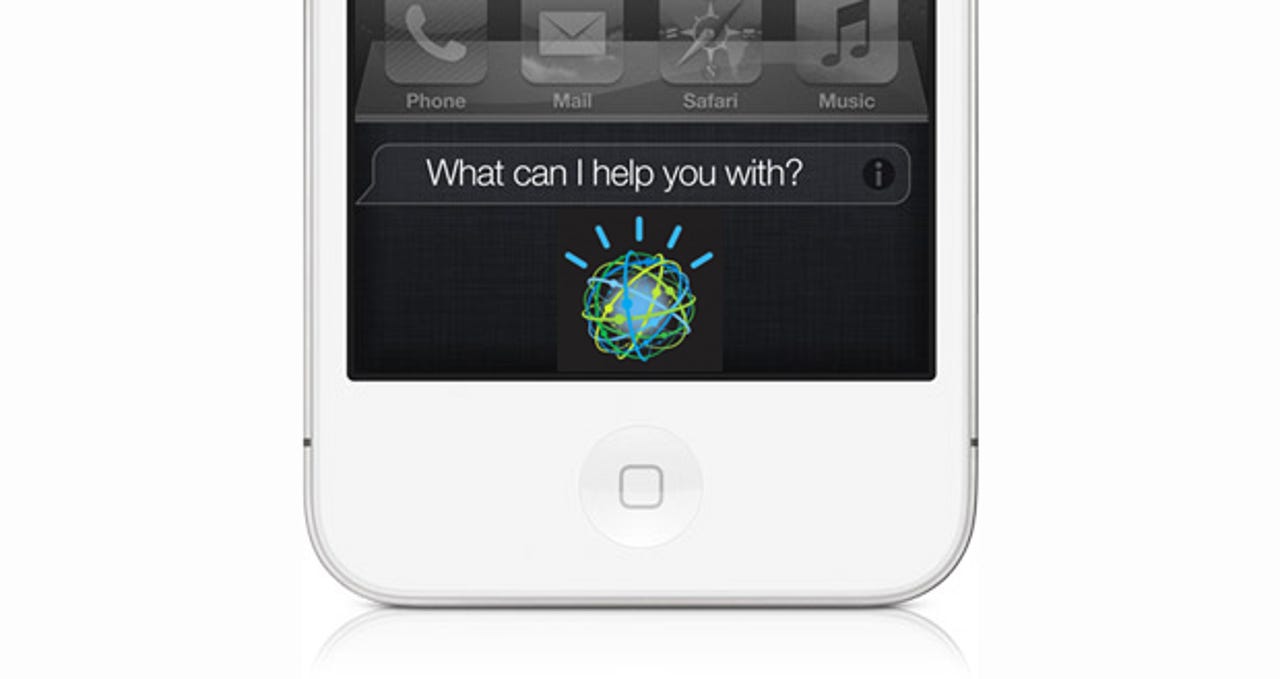
Siri stumped? Call Watson

Summary: Compared to Apple's Siri, IBM's Watson is a speech recognition genius. But the tech is too big and powerful to cram into a mobile device. That's about to change.

Compared to Apple's Siri speech-activated personal assistant, IBM's Watson is a genius.
Zooey Deschanel might ask Siri, "Is that rain?"
She might ask Watson, "Who's the author that wrote, 'It was a dark and stormy night'?"
(Edward Bulwer-Lytton, for the literary-minded among you.)
Until now, Watson's tech has been too big to cram into a mobile device. All those smarts takes a room full of servers, an incredible amount of calculations and a thick wire into the electrical mains.
That's about to change.
The power consumption behind Watson's performance is "dropping like a stone," IBM's Bernie Meyerson told Bloomberg, and that means Watson 2.0 may be mobile-ready.
(Don't get your polysilicon in a twist just yet, Siri.)
That's a big deal for IBM, which has been using Watson's brains to crunch huge datasets for financial services firms (e.g. Citigroup) and healthcare groups (WellPoint) alike. It's also a big deal for Nuance, the company behind Siri's speech recognition abilities, which also happens to own and license several IBM patents related to it.
But how and where the companies will meet is unclear. IBM has always targeted the enterprise; Nuance has played both sides but is popular with consumers, thanks to the iPhone. IBM needs more "senses" to play ball, and Siri could use more brains.
The most obvious place these two sets of technologies converge? The workplace. The consumerization of the enterprise is well underway, and the most obvious place where those collide -- your brought-from-home mobile device that you use for work and play -- is already in your pocket.
"Siri, how many ZDNet readers unsubscribed from our newsletters, on average, over the last 18 months?
"Siri, how's our EBITDA looking? Are we on track?"
Or if you're in healthcare: "Siri, what are the pros and cons of patient 67 taking tigecycline?"
Or if you're in the public sector: "Siri, which intersections have had the most collisions in the last six months?"
You get the point. We're still several years off from Watson-on-the-go, but the possibilities are tantalizing. The business implications? Even better.
Kick off your day with ZDNet's daily email newsletter. It's the freshest tech news and opinion, served hot. Get it.
Talkback
Jump from Siri to Watson?
Trying to figure out what 1+1 equals and your 6 month old baby is stumped? Call Stephen Hawkins.
Siri is widely renowned as a joke. It is the worst of all the voice assistants out there.
http://www.talkandroid.com/122651-heres-another-hilarious-siri-vs-google-voice-search-video-is-that-a-scallion-or-a-stallion/
Oh, but that's okay, Siri is beta and Apple makes that really clear in all of their celebrity TV ads.
Oh wait, no, they don't.
Widely renowned as a joke?
Siri is hardly the worst of all of the voice assistants out there, not by any stretch. I have no issues with it on a jailbroken iPhone 4... the ones for Android Gingerbread and below are crap. The ones for ICS or JB might be better but as I'm STILL waiting for the promised ICS upgrade on my HTC TBolt I could not tell you for sure.
Yes, Siri is a joke
Google gets top marks in every comparison. Even MS's alternatives have been proven to be far superior in head to head tests.
Toddy...such bold, unsourced, blanket statements
It's not that I doubt your sincerity, but, it would be nice to see a link to some credible source backing up these statements. Specifically....which tests...by which credible source showed that Apple fabricated their Siri ads. And...which head to head tests showed that currently shipping MS products are far superior to Siri.
And, please...don't cite an Android fan page as a credible source like you did yesterday. Seriously!
I wait in anxious expectation.
Weren't you the one....
1+1
ln[lim┬(n→∞)〖(1+1/n)^n 〗 ]+(sin^2x+cos^2x) =∑_(n=0)^∞ cosh y〖√(1-tanh^2〖y 〗 )〗/2^n
I can't write this as it would appear from the Ms Word equation editor here, so to get the whole story visit the link. (That is how it is translated above from Ms Word's equation Editor)
http://www.aoc.nrao.edu/~ckutz/Engineering%20Procedur1.pdf
Since he brought it up, I had to chime in. The one I have is a reprint from Rutgers Engineer 1985.
siri loves stallions
Siri, how many ZDNet readers unsubscribed from our newsletters...
I wonder who I should be subscribing too... :-\
ROTFLMAO!!!!
You are like soooo funny!
Get real. You think this is bad? Go give BGR a ride.
Who to suscribe too [sic]?
BTW, in 1987, in the Dark Ages, the British series Star Cops http://en.wikipedia.org/wiki/Star_Cops had a verbal computer interface called, and resembling, a "Box." It went off into databases and brought back information for the lead Star Cop: prior art to Siri, perhaps grounds for a nice lawsuit against Apple?
Pot, Kettle,
Cute reference, but ...
Not necessarily
When it became possible to do, it was not patentable because it was no longer an "original idea", having become a standard trope of both SF and engineering discussion.
Im fine with it taking up a room full of server as long as I can
hey, Johnny
Fine?
But nothing prevents you from having an Watson in your basement. :)
Where is the watson app???
What about understanding pronunciation of non english speakers?
If Watson is likely to be so intelligent, I would like to see it understanding english pronunciation of non-english speakers.
Not just non-English speakers
Your 'Agent'
As agents like SIRI get smarter and acquire more knowledge about you, and about everyone in your address book, and about every store, product, credit card; every trip taken, movie seen, meeting held, you will be able to assign your agent much more complex tasks that will be carried out beyond your immediate oversight. For instance, if you are having a dinner party, you might 'discuss' with your agent who you would like to attend, what you would like to serve, where and when the party is to occur. Your agent would then compose invitations, send them, follow up with those of your friends and associates known to be absent minded, order the groceries and have them delivered, remembering of course to get the propane bottle for the grill refilled if it is low. This is vastly greater degree of delegation than saying something like, "Move that meeting to Monday afternoon". And this greater scope and duration of delegation to one's agent will change the relationship between user and agent very significantly.
Today, we think of agents as an extension of the user interface to our devices and cloud platforms, or perhaps as some appliance like functionality within our phone. As agents get smarter and more knowledgable, and as we delegate more complex, longer duration tasks that are not carried out "in front of us", agents will subtly change from interfaces and appliances into servants / assistants / "employees". The more sophisticated agent will necessarily "come to the user" with questions that come up during the execution of an extended task and effectively "demand" answers from the user in order to proceed. The user will at some point need to give their agent "annual reviews" so that 1) the agent's performance can be tuned to better meet the user's needs and desires, and 2) to determine if the agent is to be "promoted" to higher levels of function and independent responsibility - something that may well incurr higher "fees" from the services provider. In other words, the agent will from time to time ask for a promotion and a raise.
As this technology progresses, the role of "user" will look more and more like that of "boss". And to get the best performance from your agent, you will need to start thinking and acting like a boss, a good boss. And the world will never be quite the same after that.