Telstra 'blackmail' taints NBN vote: Hackett

Political pressure to progress the NBN and lack of clarity about Telstra's commitment to structural separation will make next week's shareholder vote a meaningless exercise that will result in either substandard structural separation or disastrous delays to the NBN, Internode managing director Simon Hackett has warned in an attack on the government and what he says is a duplicitous Telstra board.
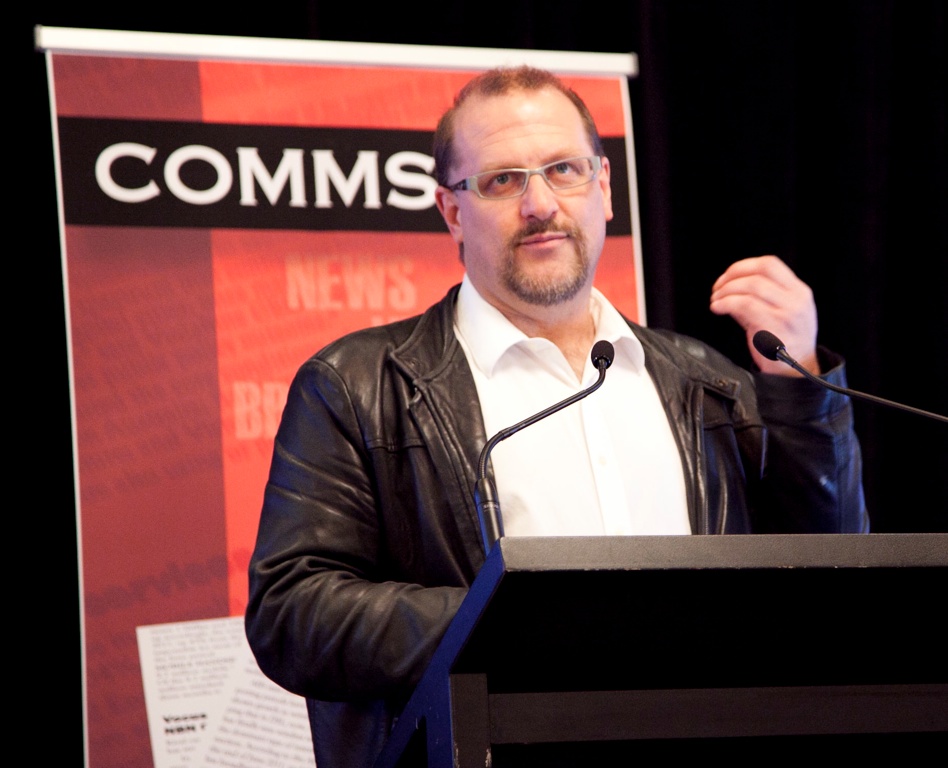
Simon Hackett
(Credit: David Braue/ZDNet Australia)
Addressing the 160-strong audience of telecoms industry heavyweights at the CommsDay Melbourne Summit yesterday, Hackett didn't mince his words in discussing Telstra's structural separation undertaking (SSU) document, which was lodged in early form and promptly rejected by the ACCC and Telstra's rivals as being inadequate.
As currently written, the SSU "is one of those unusual documents because it doesn't actually explain how Telstra undertakes to structurally separate", Hackett said. "It undertakes to explain how they don't need to, because they're really nice people and you can trust them. It's rather like trying to sell two-minute noodles on the basis that they taste good."
In this form the SSU had become a "form of blackmail" designed to pressure the government to accept substandard terms in exchange for a green light to proceed with the already-delayed project.
Because the SSU must also be accepted by regulators for the NBN to proceed, Hackett said next week's vote — at which Telstra shareholders will decide whether to accept the draft SSU as part of a broader policy package that also includes the company's $11 billion deal with NBN Co — was a toothless tiger that should rightfully have been delayed until after the SSU had been finalised and accepted by the government.
Should the SSU be modified to mollify the government, Hackett said, the deal would have to be re-presented to shareholders for approval — a process that could delay the NBN for a further six to nine months. "The Telstra board have the authority for the current undertaking, not a modified one," he explained.
"Think about this in the context of the current, flawed SSU and the pressure that would go onto the regulator: if the vote passes, the regulator would be the last barrier to the NBN existing. If and only if they decide to accept that flawed undertaking [it could proceed]; otherwise, imagine a world where they have to submit a massively modified SSU, we'd have to go around this merry-go-round again. But I don't think the current government really want the network to wait another six to nine months."
The warning came as part of a larger spray against the NBN, in which Hackett argued that the government had made three significant mistakes in its approach to the NBN.
First was the 121 points of interconnect (POI) model, against which Hackett has frequently railed as raising the cost of NBN access for retail service providers (RSPs) seeking to offer their services. "All the overheads to attack to the network rise and instead of 14 'X' I'm facing a cost of 121 'X' — whatever 'X' [the base cost of connecting] is," he explained. "NBN Co have done their part to reduce 'X', but I've still got to get to those places."
These sorts of policies had created a situation where RSPs would have to charge regional customers more to cover their costs while cutting prices in high-competition city areas. "No provider that we expect to see in the next 10 years can just average this stuff out," Hackett said. "If you want to win in the city in what will become a brutally cost-based game, you can't just squeeze this cost out and expect it to go away."
Hackett also slammed the government for allowing Telstra to retain ownership of the network in its $11 billion deal, creating a situation where the government had no option to adopt a partial fibre-to-the-node solution should future cost pressures force the government of the day to scale back the extent of the fibre NBN.
"Telstra aren't being paid to sell it to NBN Co, but are just being paid as a farmer would to stop using it to grow crops," he said. "But imagine there's another serious GFC and the government of either persuasion needs to chop half the cost out. You've got to cut the copper and reterminate the cabinets — but you can't compel Telstra to do that. You've paid them to turn the copper off but you have not gained the right to cut it in two."
With so much focus on getting the NBN Co-Telstra deal and SSU across the line, Hackett expressed concern that the everyday cost issues would seriously complicate cost dynamics in the years while the NBN was being rolled out. "The regulator is quite time-strapped and is focusing, perhaps correctly, on the big shiny thing. But it seems there is insufficient attention being paid to surviving the next 10 years, and to there being competitors left on the copper network by the time the NBN rolls around."
Hackett wasn't only about problems, however; he offered three suggestions that he argued would change the situation for the better. These included reversing the 121 POI decision and proceeding with a 14 POI model; having the ACCC declare bundles of ADSL2+ and voice services, which would stop Telstra from fudging its fixed wholesale numbers to rort providers in intervening years; and change the NBN deal so the government would get ownership of the copper rather than the current problematic situation.
"If you can define the price of access to the copper and make it equal to the price of the NBN regime, we can actually have a smooth transition and still have a competitive environment by the time we get there," he said.