The Chromebook -- it's like an iPad, but with a keyboard

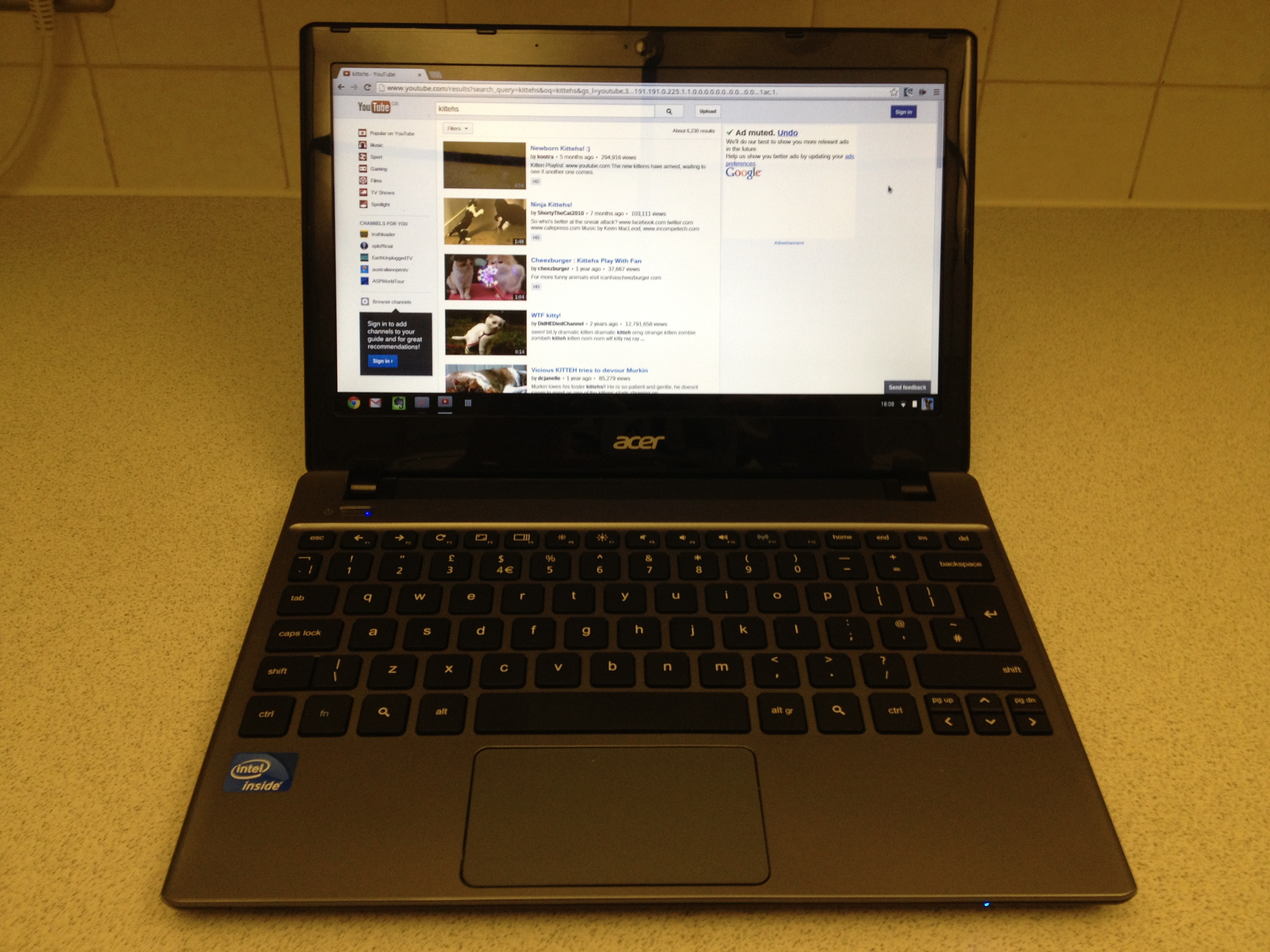
A couple of weeks ago I wrote a piece where I wondered whether Surface RT was essentially just a differently-done Chromebook. At the time I'd never tried using a Chromebook, and it seemed churlish of me to say such a thing without actually trying it. So I bought a Chromebook.
I wanted to get one of the Samsung ARM-based Chromebooks, but for some reason these seem to be in very short supply. More or less at random I bought an Acer C7 Chromebook. Well, I say at random, what I did was buy the cheapest one I could because I was presupposed to assume it would be pretty naff and I wanted to limit my exposure.
I rarely write reviews of products that I am really, really smitten by. So stand by, because the Chromebook is fantastic.
Um… it's amazing
I really wasn't expecting it to be any good. A couple of years ago I had one of the first ones on order, but cancelled it as I although I was keen to know what it was like the whole premise seemed stupid. Who would want a laptop computer that only ran a web browser and that always needs an internet connection?
This then is the entire Chromebook proposition. It's just a web browser. The Acer I bought has 16GB of storage (which is a lot, considering in principle you never store anything locally), and 2GB of RAM. When you boot it up for the first time it takes you through getting a network connection going and it then asks you to log into your Google account. This I duly did, and then Google texted me with my two-factor code and I was in. As I happen to use Chrome on my Mac, all of my favourites, apps, etc just appeared on the Chromebook.
That night I spent about three hours using it. I wrote an article using Google Docs, spent some time on TweetDeck, and mucked around with a few other things. The next day I was desperate to use it rather than my Mac and did some more work on articles in Google Docs.
Personally, I feel the only way to judge technology is sense whether or not it makes you feel comfortable and whether you unconsciously bias your selection of it rather than something else. (For example, a year ago I bought a Lumia 800 to try and hated using it so much I would rather stare bored at a blank wall than pick it up. That told me a lot about how I felt about it.)
The Chromebook gave me a sense of joy and of freedom that I haven't for many years using a computing device. In fact, the last time I felt like this about a piece of technology was when I took delivery of my version 1 iPad.
But why? It's just a web browser.
Simplicity
Precisely. It's just a web browser.
Let's talk about the iPad, because the Chromebook and the iPad are on many levels the same sort of proposition. People are often critical of the iPad because they say that it "doesn't do enough". And sure, the iPad doesn't do very much. However, people often tend to look at computing devices on a continuum where you have "limited and restricted" at one end and "complex and configurable" at the other end. There is a common presupposition in the typical technologist's mindset that one of these is bad, and one of these is good. Spoiler: technologists like complexity.
But people who aren't technologists like simplicity. And this is why the iPad sells so well in domestic settings, and also why enterprises are starting to like them. Post-PC devices -- and I'm classing the Chromebook as one of those -- are boneheaded, simple, basic, and they don't go wrong and don't cause problems.
This is one of the hallmarks of the post-PC age. Simplicity is lauded above complexity and configurability. Yes, a PC is massively configurable and flexible. And now I'm reflecting on the fact that this evening I have to try and help my father upgrade his trial version of Office 2013 to a full version. The upgrade doesn't work because he has a 32-bit version of one and a 64-bit version of the other. (I think -- that's what I've managed to grok from the error message he read out to me over the phone.) That complexity doesn't help him, and it doesn't help me. At this point, I would rather he just had a Chromebook and was done with it.
Read: The lure of the tablet -- no intimidation
Or indeed, an iPad. But then he'd need a keyboard, and an iPad and a keyboard is not necessarily a good mating. It works, but the iPad is not designed for that mode of operation. Personally I think the bigger problem with running an iPad with a keyboard is that you don't have a mouse. With a Chromebook you get a keyboard, and a mouse. At one point last week I was running it with an external keyboard and in a dual monitor set-up using the HDMI port. It was just like a PC but not.
That then is my point. Yes, Chromebook doesn't have the rich set of native apps available that the iPad does. Nor can it playback the locked-in content from the iTunes ecosystem. But what Apple has always done is pick a job and do that one thing well. Chromebook also does that -- it's a laptop that does nothing but run a very good web browser. In a good number of significant ways, if you have a desire for an "iPad with a keyboard", Chromebook is it.
Conclusion
Chromebook is a great idea. It's beautifully executed, dirt cheap, and a total joy to use. But would I actually ever recommend that anyone buy one as opposed to a cheap Windows laptop?
I think I might. Gartner put out a release this week that really resonated with me. The release talks about a structural shift in the PC market. In it one of the Gartner analysts states "Whereas as once we imagined a world in which individual users would have both a PC and a tablet as personal devices, we increasingly suspect that most individuals will shift consumption activity to a personal tablet, and perform creative and administrative tasks on a shared PC. There will be some individuals who retain both, but we believe they will be exception and not the norm."
Read: Windows 8 failed to kick-start PC market
Imagine a typical domestic environment in a few years. That might be a husband, wife, and a couple of kids. Each individual has their own smartphone, their own tablet, plus one shared Chromebook for what Gartner calls "creative tasks". (For what it's worth, I think the split between "creative" and "consumptive" uses of computing devices is artificial, but that's for another day and I'll let it pass.)
The question is then, does Chromebook fit the role of a "shared PC". The one I bought is £200 in the UK, and about $230 in the US. The average selling price (ASP) of a Windows PC is, currently, $420. That Chromebook is way cheaper. And does that family need the complexity of Windows in the computer that they share? I would wager they do not, although they might be presupposed to think that they did.
I can actually see that arrangement working really well. There's a symmetry too -- both classes of devices in that domestic arrangement are simple, ubiquitous computing-style devices.
Certainly there's nothing the Chromebook is doing wrong that stops that model from happening. Bring it on.
What do you think? Post a comment, or talk to me on Twitter: @mbrit.