The Higgs boson: Why should we care?

Summary: The scientific community is cock-a-hoop over CERN's discovery of a something that looks like the Higgs boson. But why? And what does it help us understand?
The Higgs boson — or at least, a boson "consistent with" it — has been found. The question now is: why should we care?
Well, the Higgs boson is predicted by the Standard Model of particle physics. This model explains the physics of the atom and the nucleus. Lots of weird little zippy particles (quarks and Z particles, for instance) predicted by the model have been found, which made it seem reasonably reliable.
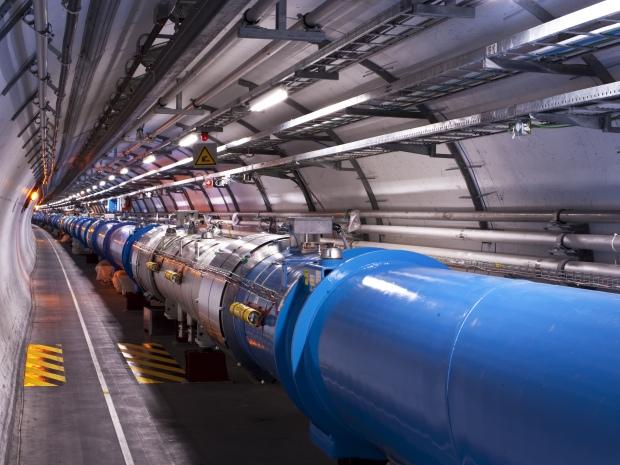
Scientists have identified the Higgs boson using the Large Hadron Collider at CERN. Image credit: CERNSo physicists would be very annoyed if something as big as the Higgs boson were to pull the rug out from under the whole thing by failing to exist.
Another reason for CERN's celebrations is that it was hard to find. That's because it is so big. For a particle.
Thanks to Einstein, we know that mass and energy are the same thing, and the Higgs is a very high-energy particle indeed. It was, in fact, lurking somewhere between 125GeV and 126GeV on the energy spectrum. Top quarks are very massive particles, clocking in at 172GeV — around the same as an atom of Tungsten. By contrast, the humble photon has an energy of the order of a single electron volt, effectively having zero mass.
Large particles are unstable, decaying quickly into smaller particles. This means that any naturally occurring Higgs bosons would have decayed long, long ago, before there even were galaxies to be far, far away.
It also means that it is not the Higgs itself that physicists are looking for, but the products of its decay. In the case of the top quark, these smaller particles are mostly the bottom quark, but also the strange and down quarks. The Higgs boson should decay almost immediately into some combination of electrons and hadrons, and it is these energetic traces that scientists went looking for.
A very energetic explosion
To find something so big, particle physicists needed to make a very energetic explosion. So they built the Large Hadron Collider at CERN. This is a monumentally powerful particle accelerator, capable of creating the kinds of collisions between proton beams that might just produce a few stray Higgs bosons, which would then decay in a tell-tale way.
What does the Higgs boson do? Mostly, it provides evidence of the Higgs field. This was an idea put forward by Professor Peter Higgs to explain why matter has mass. Conceptually, it is like a sticky gluey jelly that permeates the whole of the universe. The strength of a particle's interaction with the Higgs field determines its mass.
All elementary particles are either bosons or fermions. A fermion is something like an electron, and is generally associated with matter. A boson, in general, is a force-carrying particle that mediates a field. (In my nuclear physics classes, fermions were described to me as being like tigers [I confess, I have forgotten why], while bosons were like cattle, always being in a field. Har har.) For example, photons are the force carriers that mediate the electromagnetic field.
So a Higgs boson is the force-carrying particle, or smallest excitation possible, of the Higgs field. Find it, and we prove the existence of the Higgs field, and thus the completeness (almost) of the standard model of physics.
Beyond this, it gets trickier. The trouble with answering the 'Why we should care?' question is that the reason we should care is almost as inexplicable as the physics itself. It confirms the standard model. It means we don't have to go back to the drawing board and start again.
The impact of the discovery for the Average Joe is not going to be huge. It is massive for physics, because it is an extra fact. And there is nothing scientists like more than an extra fact.
Kick off your day with ZDNet's daily email newsletter. It's the freshest tech news and opinion, served hot. Get it.
Talkback
Gravity not due to any Higgs field
You studied physics for a whole couple years?
Keep practicing :)
PS. I wonder if it's too late to change my name to "emmeffer"?
Reply
Thanks
The Higgs boson: Why should we care?
Do not take that the wrong way, I am in support of science for the sake of science and general knowledge but the tech writers I've seen have done a very poor job of letting readers know how it may impact their lives. It's almost like the news we have discivered planets that may have life, intresting to be sure but not something that means much to the vast majority.
I'm sure that the vast majority would be very interested in alien life
Real world applications?
(I'm guessing Higgs himself is feeling pretty pleased, too.)
But the average person buying a skinny latte is probably not going to have his or her world rocked by the discovery any time soon.
Lucy
The Higgs boson: Why should we care? The Higgs boson: Why should we care?
The Journey
This is why people discuss things you do not quite understand. The ideas are out of your reach. You *try* to understand them....
Suddenly you accept the "facts"...you *know* nothing.
You missed The Journey.
[Words of wisdom from Grand Theft Auto IV]
Man I wish we could edit our posts
ok
Bazinga!
Better analogy, please.
Plunging something into jelly does not make it heavy. I makes it stickey. I know. I tried it once.
Would some bright, aspiring physicist please offer up some description of the nature of the interaction between a particle and the Higgs field that yields the properties (inertia, gravitational attraction, increase of apparent mass with increasing relative velocity...) that one associates with mass... Jelly ain't ever going to cut it.
Dunno
you're at the wrong place
Why should we are?
Will the Higgs field matter?
The question is not answered
It explains the reasoning behind the experiment - to prove a theory.
For me there must be something valuable in this knowledge - millions of dollars worth of LHC building to prove a theory - but how can this knowledge change the world? Where can this knowledge be applied to useful technologies that will improve the human race as a species? This is a large investment with seemingly very little return in terms of advancement in technology or quality of life. What can the LHC be used for now? We seem to have the answer, so where do we go from here??? What does it mean - anyone???
Patience
This is similar in scale to the discovery of the electon and the transistor.
We look back at those findings and the technology that it has created in amazement and wonder - I do anyway.
I guarantee that generations will look back in a similar way reagrding this discovery. We should care because it is further understanding and knowledge of how the universe and everything in it works.