The M-word that's Linux's curse
Summary: No, it's not Microsoft — it's marketing and the Linux and open-source world's failure to take it sufficiently seriously, says Dmitry Kaglik
The development of the live session is major Linux achievement, yet it also embodies the shortcomings of the open-source community when it comes to marketing its software, says Dmitry Kaglik.
Klaus Knopper is a great man. Who could argue with that? He brought into the Linux world the very thing that everyone uses and appreciates: the live session.
Live session is a way to run a Linux or BSD distribution from a CD or, more recently, from a DVD or USB drive. It makes you independent of the data on the hard disk — technically, the computer need have no hard drive at all.
Many GNU/Linux and even BSD distributions nowadays offer live versions. Most teams actually only produce a live image with an option to install. Very few still provide only the installation ISO image. Some still have separate live and install images, but usually the live disk can be used for installation as well.
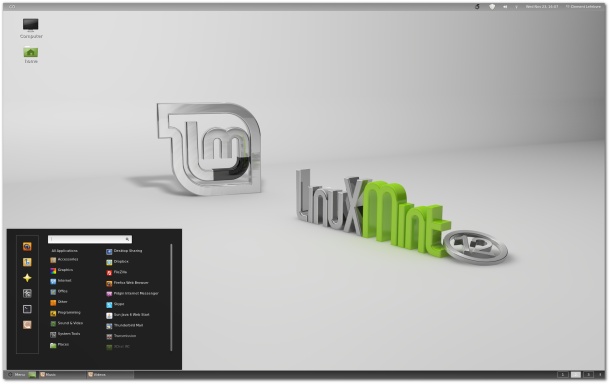
Can Linux and all its various distributions get better at marketing itself?
It's worth mentioning that there's a separate category of distributions that are solely intended for live usage, and not for hard-drive installation. For those distributions, such as Knoppix, Slax, Puppy Linux, and Porteus, the intention is to provide a free-standing, independent live system. Even if there is a way to install the operating system on the hard drive, that is not the real purpose of these distributions.
But let's come back to the teams who produce live images intended for a future installation. What is the purpose of the live disk in this case?
- It's a business card.
- It's a free trial offer.
- It's a shopping window.
- It's a point of sale.
- It's the place where user sees the system for the first time.
It's good if the user already has a firm intention to pass quickly through the live session and start the installation process. No problems, in that case. The details of the live system are not the relevant issue.
But what if the user wants to play with a live system before the installation? What if he or she wants to check hardware compatibility? What if he or she wants to check for the existence of some favourite applications in the repositories?
Then the distribution team has a problem. There's a good chance the user will see issues that arise only in the live session itself. These issues could be unpolished integration of applications, non-functioning search in the package manager, or a non-working wireless internet connection.
Put yourself in the shoes of a newbie user, whose thinking may go something like this: "The issues in this Linux distribution are just too annoying. I'm not sure I want to waste my time finding a way to fix them myself, even if I could. I'd have to look in the forums and wikis and I don't want to do that. Plus those ugly wallpapers I see now on my desktop?
"There are also other distributions that people say are more user friendly, which I'd better check out. Or perhaps I'd better stick to my good old Microsoft Windows. At least it works, and I know how to use it."
Are these the thoughts a distribution team wants to provoke in a potential user? I bet not. They want their system to be appreciated and popular. But they need to deserve that popularity first. So the software needs to be:
- User friendly
- Polished
- Bug free
- Cute
So distribution teams need to make more efforts to get the user to install their operating system, making it something that is good enough to actively sell their product. They need to remember that whatever is in the installed version, it is not relevant until the user loads it. Until then, only the live CD is speaking for the distribution.
Yes, this is marketing. Marketing doesn't always sit that comfortably with the spirit of open source and freedom, but it's something that is severely lacking in the Linux world. Perhaps it's the weakness that goes some way to explaining why Linux struggles to overcome the psychological barrier of five to 10 percent of usage on desktops.
Dmitry Kaglik, who goes online by the name DarkDuck, is author and owner of Linux Notes from DarkDuck, a blog dedicated to Linux and everything around it.
Kick off your day with ZDNet's daily email newsletter. It's the freshest tech news and opinion, served hot. Get it.

Talkback
Also, the reason Linux struggles on desktops is Microsoft's relationship with OEM's. Windows is not always hardware-compatible, bug-free or even polished or cute, but everybody has to adapt because it's on every PC, from Argos to PC World. That's the reason. FUD marketing and exploitation of their monopoly. Windows 2? Windows ME? Windows Vista?
The fact is, Linux use (not just desktop) has grown at an incredible rate. More and more companies and governments are switching - and on desktop too. I don't think Linux desktop is struggling at all. It's thriving. When it was born in the early 90's, there was only Windows, worldwide. Even if Linux is on 1% of the billion PC's in the world, that is still a phenomenal amount, considering there has been very little marketing.
The strength of Linux is in it's actual strength. Not a percieved strength created by a marketing team (or percieved weakness created by a Windows "Get the Facts" marketing team).
Please make your articles more accurate and actually about something in the future...
> When it was born in the early 90's, there was only Windows, worldwide.
Not true, as a matter of fact. Rivals to Windows included IBM's OS/2 (backed with hundreds of millions of dollars in anti-Microsoft marketing), DR GEM (which also ran on Motorola chips), DesqView, numerous versions of Unix (Xenix, PC IX, BSD, Sun SVR4 etc), and several rival systems running Motorola 68xxx chips such as Apple, Atari, Commodore Amiga and Sinclair QL.
Initially, most PC OEMs chose not to pre-install Windows 3. They adopted it because Windows PCs sold well: they were what people wanted to buy at a price they could afford.
Obviously, many companies have tried to sell PCs with Linux pre-installed. This included VA Linux, which in December 1999 had the stock symbol LNUX and the most successful tech IPO of all time. http://www.forbes.com/1999/05/03/feat.html
I'm not totally convinced that making it onto 1% of desktops in 20 years is a great result, given the unrelenting pro-Linux/anti-Microsoft hype. YMMV.
1% desktops running Linux is an achievement all things considered, just like Mac's 9%.
Linux, despite being mature and robust, does struggle to gain acceptance, or even exposure, for a considerable number of reasons which I do not propose to enumerate here.
The bottom line is that Linux, like any other product, does need to be professionally marketed if it is to gain wider support and market share. Unlike Windows and Apple, Linux is almost unknown to the average computer user. No-one whom I have introduced to Linux had ever heard of it before.
I think general perception is that its not quite there yet....but those who use it daily find it perfectly adequate! Its just getting the people to jump in the first place....
I would be very interested in some facts and figures for Linux use in the non desktop environment.
Linux might need marketing if it wasn't evolving all the time, fuelled by scientific, business, and humanist ideologies, hammered on the anvil of a myriad feudal communities. And if people could just shut up about it once they've discovered it!
But it is, and so it doesn't.
These students are graduating without fear of Linux, and are doing the promotional work for it's acceptance.
But the school has to promote the use of Linux to other faculties, as a way for students to cut costs. Therefore, while MS is the laptop standard, a tested Linux distribution could be made available for the schools.
In fact, I would say that there is no Linux distribution that I have encountered that is oriented to students in public, private, college or universities.
By the way dear school administrators, there are free packages geared to school administration, from finance, time and attendance, inventory, teacher assignments, and student information (family, next of kin, allergies, locker, lock id, courses, marks, etc. etc.)
The comments are all good, but missing something.
A Live DVD of Mint is the best way to rescue a hosed Windows PC.
It's also invaluable when you need to use someone else's Windows PC to do online banking, retirement or purchasing in a totally secure environment. They only take a few minutes to boot up and run very fast on modern hardware, seeming almost like an installed OS. I would recommend Linux Mint 13 which also can be set up on a bootable flash drive. If you are trying to access files on a Windows drive and get an access error, you can right click the drive or folder and select "Open as Administrator". The background will change color to show that you are accessing restricted files. Once you close the Window, it will revert back to normal settings.
Just remember, you are working off of a CD or DVD that can't be written to. If you want to backup your Windows Files, you have to use a flash drive or external hard drive. If you install CLAM AV,
Continuation, CLAM AV.