Ubuntu 12.04.1: LTS maintenance release

Summary: The current LTS release of the Ubuntu operating system will shortly get its first maintenance release — one of four due over its five-year support lifetime.
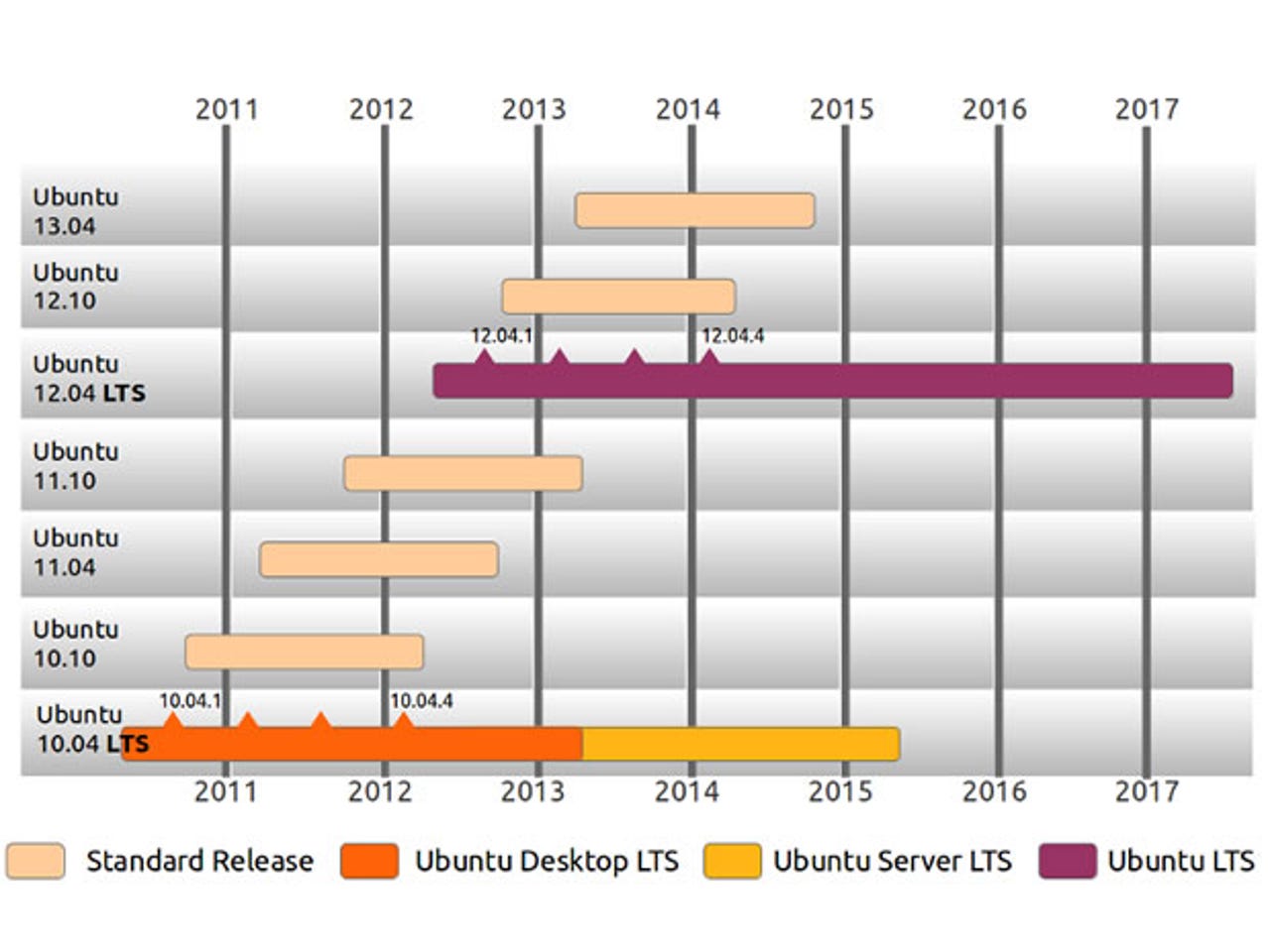
As most Ubuntu users will know, Ubuntu 12.04 is a Long Term Support (LTS) release. As an LTS, Ubuntu 12.04 (Precise Pangolin), released on 26 April 2012, is scheduled to receive updates and support, for both the desktop and server versions, until October 2017. What many Ubuntu users may not know is that Ubuntu 12.04 will see maintenance releases over this period. The first of those, 12.04.1, is due on 16 August.
During its five years of life, Precise Pangolin is scheduled to receive three further maintenance releases: 12.04.2 on 7 February 2013, Ubuntu 12.04.3 in mid-2013 and Ubuntu 12.04.4 on 24 January 2014.
One of the most annoying aspects of installing modern software is the frequently drawn-out process of downloading and installing updates — updates that are replacing software elements installed earlier in the process, and therefore increasing the total install time. This is because a release install image freezes the software at a fixed point in time, after which the image rapidly becomes out-of-date. As a result, an install is often accompanied by a large number of updates, with the volume of updates getting larger as time passes.
With a long-lifetime LTS release, the update problem is exacerbated. A partial solution is to occasionally update the install image during the span of the product's lifetime. The Ubuntu maintenance releases are such updates, and new installations performed using a maintenance release get the benefit of fewer updates required as part of a fresh install. Users who installed early on in the life cycle, and regularly applied updates as they became available, don't need to worry about the maintenance releases because they already have the updates installed.
Since the majority of updates tend to appear during the early phase of a product's life cycle and the frequency of fresh installs falls, it makes sense to schedule maintenance releases to taper off towards end-of-life. With Ubuntu 12.04, all the planned maintenance releases are scheduled for the first two years of its five-year support lifetime.
If you're planning a fresh install of the current LTS version of Ubuntu you'll save on install time if you wait for the first maintenance release. If you're hungering for the next Ubuntu release, 12.10 (Quantal Quetzal), you don't have that long to wait — the first beta is due on 6 September and the final release on 18 October. I'll be reporting on 12.10 as its release draws nearer.
Kick off your day with ZDNet's daily email newsletter. It's the freshest tech news and opinion, served hot. Get it.
Talkback
Ubuntu 12.04.1: LTS maintenance release
I like it
Of course, I try to stick with the latest release period when I go with Ubuntu.
Ubuntu 12.04.1: LTS maintenance release
@trollrock
>>If you're planning a fresh install of the current LTS version of Ubuntu you'll save on install time if you wait for the first maintenance release.
As far as the downtime is concerned, once again, unlike the Microsoft piece of indivisible blob, any GNU/Linux is highly modular. Say, the system would very rarely require reboots, when the kernel needs replacing. But even in that case there is ksplice to eliminate such requirement entirely.
And yes, it's better to have an important patch available for a vulnerability as soon as possible, rather than linger a month or two while it is actively exploited in the wild. And he latter is the Microsoft way.
Why respond to LD
mea culpa
No he can't
@eulampius
@boycottFUD
Well
Gotta go. Work to do before I can do the work I need to do.
@DannyO_0x98
how long you can delay?
And enjoy another ZeuS or conficker on your system. Or you're confusing it with a GNU/Linux distro, where you do your work, while patches are applied on the background? Say, if it's applied to an office app, say write, you're working with, when update is done, you can save your docs and issue "killall lowriter;lowriter&" At any rate, no reboot is needed.
Facts to fight the FUD
The Service Pack is a rollup of updates that are provided over time. This includes all security patches, which are provided on a timely basis, so that they can be applied immediately, as well as all suggested updates. Unlike Windows, all of the 3rd party software that you install from the Ubuntu software repositories is updated ... your full system is up to date, not just some percentage of it.
So if you've been keeping your system up to date via regular updates from the software repositories, the service pack will have only a modest amount of updates for you. Its key role is for image-builders - people who want an up-to-date image to use for setting up new PCs/servers, to minimize the amount of post-install updates that are necessary, and to minimize the window when any security patches issued since the original release will not be present.
This is all very much like what MS does for Windows - only more complete (covering much more software than just the OS), and much less often requiring a reboot. And, based on our metrics, much less fragile of an update process - no registry or GPO breakages, like occur on a semi-regular basis on a subset of machines being updated with Windows patches or service packs. A problem with an update is a rare thing for our Ubuntu devices, and simply not a rare thing for our Windows devices.
Encouraging FUD
He will make some ridiculous assertion that EVERYONE already knows is false, and then 50 people will comment challenging it. Thereby cluttering up the comments on every linux story with a bunch of non-sense.
You DO realize you are giving him exactly what he wants, don't you? So how about doing everyone a favor and "Flight the FUD" by ignoring him.
Get Informed
Stop feeding the troll..
Possibly its' too complex for you.
Ubuntu 12.04.1: LTS maintenance release
ubuntu 10.04
my mistake