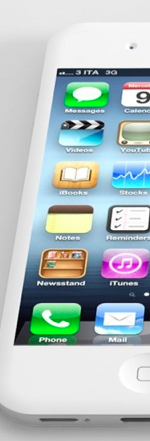
Will the iPhone 5 display remain competitive?

Summary: Much has been rumored about the specs of the upcoming iPhone 5 display. Dr. Raymond Soneira of DisplayMate Technologies concurs that it'll probably include a 1136 x 640 Retina Display. But is it enough to stave off an influx of new, high-resolution Android phones?

The iPhone 4/4S screen is 960 x 640 pixels and the concensus is that the iPhone 5 will bump that resolution up to 1136 x 640.
But a case can be made for also extending the short side from 640 to 720 pixels to allow it to display "true HD" content without as much scaling.
DisplayMate Technologies' Dr. Raymond Soneira thinks that a 1280 x 720 "true HD" resolution would be much better because it would reduce processor cycles and thus extend battery life:
That's 176 more vertical pixels, so existing Apps expecting 960x640 will simply be Letterboxed with 88 pixel black borders on the top and bottom. But since we are already Letterboxing, why not raise the 640 pixel base up to 720 pixels and add 40 pixel black borders there as well? Even better... 720 pixels is true HD High Definition - that is not only a major marketing advantage but there is much less processor overhead (and battery power) from rescaling content from 1080p to 720p than to 640p (rescaling by 3/2=1.50 rather than by 1.69).
If the aspect ratio of the iPhone 5 increases from 3:2 to 16:9, it stands to reason that it will maintain the same 640 pixels horizontally and add 176 additional veritcal pixels.
A 640 pixel width also makes more sense from a software perspective because it maintains compatibility with existing apps -- which would only have to letterbox on one axis. Developers who update their apps for the iPhone 5 will only have to add additional pixels on one axis, instead of two, which is exponentially easier.
Soneira also weighs in with his predictions on other specs of the anticipated iPhone 5 display, including PPI (326, but as low as 286), reflectance (under 5 percent), contrast (CRHAL of 90, like the Lumia 900) and color gamut (100 percent of the sRGB) in an excellent post on the DisplayMate website.
Other HD smartphones like the Samsung Galaxy S III and Galaxy Nexus have 1280 x 720 pixel resolution but they're Pentile Matrix Super AMOLED displays which aren't as sharp as true RGB panels. HTC, Samsung and Google will claim that their devices have more resolution but the iPhone 5 will most likely be sharper.
But forget the bogus Pentil displays, the real questions is how the iPhone 5 panel will stack up against the new RGB panels next week's rumored HTC ONE X+ and the 4.7-inch, 720p, Super LCD 2 panel coming in the HTC Zenith.
Is a 1136 x 640 iPhone 5 display going to be competitive with a raft of new Android devices coming to market -- for a whole year? I'm skeptical.
Kick off your day with ZDNet's daily email newsletter. It's the freshest tech news and opinion, served hot. Get it.
Talkback
Wow, that would be badly inaccurate...
If it isn't Apple then assume its not better? Huh?
You are being way too earnest!
ummm try will it stand up to the nokia 920 is more the question..
No-Kia
Gazing longingly...
Even so, you are only talking about the home screen of WP.
I don't know about you, but even with the amazing amount of information it provides, I don't really spend that long gazing longingly at the home screen with no other agenda.
Do you?
Re: Stupid and Ugly are very subjective.
Large areas of flat colour still look like large areas of flat colour, regardless of how high the resolution is. The Metro interface is simply not optimized for high-res screens.
Wait... what?
Re: What the heck does that mean?
The Metro interface is simply not optimized for high-res screens.
I have a Nokia mobile
"but it's not a smart phone (I'd need to have the income of a billionaire "
True to say
Amoled, and non-pentile. Higher pixel density than iPhone even at 4.5 inch.
With the new capacitive touch that works with any object, not just fingers and capacitive stylus, Nokia will be the one to beat.
On the radar
The 920 has an LCD display, read the specs
http://www.nokia.com/global/products/phone/lumia920/specifications/
Not likely
Their LCD is pretty similar to other IPS, 1280x720 LCD display used on smartphones, and should be pretty similar to Apple's as well. Sure, they have some near tricks. They have a brighter backlight -- these higher density LCDs aren't as transmissive as the older ones, and IPS displays are worse, given the two-transistor-per-cell design. I'm pretty sure Apple's got a bright LCD backlight, too. We know, without question, either will be able to make mice-meat out of a battery in short order.
Their other PureMotion thing, whatever they're calling it, seems directly targeted against Apple's LCD display. What they're doing -- the drive the LCD with a higher voltage for an instant, when the cell switches, in an effort to switch faster. They claim the "other" display switches in 28ms, theirs in 7ms. If true, that would make their display better than the "other" display for games and videos. Of course, OLED displays switch in a few nanoseconds, so this is a non-issue against OLED.
As for pentile, yeah, there have been some issues with pentile displays. The advantage is that it uses 20% less power. The disadvantage, possible color distortions. Particularly when you have a large OLED display with lower resolution -- if you can see the subpixels, you lose with pentile. On the other hand, we're supposed to believe that anything in the 300dpi neighborhood on a smartphone is a "retina" display, meaning an ordinary sighted person can't distinguish individual pixels. In that case, the pentile is not the same kind of problem -- if you can't see individual pixels, you certainly can't see individual subpixels. There are a few issues with OLED displays no one talks about (the quality drops off when you dim them too much, LEDs are driven from a backlight, so the display itself behaves exactly the same at any brightness level). But an OLED is inherently sharper -- less stuff between you and the light source (eg, nothing but a touchscreen and some glass), so at a proper brightness level, the OLED is the superior display.
Their touch screen is an interesting idea. I play guitar, and due to the calluses on my left hand, my Galaxy Nexus tends to ignore requests from my left hand, only obeying my left. If their touch screen improves this situation, it's an interesting technology. The potential downside, though... what happens in my pocket? A normal touchscreen needs more capacitance change than possible from my leg though a pocket. If this is super sensitive, though, it's going to be constantly registering touches in my pocket. At worst, that's going to run the battery down faster, unless you ensure the touchscreen is completely off before pocketing it. And it could get even more interesting -- back to the days of pocket-dialing, only with a whole slew of apps to play with.
BlackBerry 10 all touch phone has all comers beat at 356 ppi
4.2-inch 1280x768 HD LCD (356dpi)
http://crackberry.com/blackberry-10-alpha-dev-device-specs-and-features
Yeah, but...
I have a retina Macbook Pro, and I'm starting to think that not only is PPI not everything, but that its not anything!
Apple pretty much has it correct
There are other opinions... some display people claim you need a bit more resolution. But there is a point here -- once you're at Apple's "retina" resolution, adding more pixels doesn't hurt anything, but it also doesn't help any.
Of course, on larger devices, you don't need the same density. While my Galaxy Nexus (1280x720 4.65", 316ppi) meets the "retina" definition Apple's suggested for 12" viewing, I'm more likely to be viewing from 18" or so. Same idea with Apple's "retina" iPad and MacBook... they have lower PPI rating, but you're going to be viewing from a farther distance.
Dunno if that's really by much . . .
There's some processing overhead to rescaling - but I dunno if it's really by that much, especially since it has a GPU. Back in the days of the x86, rescaling was a big hit, but today? Not so much. Especially since it'll be done on a GPU (designed to do graphical operations natively) rather than a CPU (not designed for graphics).
Anyhoo, the big battery hit seems to be that backlight. Doesn't seem to matter what I do with, if the display's on, it drains my battery. Watching YouTube videos on my iPhone 4 (which is always rescaled/letterboxed currently) doesn't seem to hit my battery any more than having it at the home screen.
"Is a 1136 x 640 iPhone 5 display going to be competitive with a raft of new Android devices coming to market -- for a whole year?"
Yes, because most people aren't bean counters. They don't count pixels when buying a device. If they were going for an iPhone, they're not going to suddenly switch to an Android just because it has a few more pixels on its display.
It really doesn't matter.
https://lh5.googleusercontent.com/-lUdZsv7VkhY/UBsM5YCx57I/AAAAAAAAA_c/iW8sComrfGo/s467/pic049.jpeg