Can RIM bounce back? Take the long view, investor says

Summary: A RIM investor says the company can turn itself around in four to five years. Did shareholders prematurely pull the plug after a few bumps in the road?
BlackBerry-maker Research in Motion, which has fallen on hard times in the past year, could take upwards of five years to recover, according to one analyst. That is, if it even gets that far.
Investor Prem Watsa, whose FairFax Financial took a five percent stake in RIM last year, told Reuters that it's entirely possible for the company to bounce back from a year of poor sales, a crippling global network outage and rebelling shareholders.
It's a bold claim: the value of the company's shares has dropped more than 70 percent over the past 12 months as rivals Apple and Google eat away at its core business customer base with consumer devices that are more easily switch between work and home lives.
Is RIM experiencing a few (major) bumps in the road? Or is the company truly up the creek without a paddle?
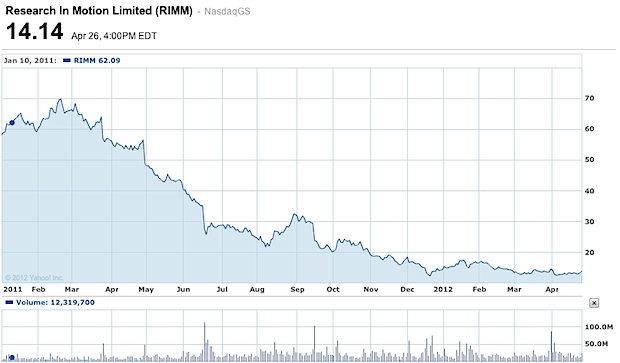
There are two things that may keep the company from falling to its knees, according to Watsa: RIM has no long-term debt, and it still has $2.1 billion in cash on hand. If the company is looking for a comeback, it's a strong position from which to start.
And the BlackBerry brand still holds weight in RIM's most important markets, notably the U.K. with 8 million and Indonesia with 7 million subscribers, respectively. Shares jumped 4 percent on recent chatter of BlackBerry 10 hitting the market later this year, indicating there is still some energy around the company.
To overcome the hurdles, the company needs to truly understand what went wrong in the first place, and acknowledge its faltering position in the marketplace. A full-on recovery will be impossible if it is content to merely coast on what strength it has left. (Ahem, Nokia.)
Hurdle: leadership
Co-chief executives Mike Lazaridis and Jim Balsillie stepped down in January. It may have been the right decision, but it came far too late. The company needed a fresh direction long ago, and probably should have poached a high-flyer from Google, Nokia, Microsoft, or even Amazon --- even if he or she had little or no experience in the mobile industry --- rather than bumping up Siemens veteran Thorsten Heins to the chief's chair.
Normally, a chief operating officer would bring a healthy sense of corporate efficiency to the company's top spot. In this case, it's clear that RIM needs innovation, inspiration and execution. If Heins couldn't hack it before, what indicates he will now?
From what we've seen so far, Heins has talked the talk but failed to walk the walk. In fact, he can't even talk the talk: RIM's public relations department has already reneged on his comments to clarify that it would not in fact bail out on the consumer market. He set out a five-point plan of things he wanted to change, but has failed in at least two of them so far: drumming up shareholder support, and making the company more marketing driven. The other three simply remain to be seen.
Hurdle: momentum
ComScore figures show that HTC replaced RIM in global market share in the three months between November and February. HTC rose to 6.3 percent, while RIM slipped as much as Google gained in the same period, by 3.2 percent. It's become clear that RIM has an image problem: Apple and Google have stolen the limelight. RIM remaining on the stage, but nobody's listening.
BlackBerry is still a powerful brand that resonates with many. Despite a handful of high-profile security flubs, it is still largely trusted. But its failure to keep up with customer tastes has caused the company to stumble in the market --- and it's seen that way. ("BlackBerry thumb" was a phenomenon seven years ago. In the minds of many, RIM is still stuck in 2005.) Evolution isn't bad, but RIM has failed to keep up with the market. It needs to be redefined, because in this sense, RIM hasn't brought anything "new" in a long time. BlackBerry 10 could change this.
Hurdle: core competencies
It's hard to fault RIM for failing to keep up with the consumer market, because it never really understood it. When consumer and business interests began to converge, it was understandable that the company would need to adapt.
But when a datacenter outage spread from London to the rest of the world, RIM failed at the one thing that hasn't changed: reliability. RIM may not stand for hip, but it needs to stand for reliability. If it doesn't have that, it's lost everything that made it attractive in the first place. Granted, the outage was unprecedented and brief in the grand scheme of things. But it had a catastrophic effect on the company's promise to its business customers: we'll be there for you when others are not.
Is there a way out?
In the mobile market, five years is a long way off and impossible to predict. For all we know, Siri will be making us coffee in the morning and humanoid Androids will be deployed to offer us foot massages.
If it wants to be a player, RIM needs to up its game now. No more delays, and no more coasting. The company is far from dead, but it needs to internalise rapid iteration, constant innovation and an unshakable focus on its core customers: business. Will RIM rebound? Not overnight. But it starts by making a five-year-plan to get there, but also building in the flexibility to adapt when the industry environment shifts in new and unpredictable ways.
It's time for RIM to get aggressive again. In the short term, that means reacting more rapidly. In the long term, that means incorporating today's changes into tomorrow's plans. But it starts with the BlackBerry 10 operating system. Get it out the door --- now.
Image credit: Yahoo Finance/ZDNet.
Related:
- RIM has "lost it": Shareholders call for company break-up, or sell-off
- RIM: Open the competitive floodgates, end BlackBerry exclusivity
- BlackBerry maker denies consumer market retreat
- RIM's new chief: Five things I'll change
- comScore: RIM, Microsoft face mobile market share crisis
Kick off your day with ZDNet's daily email newsletter. It's the freshest tech news and opinion, served hot. Get it.
Talkback
Unlikely To Succeed... At Least Here, Anyway...
BlackBerry 10 is an elegant and user-friendly OS that is finally coming of age on the PlayBook, and once it's ported to mobile devices, it should gain some level of traction. Unfortunately, it just may not be here in the United States.
Keep in mind that the line of BlackBerry 10 devices won't be released until the end of the third quarter, or early in the fourth. The great obstacle is that this is the same period Apple will be unveiling and releasing its next-generation iPhone. It goes without saying that the next iPhone will easily outsell all of the new BlackBerry devices combined, especially in the U.S. This will cast a deadly pall over RIM's sales figures going forward, but only if it focuses too heavily on this market.
RIM's best hope at this point is to focus with laser-like efficiency on its strongest markets in Europe and Asia. While the next iPhone will be an impediment there as well, its impact will be far less debilitating. Also, RIM should center its attention on its considerable enterprise services, and consider the proposals of its shareholders in selling some of them off. While $2.1 billion seems like a hefty number, keep in mind that Apple's valuations are over two-hundred times that amount.
Yes, RIM needs to evolve on all fronts, but with a strong OS and a foothold in several markets overseas, it's hardly an impossible task. Difficult? Yes. However, if Thorsten Heins can see the proverbial writing on the wall and match consumer needs and demands along with those of businesses, then RIM can be a force in the mobile industry sector for many years to come.
I'll call it.
You want less competition?
So, the long view is that Apple will fall in 4 years
Right. Steve Jobs. I mean he designed the iPod, iPhone and iPad, wrote all the software, set up the stores and managed to supply chain. He was a busy man.
Apple is doomed.
Thick...
Not doomed
Atari was the innovator until Commodore stole their thunder. Commodore was home computing king, until Sega and Nintendo took a chunk. Nintendo and Sega were unassailable in the game console market, until Sony came along. Nintendo and Sony were unbeatable, until Microsoft came along and Microsoft were insurmountable - and now? Yes, we are all talking about whether it is just possible that more people will start moving away from Windows, etc. Nintendo for the first time ever can not rely on its fanbase to make it products successful. None of the above are necessarily doomed, but things do change....
Edit: I'm not suggesting that RIM will be THE company, I'm just replying to your general point about Apple in 4 years.
I don't think they have much of a chance
It took a SINGLE device to basically destroy RIM
RIM is where it is today, because they are not improving at all. What have they release lately that is nothing more than a "late to the game / me-too" product??
Data security and safety?? That safety was broken before they even gave the source to highly hostile governments in desperate move to grow in middle eastern markets (because they are losing market share rapidly everywhere else).
They settle for less
They need to ask the hard question: id BB OS 10 truky going to offer any real palatable advantages over iOS and Android? If notm RIM really needs a backup plan for survival. There is a saying in business: If you cannot be better than your competition and offer more value to the consumer, you shouldn't build the product.
Facts - to another Apple-ite
To be clear though, the iPhone absolutely did NOT establish media consumption on smartphones. It was already happening. 3 network have been providing media content to smartphones for around 10 years in the UK. PocketPC and Windows Mobile Smartphones have been around just as long and included media features and FULL Internet Explorer. Nokia were heading the same way with their Symbian based phones. Additionally, take a look at the specs of Windows Mobile and Nokia handsets around the time the iPhone was released. The iPhone was nothing short of pathetic! In fact, I have been able to demonstrate to iPhone users, that my old HTC Blueangel, could absolutely challenge at least an iPhone 3G on functionality (except the 3G part of course).
Things were progressing nicely (in fact rapidly) without Apple, thank you very much, but as to Blackberry, yeah, not so much....
26 days late Zack... But a definate Bazinga....
Wow
I don't see RIM coming back from this anytime soon.
Maybe google? After all as I've read google already has
Pagan jim
Probably too late...
Welcome!!!!!!!!!!@@@@@@@@@@@
http://www.a1ash.com/vb/
</a><a href="http://www.a1ash.com/vb/a1ash102179/"> ?????????? 2013 </a></p>
</a><a href="http://www.a1ash.com/vb/a1ash102182/"> ???????????? ???????????? 2013 </a></p>
</a><a href="http://www.a1ash.com/vb/a1ash102183/"> ???????????? ???????? 2013 </a></p>
</a><a href="http://www.a1ash.com/vb/a1ash102184/"> ?????????? ?????????? 2013 </a></p>
</a><a href="http://www.a1ash.com/vb/a1ash102185/"> ?????????? ???? 2013 </a></p>
</a><a href="http://www.a1ash.com/vb/a1ash102186/"> ?????????? ???????????????? 2013 </a></p>
</a><a href="http://www.a1ash.com/vb/a1ash102188/"> ?????????? ?????????? 2012 </a></p>
</a><a href="http://www.a1ash.com/vb/a1ash102189/"> ?????????? ?????????? ?????? ?????????? 2012 </a></p>
</a><a href="http://www.a1ash.com/vb/a1ash102190/"> ?????????? ???????? 2013 </a></p>
</a><a href="http://www.a1ash.com/vb/a1ash102191/"> ?????????? ???????????? 2013 </a></p>
</a><a href="http://www.a1ash.com/vb/a1ash102192/"> ?????????? ???????????? 2013 </a></p>
</a><a href="http://www.a1ash.com/vb/a1ash102193/"> ?????????? ???????????? 2013 </a></p>
</a><a href="http://www.a1ash.com/vb/a1ash102194/"> ?????????? ?????????? 2013 </a></p>
a1ash.com
http://www.a1ash.com/vb/f146/
http://www.a1ash.com/vb/f128/
http://www.a1ash.com/vb/f135/
http://www.a1ash.com/vb/f24/
http://www.a1ash.com/vb/f160/
http://www.a1ash.com/vb/f129/
http://www.a1ash.com/vb/f117/
http://www.a1ash.com/upload
http://www.bnt-g.com/vb/
RIM's future is up in the air?
The acquisition of QNX, a world leader in embedded systems, has implications that go well beyond mobile phones and tablets. QNX is a suitable system for cars, refrigerators, home security systems, missile systems and the list goes on and on and on. Couple all this with the acquisition of Paratek Microwave Inc. and now all your QNX based systems have the ability to communicate with the increasingly popular cloud that every one is talking about. Is the fog starting to lift yet?
While so many on the "Keyboard Advisory Committee" (yes, that would be the tech media) are more then happy to spread their dire predictions for RIM's future, RIM is quietly positioning themselves not to be relavent where we are today, but where we will be in the not so distant future. And from what I can see, that future is in the cloud and whether you like it, or not, you will very likely be using a RIM product in one form, or another.
A third ecosystem
I have alreday made the switch to Windows Phone Mango from Android.
So I think it will be Android, iPhone and Windows Phone in the future.
Bada, RIM, Symbian etc.. will not survive in the long run.
RIm tried to emulate iphone. It did have touch screen black berrys
The only thing keeping RIM afloat is government contracts with military and other departments. Some corporations still have contracts with RIM. However private sector are making the switch to bring your own device scheme which save money on hardware, and tech support contract for BB systems.
it's too late. The consumer phone market occupied by apple and the Android triforce (HTC, Samsung, and Motorolla)is too tough to penatrate. It's existing market is desolving like tissue paper in a toilet simply because they are outmatched by more compelling products.