ie8 fix
madison

ERP failure: New research and statistics

By | February 3, 2010, 8:02am PST

Summary: Panorama Consulting today released results of a study comparing gaps between customer expectations and actual results achieved on ERP projects.

Panorama Consulting today released results of a study, called 2010 ERP Report, comparing gaps between customer expectations and actual results achieved on enterprise resource planning (ERP) projects.

While the findings are consistent with similar studies, Panorama is a consulting company and not a neutral research organization, although it is not affiliated with software vendors. This does not invalidate the results, but as a policy matter we should retain some skepticism toward the findings.

Key Findings

The research describes five primary results:

  1. ERP implementations take longer than expected
  2. ERP implementations cost more than expected
  3. Most ERP implementations under-deliver business value
  4. Software as a service (SaaS) implementations take less time than on-premise ERP implementations, but deliver less business value
  5. Companies do not effectively manage the organizational changes of ERP

Implementation length. The study states that more than half the implementations surveyed exceed planned time:

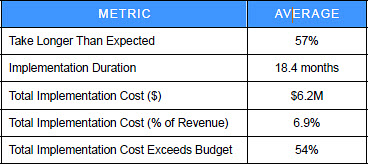
According to Panorama’s study, 57% of ERP implementations take longer than expected (see table below). This challenge is partly attributed to the fact that many companies in our study either had unrealistic expectations regarding timeframes and/or did not account for key project activities in their implementation planning processes.

As the table indicates, both time and budget frequently exceed planned levels:
Implementation budget. The report compares implementation budget variance in 2010 to a comparable study performed in 2008:

As illustrated in the table above, 54% of ERP implementations go over budget. This is a slight decrease from the 2008 study, which showed that 59% of implementations cost more than planned. The finding is attributed to the fact that many organizations in our study failed to identify and budget implementation costs not attributable to software vendors, such as project management, organizational change management, hardware upgrades and the like.

Measurable benefits. These figures are perhaps the most damning in the study. The report says a significant number of implementations surveyed did not deliver anywhere near the anticipated benefit or value:

As Figure D (below) outlines, 41% of companies surveyed fail to realize at least half of the business benefits they expected from their ERP systems, and 22% of implementations fail to deliver at least some measurable business benefits from their ERP solutions. In addition, over one in three companies surveyed (40%) realized major operational disruptions after implementation go-live, such as the inability to ship products or to close the books. Finally, only 68% of executives and 61% of employees are at least somewhat satisfied with their ERP solutions.

SaaS implementations. The study concludes that SaaS deployments are faster than traditional, on-premise implementations yet are even less likely to deliver expected results. This stunning claim demands additional research and detail:

The study reveals that on average, SaaS and hosted solutions are implemented in less time (11.6 months for SaaS vs. 18.4 for on-premise), at a lower cost (6.2% vs. 6.9% of annual revenue, Figure F) and at a slightly higher level of executive satisfaction (52.6% vs. 50.0%) than traditional on-premise solutions. However, as with any ERP solution, SaaS has its drawbacks. SaaS implementations are significantly less likely to deliver the expected business benefits (23.5% vs. 42.9%) than on-premise solutions. In addition, SaaS implementations are significantly more likely to exceed budget than on-premise initiatives (70.6% vs. 59% for other delivery options).

Implementation change management. The study finds that most organizations have a hard time managing the business transformation aspects of ERP. Since transformation is often an important reason companies take on ERP projects, these conclusions are not surprising:

Over 53% of implementing organizations assess their ability to deal with change as fairly poor or very poor. In addition, 47% say communication between management and employees is poor. These types of environments are not conducive to effective ERP implementations. Organizational change management tools, however, help address such barriers to make the rollouts more successful.

In addition, over 60% of organizations suffer from poor visibility of data and poor integration in their old systems. This metric suggests that employees using a new ERP system have strong organizational resistance and steep learning curves

THE PROJECT FAILURES ANALYSIS

The findings reported here are consistent with research performed by others on this subject. For this reason, I accept the findings as appearing to be generally valid.

At the same time, Panorama is consulting organization and these results are therefore self-serving, which makes the data suspect even if it is accurate. Panorama’s research is worthwhile, but would be more credible if the company engaged an independent research organization to conduct similar studies in the future.

In addition to adding credibility, a professional research firm would ensure consistency of the study methodology year over year. This would increase the value of the research by adding confidence to both the conclusions and the trend information over time.

On a different subject, the report presents a startling and unexpected discussion about the business value achieved from SaaS versus on-premise implementations. I would like additional research and details exploring this assertion, which is presented as fact in the report:

While SaaS is clearly on a high-growth trajectory, our independent findings reveal that industry hype is misaligned with actual results.

My take. I applaud Panorama for conducting this research and encourage the company to take whatever steps are required to ensure the research is independent, reliable, and consistent over time.

Kick off your day with ZDNet's daily e-mail newsletter. It's the freshest tech news and opinion, served hot. Get it.

Michael Krigsman is a recognized authority on the causes and prevention of IT failures.

Disclosure

Michael Krigsman

Michael Krigsman writes and speaks about technology in a manner that most observers consider to be fair and balanced. Michael believes that writing about IT failures, which often have complex causes, creates a unique obligation to be reasonable and accurate in both reporting and analysis.

Michael maintains active personal and professional relationships with enterprise technology buyers, vendors, analyst firms (or individual analysts), consultants, and system integrators. As CEO of Asuret, Michael sells and delivers paid services to members of these same groups.

Vendors regularly reimburse Michael's out-of-pocket travel expenses to attend industry conferences and events. Conference organizers frequently waive entry fees when Michael attends industry events. Michael often speaks at industry conferences and events.

He is a member of the Enterprise Irregulars, a loose association of consultants, investors, industry representatives, analysts, and users of enterprise software.

For daily updates on Michael's activities, follow him on Twitter.

Biography

Michael Krigsman

Michael Krigsman is CEO of Asuret, Inc., a consulting company dedicated to reducing technology implementation failures. Asuret's suite of software tools improve the success rate of enterprise software deployments by quantifying and measuring governance issues that cause most project failures. Michael led the research effort underlying Asuret's model of collective intelligence and its practical application to reducing IT failures in consulting environments. He is a recognized authority on the causes and prevention of IT failures and is frequently quoted in the press on IT project and related CIO issues. He is considered an enterprise software industry "influencer" and provides advice to technology buyers, vendors, and services firms.

Previously, Michael served as CEO of Cambridge Publications, which develops tools and processes for software implementations and related business practice automation projects. Michael has been involved with hundreds of software development projects, for companies ranging from small startups to Fortune 500 organizations. Michael graduated with an M.B.A. from Boston University and a B.A. from Bard College. He is a Board member of the America's Cup Hall of Fame and the Herreshoff Marine Museum in Bristol, RI.

6
Comments

Join the conversation!

Just In

SaaS small business ERP?
salesorder.com 6th Mar 2011
Applause for Jason who hit's the nail on the head! "I've found that almost 100% of the time, companies hire consultants so that they "don't have to read through all that stuff" - mostly because the ERP system is bloated with features and finding the answers in the related documentation is like reading a book through a straw.

Almost all ERP vendors did not set out to design a system with the end in mind. Even with all of the evidence staring them in the face that the number one problem with ERP is it's complex, they missed the real customer problem - make it easy to use and set up to cut entry costs.

Salesorder.com small business SaaS ERP was built from the ground up to be really easy to use and configure by the business owner and their team. The fact is most business owners implement it themselves with little or no help from expensive consultants.

Software as a Service means exactly that - Service - which means the vendor should help the customer circumvent the need for consultants by providing superior and knowledgable online Customer Services.
0 Votes
+ -
have the stats changed that much?
philsimonsystems 3rd Feb 2010
I agree that the SaaS findings are a bit surprising but, at least to me, the study confirms numbers that seem to have remained pretty constant.

Clearly SaaS is not an elixir for bad data, organizational politics, undefined business processes, and the other usual suspects endemic to traditional ERP projects.
0 Votes
+ -
Contributr
Agreed
mkrigsman@... 3rd Feb 2010
And I hope the post made that clear.
0 Votes
+ -
RE: ERP failure: New research and statistics
ggheorghiu@... 3rd Feb 2010
Great research. Unfortunately, is shows once again that
ERP implementations are not well prepared ahead of time.

And this makes me wonder: does anyone read all these
articles, reports, etc. on ERP failures and what vendors
and customers should do to avoid then?
0 Votes
+ -
Wonder no more...
jasonp@... 4th Feb 2010
I've taken part in several dozen ERP implementations and I've found that almost 100% of the time, companies hire consultants so that they "don't have to read through all that stuff". I've been called in to jumpstart several implementations that had essentially stalled out. What I've discovered in those instances is that the consultants didn't bother reading through all that stuff either. I think the biggest lesson that is never taught is that something with the size and scope of an ERP implementation simply can't be generically scripted out into a blueprint for success somewhere else. Sure, there are constants that need to be done for each implementation, but the variables far outweigh these constants. At the end of the day, the only guage of success or failure can be answered by asking a single question...does the software help your employees do their jobs or does it get in the way? If it introduces complexities or innefficiencies that weren't there before, the implementation is a failure. If it fails to get off the ground, it's a monumental failure.
0 Votes
+ -
Failure = Success
barence773 4th Feb 2010
My company (a leader in the cosmetics industry) rolled out an SAP implementation in the US last year, with the intention of replacing our Oracle 11i ERP system. Somewhere along the way, the money ran out, or some other complication appeared, and the deadline to 'turn off' Oracle was pushed out another 18 months.

The company then announced that the SAP roll-out was a big success!! SAP has not improved a single process since the US roll-out. The company has simply shifted existing processes into SAP, and caused massive confusion and delays in the process.

But Failure = Success, at least according to the Executive Committee...
0 Votes
+ -
SaaS small business ERP?
salesorder.com 6th Mar 2011
Applause for Jason who hit's the nail on the head! "I've found that almost 100% of the time, companies hire consultants so that they "don't have to read through all that stuff" - mostly because the ERP system is bloated with features and finding the answers in the related documentation is like reading a book through a straw.

Almost all ERP vendors did not set out to design a system with the end in mind. Even with all of the evidence staring them in the face that the number one problem with ERP is it's complex, they missed the real customer problem - make it easy to use and set up to cut entry costs.

Salesorder.com small business SaaS ERP was built from the ground up to be really easy to use and configure by the business owner and their team. The fact is most business owners implement it themselves with little or no help from expensive consultants.

Software as a Service means exactly that - Service - which means the vendor should help the customer circumvent the need for consultants by providing superior and knowledgable online Customer Services.

Join the conversation!

Formatting +
BB Codes - Note: HTML is not supported in forums
  • [b] Bold [/b]
  • [i] Italic [/i]
  • [u] Underline [/u]
  • [s] Strikethrough [/s]
  • [q] "Quote" [/q]
  • [ol][*] 1. Ordered List [/ol]
  • [ul][*] · Unordered List [/ul]
  • [pre] Preformat [/pre]
  • [quote] "Blockquote" [/quote]
ie8 fix
Click Here
ie8 fix

The best of ZDNet, delivered

ZDNet Newsletters

Get the best of ZDNet delivered straight to your inbox

Facebook Activity

White Papers, Webcasts, & Resources
ie8 fix
ie8 fix